


The GCC Space & Security Online Conference 2026, organised by SpaceTech in Gulf, brought together government officials, investors, operators and industry leaders for a full day of panels covering every dimension of the region’s growing space sector. Here is a quick overview of what each session covered.
The event was supported by Access Partnership as Presenting Partner, with MB Sat and Orbitworks as Conference Partners, and D-Orbit and Spacioply as Supporting Partners. Here is a quick overview of what each session covered.
Panel 1: GCC Government Space Programmes & National Strategies
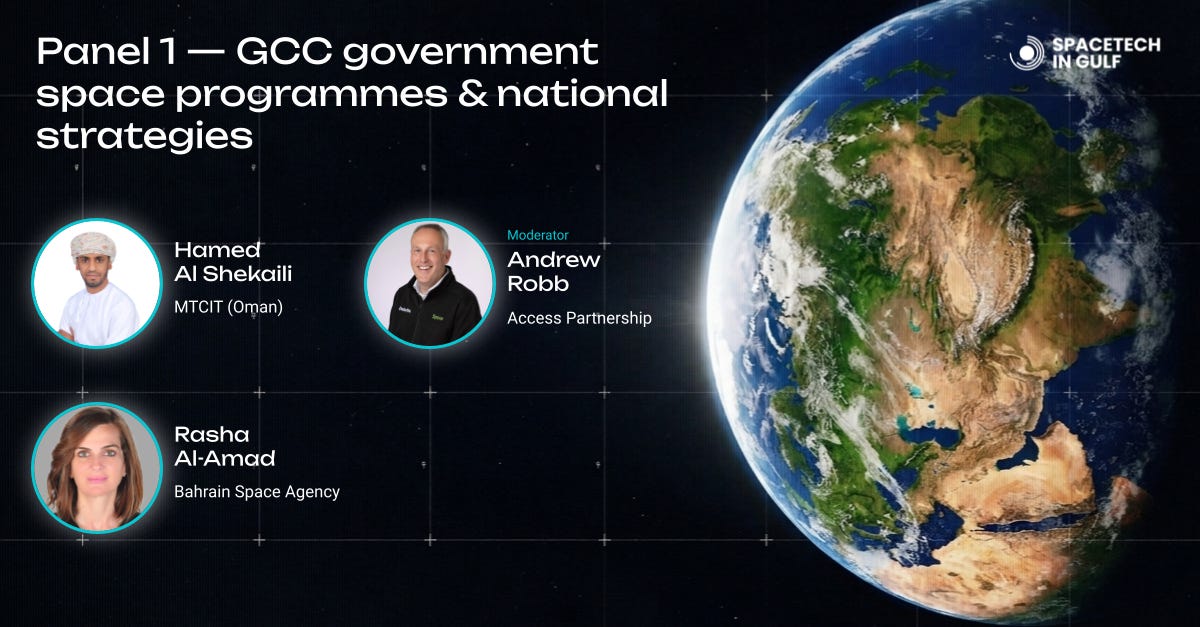
Moderated by Andy Robb (Access Partnership), with Rasha Al-Amad (Bahrain Space Agency) and Hamed Al Shekaili (MTCIT Oman).
This opening panel set the scene by examining how GCC nations are building and executing their national space agendas. Rasha Al-Amad (Bahrain Space Agency) discussed developing the country’s space policy and three successive strategic plans, while Hamed Al Shekaili (MTCIT Oman) outlined how the Sultanate’s space ambitions are anchored in Vision 2040 and driven through a national space executive programme. The conversation highlighted the role of civil space agencies as catalysts for broader economic and industrial development, and the importance of international collaborations, knowledge transfer and joint missions in building local capacity from the ground up.
Panel 2: Financing the GCC Space Sector
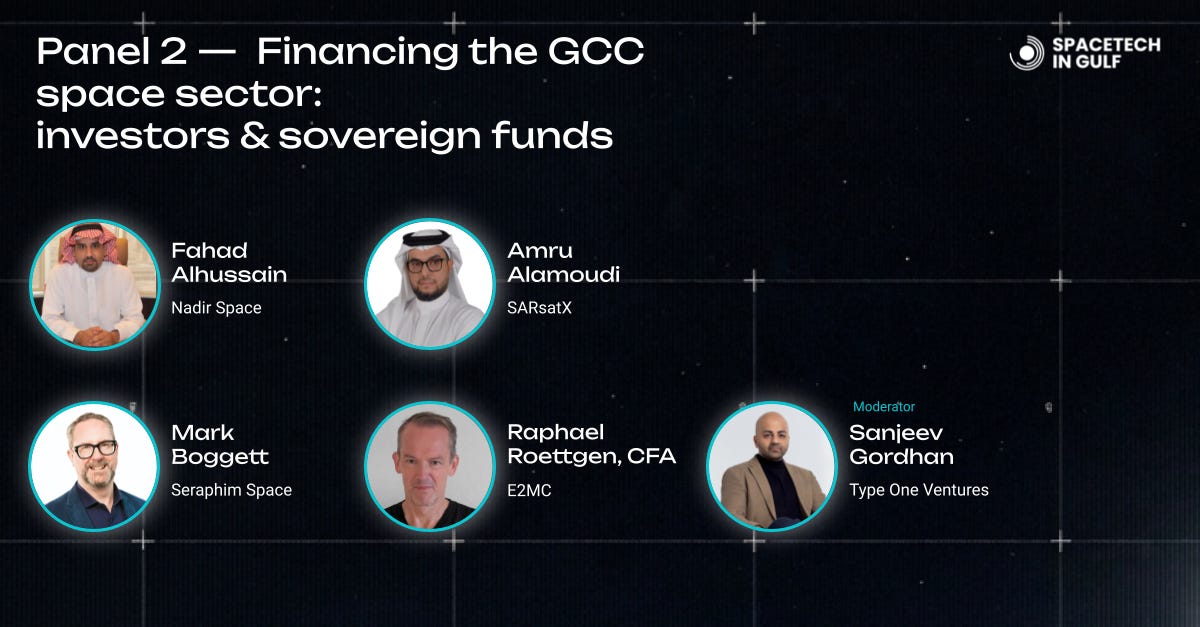
Moderated by Sanjeev Gordhan (Type One Ventures), with Mark Boggett (Seraphim Space), Raphael Roettgen (E2MC), Amru Alamoudi (SARsatX) and Fahad Alhussain (Nadir Space).
Five leading space investors and entrepreneurs explored how the GCC’s space sector can attract and sustain the capital it needs to grow. The panel wrestled with the tension between sovereign capital — which prioritises capability building — and venture capital, which carries fiduciary duties to deliver returns. Mark Boggett (Seraphim Space) argued that sovereignty should enhance business value, not replace financial discipline, while Raphael Roettgen (E2MC) warned against companies becoming addicted to government contracts. Amru Alamoudi (SARsatX) stressed the importance of geopolitical alignment in attracting foreign sovereign capital, and Fahad Alhussain (Nadir Space) emphasised that patient government capital is essential to carry the industry to maturity. The pending SpaceX IPO was discussed as a potentially landmark event for the whole sector, with panellists broadly optimistic it would bring more capital into the industry and lift all boats.
Panel 3: Telecommunications & Connectivity in the GCC
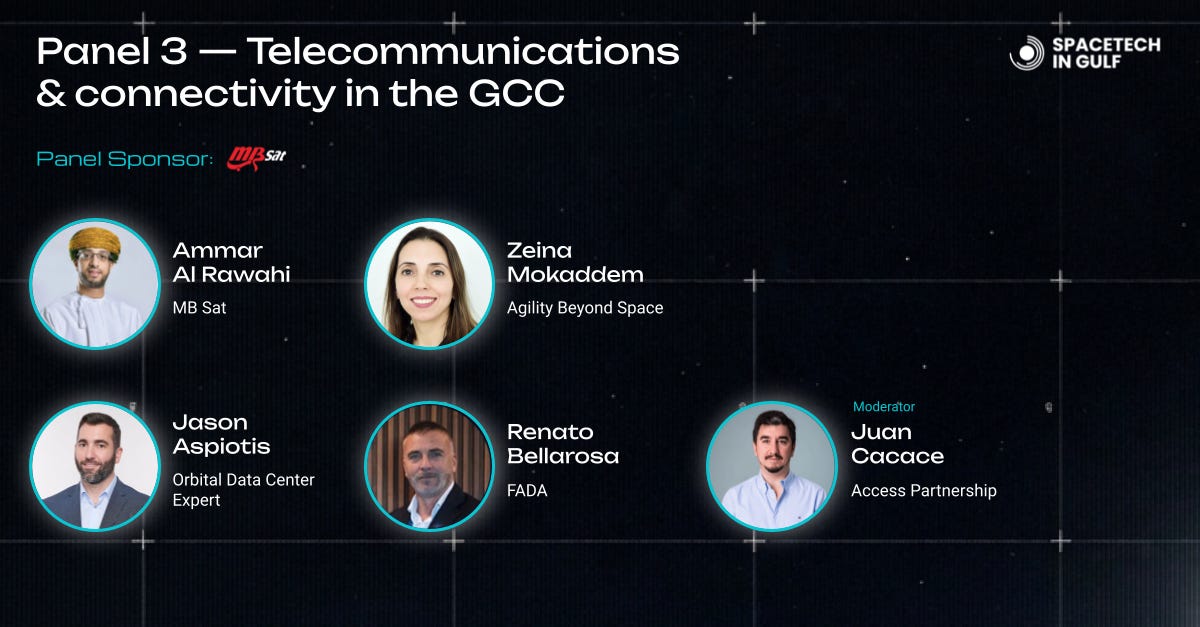
Moderated by Juan Cacace (Access Partnership), with Ammar Al Rawahi (MB Sat), Zeina Mokaddem (Agility Beyond Space), Jason Aspiotis (Orbital Data Centre Expert) and Renato Bellarosa (FADA).
This panel examined the evolving satellite communications landscape in the Gulf, from geostationary operators to emerging LEO constellations and the concept of orbital data centres. Ammar Al Rawahi (MB Sat) and Zeina Mokaddem (Agility Beyond Space) debated the right strategic model for the region — whether to build sovereign national capacity or continue relying on global players — and concluded that both approaches have a role to play. Jason Aspiotis, an orbital data centre expert, explored how sovereign orbital cloud capabilities could reshape connectivity infrastructure, while Renato Bellarosa (FADA) offered a perspective from inside the UAE’s flagship SAR satellite programme. The session also touched on how new non-terrestrial network architectures and AI-enabled infrastructure are reshaping what connectivity means for government, maritime and enterprise customers across the GCC.
Panel 4: Earth Observation — Government & Security Applications Across the GCC
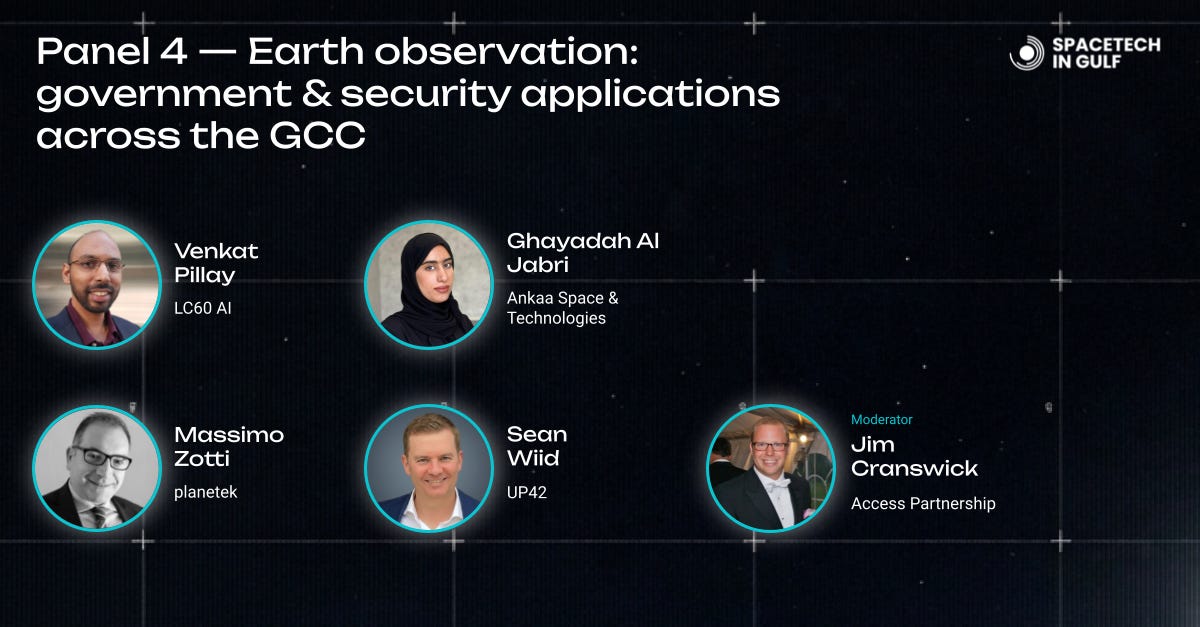
Moderated by Jim Cranswick (Access Partnership), with Massimo Zotti (Planetek Italia), Ghayadah Al Jabri (Ankaa Space), Sean Wiid (UP42/Neo Space Group) and Venkat Pillay (LC60 AI).
Earth observation was explored through three lenses: sovereignty (who controls the data and how it is gathered), resilience (the difference between owning assets and having genuine operational control) and acceleration (the impact of AI and on-orbit processing). The panel noted how Gulf countries have shifted from being consumers of EO data to architects of their own EO infrastructure. Massimo Zotti (Planetek Italia) described how on-board processing is transforming satellites into intelligent nodes that can detect events and trigger autonomous responses, dramatically cutting the time from observation to decision. Ghayadah Al Jabri (Ankaa Space, Oman) highlighted her company’s work integrating satellite and drone EO data for government clients, alongside capacity-building programmes for local space startups. Sean Wiid (UP42/Neo Space Group) and Venkat Pillay (LC60 AI) rounded out the discussion on AI-driven analytics for border security, maritime awareness and critical infrastructure protection.
Panel 5: The GCC Space Economy & International Cooperation
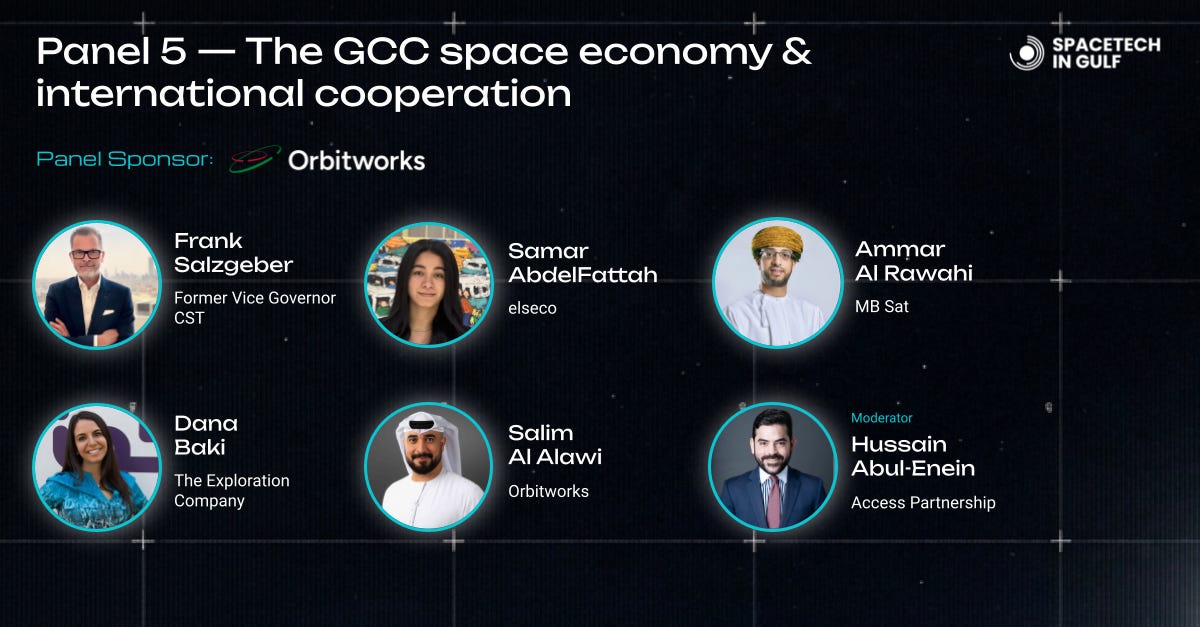
Moderated by Hussain Abul-Enein (Access Partnership), with Frank Salzgeber (former Vice Governor, CST), Salim Al Alawi (Orbitworks), Dana Baki (The Exploration Company), Samar AbdelFattah (elseco) and Ammar Al Rawahi (MB Sat).
With the global space economy projected to exceed $1.8 trillion by 2035, this panel focused on how GCC countries can move from participation to genuine leadership. Frank Salzgeber (former Vice Governor, CST) argued that the GCC’s lack of legacy incumbents is actually an advantage, allowing the region to build open, competitive markets from scratch, and highlighted Saudi Arabia’s push to grow from 5,000 to 27,000 space sector jobs by 2035. Salim Al Alawi (Orbitworks) described how private investment in satellite manufacturing infrastructure lowers the barrier to entry for others. Dana Baki (The Exploration Company), Samar AbdelFattah (elseco) and Ammar Al Rawahi (MB Sat) added perspectives on commercial collaboration, insurance and regional satellite operations. Panellists broadly agreed that the ambition must be to create globally competitive companies, not just domestic ones.
Panel 6: New Security Strategies & Space Domain Awareness in the Middle East
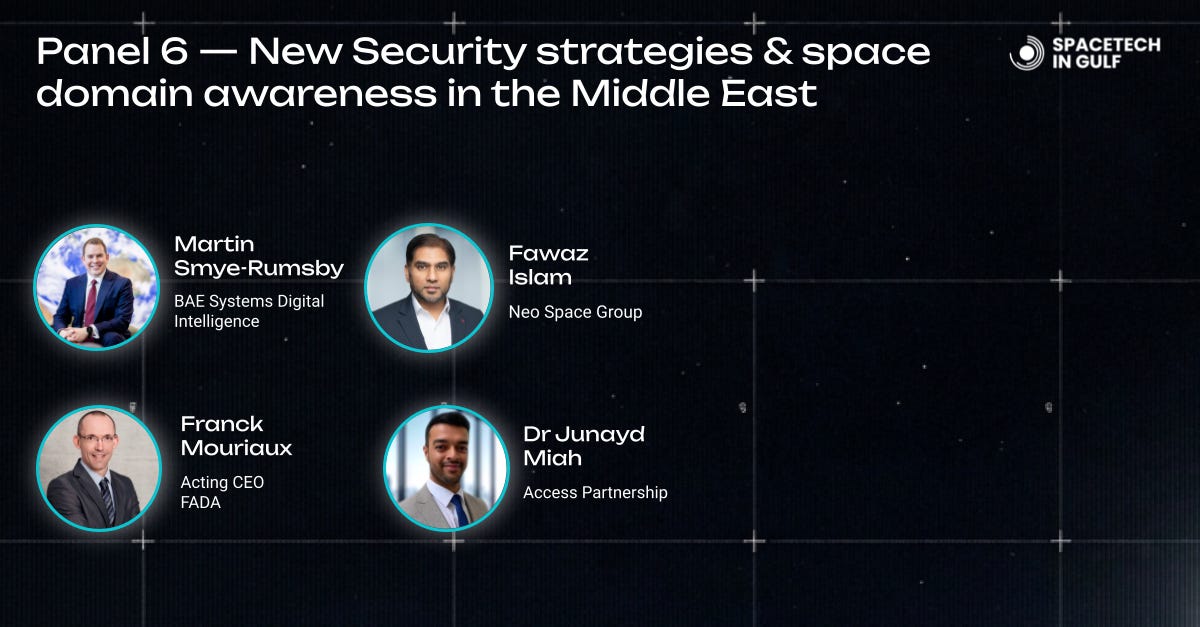
Moderated by Dr Junayd Miah (Access Partnership), with Fawaz Islam (Neo Space Group), Franck Mouriaux (FADA) and Martin Smye-Rumsby (BAE Systems Digital Intelligence).
The security-focused panel explored whether GCC countries are genuinely achieving space sovereignty or still largely dependent on external partners. Fawaz Islam (Neo Space Group) outlined NSG’s mandate as Saudi Arabia’s national space champion — spanning geospatial, satellite communications and PNT — and its acquisition of UP42 to build a local EO data marketplace. Franck Mouriaux (FADA) described the UAE’s SARB synthetic aperture radar satellite programme as concrete evidence that sovereignty is already becoming a reality, not just a concept. Martin Smye-Rumsby (BAE Systems Digital Intelligence) presented AZALEA, a privately financed RF-sensing and SAR constellation, and stressed that space now sits alongside land, air, maritime and cyber as a war-fighting domain. The discussion also covered GNSS interference challenges in the region and the need to build specialised talent pipelines.
Fireside Chat: The GCC as a Space Power — Where Do We Stand?
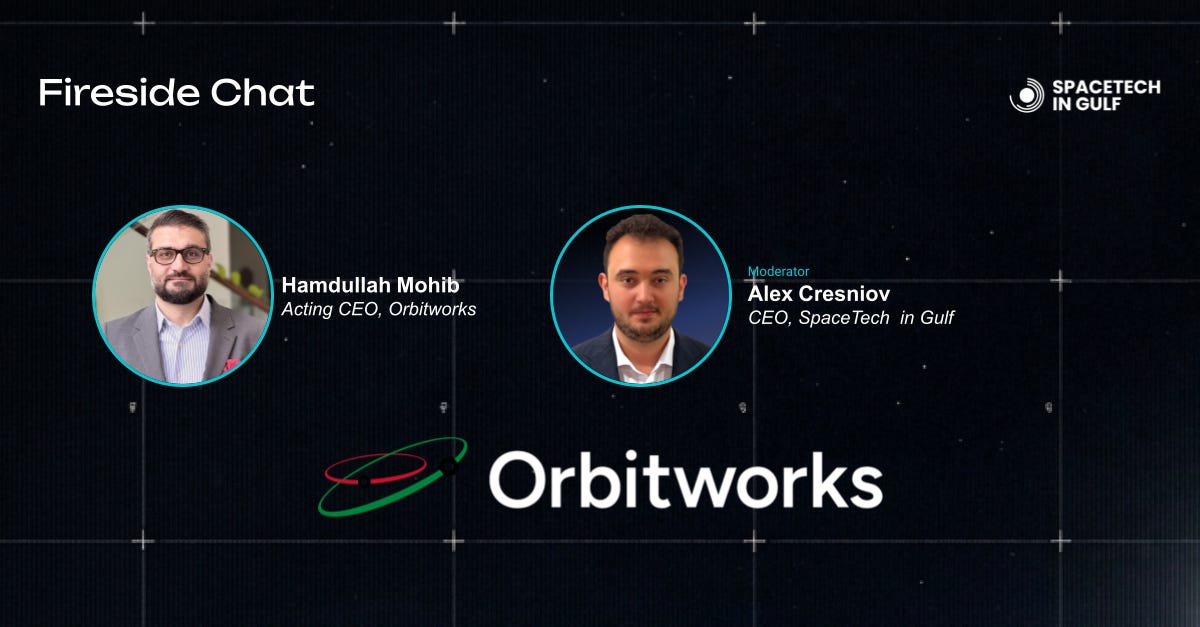
The conference included a fireside chat between Alexei Cresniov (SpaceTech in Gulf) and Hamdullah Mohib (CEO, Orbitworks) about just how far the GCC has come as a space power. Orbitworks — based in Abu Dhabi’s KIZAD zone and capable of manufacturing up to 50 satellites per year — was presented as a symbol of the region’s maturation: a commercial satellite integrator building its own 10-satellite constellation while also offering manufacturing and testing services to regional and international customers. The session highlighted the UAE’s evolving ecosystem of universities, research centres and commercial firms, and noted that a partnership with France’s CNES to use the Alter constellation for French services marks the first time a constellation built in the region has been contracted by a sophisticated external space actor — a powerful sign of growing export credibility.
Spotlight: Three Innovators Reshaping the GCC Space Frontier
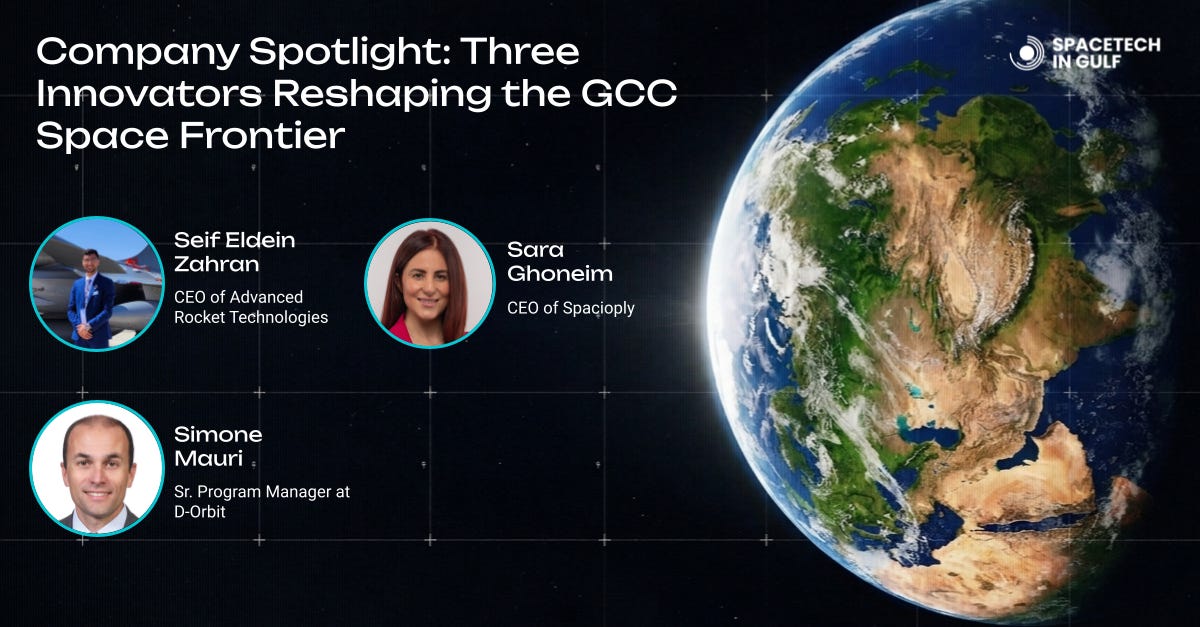
Three companies presented on the sidelines of the conference. Sara Ghoneim introduced Spacioply, a capability intelligence platform helping GCC governments close the localisation intelligence gap. Simone Mauri presented D-Orbit — 24 missions, 100% success rate — and its Saudi manufacturing hub, D-Orbit Saudi. And Seif Eldein Zahran pitched Advanced Rocket Technologies (ART), an Oman-registered startup building the region’s first sovereign launch capability, including what could become the first locally produced rocket motor from the Gulf.
All panel transcripts and recordings are available on SpaceTech in Gulf.