

Speakers
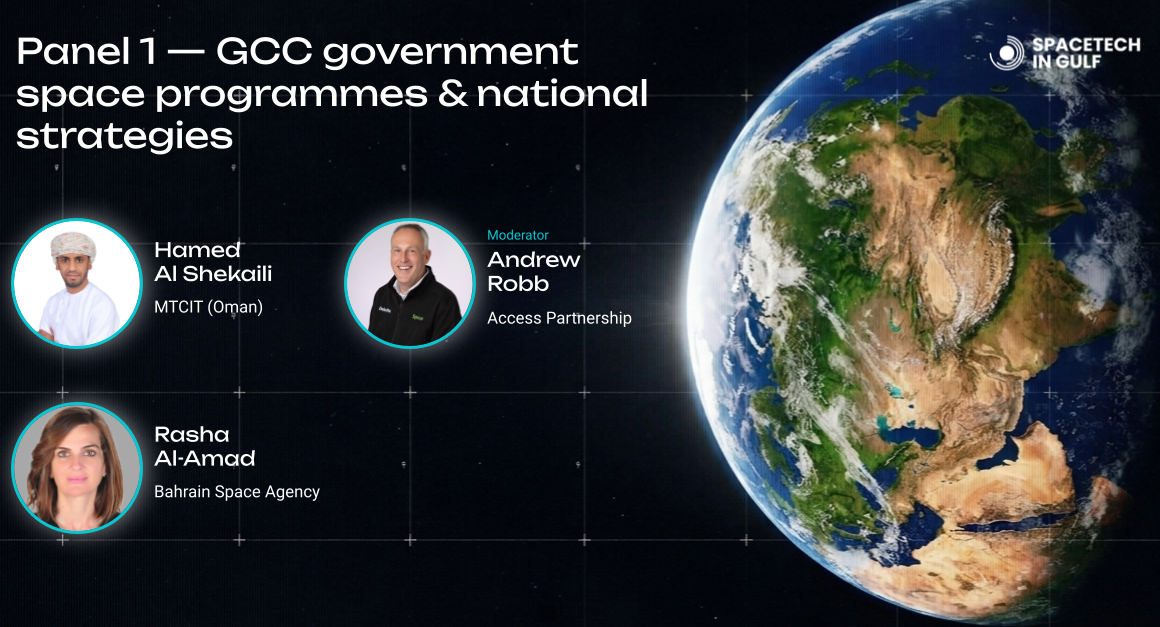
| Role | Name | Organisation |
| Moderator | Andy Robb | Access Partnership |
| Speaker | Rasha Al-Amad | Bahrain Space Agency |
| Speaker | Hamed Al Shekaili | MTCIT Oman |
Full Transcript
Opening and Introductions
[00:00] Alexei Cresniov:
We are starting our first panel. I’m answering some of the questions from the chat, so each panel will take about 45 minutes. The panel is focused on government space programmes and strategies. Andrew Robb is the moderator.
[00:32] Andy Robb:
Thank you, Alex and Janade for that introduction. My name, as you can see on the screen, is Andy Robb from Access Partnership, and I have the coolest job title in the world. I’m our global chief space officer, and I’m joined by two of the coolest people in the world to discuss this first session on national space strategies.
[01:03] Andy Robb:
Access Partnership helps organisations access the new space economy. When you think about accessing that economy, the starting point for most countries sits within civil space agencies as the catalyst. Before we get into detail, I’d like my colleagues to introduce themselves and explain their roles in their respective space agencies.
[01:27] Andy Robb:
I’ll turn to Rasha first.
[01:34] Rasha Al-Amad:
Good afternoon, esteemed guests. It’s my pleasure to be here at the GCC Space and Security Conference alongside my colleagues. My name is Rasha Al-Amad, and I’m Chief Strategic Planning and Projects at Bahrain Space Agency. I’ve been with the agency since its establishment and have worked on developing the national space policy, three strategic plans so far, with relevant stakeholders and reporting on their progress. I also work on international collaborations, building future partnerships with the private sector and with government space agencies on joint missions, technology development, and knowledge transfer.
[02:21] Andy Robb:
Thank you, Rasha. I’ll hand over to Hamed Al Shekaili from MTCIT, the Omani equivalent of a space agency, to introduce himself.
[02:34] Hamed Al Shekaili:
Hello everybody. First of all, I’d like to thank SpaceTech in Gulf for their first online conference. I’m proud to be here to talk about Oman’s initiative in collaboration with stakeholders around the world. My name is Hamed Al Shekaili from the Sultanate of Oman. I work as Director of Space Projects Program at the Ministry of Transport, Communications and Information Technology. My role is overseeing and coordinating the implementation of national space initiatives and projects. Our work in Oman to achieve Oman’s ambition in space is related to Oman Vision 2040 and led by our national space policy and executive program.
Strategy and Vision
[03:42] Andy Robb:
Please put questions in the chat and we’ll get to those at the end. We’ll speak for about 20 to 25 minutes and cover five topics: national strategy, sovereignty, regulation, collaboration, and talent. We’ll start with vision to execution. National space strategies often align with wider country strategies, but I’d like to understand how they are changing and how priorities are being set. I’ll begin with Bahrain.
[05:10] Rasha Al-Amad:
In Bahrain, Vision 2030 was announced in 2008, before the national space policy in 2018. The space policy was designed to achieve His Majesty’s vision in the space field and support Bahrain’s Vision 2030, the government action plan, and national needs. Our plan supports Bahrain’s aspiration to move from an oil-driven economy to a competitive economy led by the private sector. It also supports the new space economy, with focus not only on government missions but also on commercialization, innovation, private sector participation, and economic impact. This is reflected in the policy through objectives such as public-private partnerships, collaboration to achieve presence in space, creating a new space sector that supports economic diversification away from oil and gas, attracting investment through regulation and incentives, and supporting R&D, innovation, entrepreneurship, and space data applications.
[07:13] Hamed Al Shekaili:
The space sector in Oman has an interest to be a standalone sector by royal decree. Oman considers space an important sector that works as an enabler and a leader for the future economy. Oman’s national space policy and executive program were launched in 2023. They were prepared with international partners as we moved toward the new space economy, but with Oman’s own approach. The policy is closely linked to Oman Vision 2040 and the five-year development plan, as well as the national digital economy program. The focus is economic diversification, and commercialization is the first priority at this stage. There is also a concern for environmental sustainability and for building national capabilities so that Oman can achieve sovereignty in future space initiatives in collaboration with other countries. The 2023 to 2033 space strategy focuses on establishing space infrastructure that will enable Oman to develop its own capabilities and integrate with the world while serving the region.
Changing Priorities
[12:10] Andy Robb:
We’re in the midst of disruption across the space sector. Has that changed your priorities?
[12:30] Rasha Al-Amad:
Yes, definitely. Priorities have gradually shifted. Initially, the focus was on space education, outreach, and building capabilities in upstream and downstream. That led to projects like Light-1, the first Emirati-Bahraini satellite, which was mainly for capacity building. Priorities then shifted toward indigenous technologies and nationalization of space technologies and local capabilities, as shown by the Al-Munther satellite, launched last year. It included four fully in-house developed payloads and tested new algorithms in space. In the future, Bahrain expects to develop advanced infrastructure such as assembly, integration, and testing facilities, advanced ground stations, stronger private sector participation, advanced missions, and eventually a national space law to stimulate private sector growth.
Sovereignty and Partnerships
[14:19] Andy Robb:
That leads to sovereignty. In a disrupted world, is this changing your approach to partnerships and technology transfer?
[15:09] Rasha Al-Amad:
Governments are rethinking how things are done. Bahrain’s partnership model values long-term strategic partnerships, with the main purpose of capacity building while achieving the objectives of both partners. In the future, the model may shift toward shared missions to reduce cost, risk, and duration, as well as shared infrastructure. It may move away from pure knowledge transfer and capacity building. For space missions in Bahrain, we currently favour turnkey procurement models where one contract covers build, development, launch, operation, and ground segment, while maximizing knowledge transfer. Because Bahrain does not yet have its own facilities, satellites are integrated in partner facilities. In the future, the approach may shift toward multiple procurements under one project, with more emphasis on nationalizing technologies and using future domestic infrastructure.
[17:37] Hamed Al Shekaili:
Oman is newly established and we learn from global experience in the new space economy. Our focus is on downstream applications, partnership, and working closely with stakeholders. We want the private sector to invest in the sector for economic diversification and faster innovation. A good example is Etlaq Spaceport in Duqm, which is expected to be ready for commercial activities by 2029. This project depends on international collaboration and partnership. Oman aims to serve the region and other countries while transferring knowledge and localising space technology and products. Oman also co-organised the second Middle East Space Conference with Novaspace, with more than 500 attendees from about 30 countries. That shows the value of collaboration and practical exchange.
Regulation and Law
[21:12] Andy Robb:
Moving to regulation. Can regulation stimulate growth and commercialization, or can it hinder foreign direct investment?
[22:17] Rasha Al-Amad:
In Bahrain, regulation is there to attract the commercial sector. Bahrain offers a tax-efficient, digital environment, cloud-first policies, strong government support, investor support through EDB, wage support through Tamkeen, and 100% foreign ownership in most sectors. Bahrain is working on a national space law, which should accelerate commercial ambitions by providing clear governance, reducing uncertainty, enabling public-private partnerships, attracting investors, and creating a competitive environment. At the same time, the law would protect the kingdom by ensuring that private sector activity complies with national and international space law.
[26:18] Hamed Al Shekaili:
Oman has a royal decree to establish an AI city, which can also host the space sector. That means special treatment and incentives for investors, including zero taxation, wage support, and easier licensing. Oman is drafting its space law and expects it to be launched this year. The goal is not to restrict companies but to make things clear and transparent for all stakeholders and operators. Etlaq Spaceport’s first experimental suborbital launch in December 2024 happened because several government entities worked closely together to ease the process, even without a dedicated space law in place.
Regional Collaboration
[30:13] Andy Robb:
In a disrupted world, will countries collaborate more or less?
[30:57] Rasha Al-Amad:
Collaboration will definitely happen more. There is currently GCC-wide cooperation in space activities because the region shares common interests such as economic diversification, sustainability, technology development, and capability building. The GCC also shares common challenges such as water scarcity and environmental sustainability, which makes joint solutions and joint missions important. Bahrain chairs the GCC Space Cooperation Committee this year, and Bahrain also participates in the Arab Space Cooperation Group. There is both collaboration and competition. Bahrain wants to distinguish itself in the GCC value chain, but the country has reached this point with strong support from the UAE and Saudi Arabia during its establishment phase. Bahrain works on joint missions such as Light-1, the Space for Sustainability program, and a lunar rover project with Mohammed bin Rashid Space Centre.
[34:10] Hamed Al Shekaili:
Oman agrees. The country supports GCC and Arab space cooperation, as well as UN agreements. Bahrain and Oman, along with most GCC countries, are members of the Regional Centre for Space Science and Technology Education in Jordan. Oman transfers practices from government to private sector. The ministry guides private companies rather than providing all services directly. The government and private sector are moving together with the same strategy and trends, which maximizes Oman’s presence in the sector.
Talent and Capacity Building
[37:15] Andy Robb:
Our final topic is workforce and talent pipelines. How are you building capacity for these long-term strategies?
[37:59] Rasha Al-Amad:
Talent development is a key pillar of a sustainable space sector. You cannot commercialize or attract investors without local talent, outreach, and awareness. Bahrain supports this through advanced academic studies, scholarships in the UK and UAE, real projects that provide knowledge transfer, specialized training courses, internships, job shadowing, research partnerships, and hackathons. Bahrain organizes annual Space Apps hackathons, and last year, with the Al-Munther launch, it organized three hackathons. This year the Arab Space Cooperation Group is working on the first pan-Arab hackathon using data from Arab Satellite 813.
[41:42] Hamed Al Shekaili:
Oman shares the same belief in talent localisation and capacity building. It is one of the four pillars of the space policy and executive program. Oman has royal directives to develop a national capacity building program in the space sector from 2024 to 2027, focused on professionals, entrepreneurs and startups, and academia. In 2023, Oman had 152 employees working in space organizations. Now there are more than 400, and local talent is now active in earth observation analytics, IT projects, satellite communication, operations, and maintenance. Oman conducted workshops from 2023 to 2025 with 300 participants from government, private sector, entrepreneurship, and academia.
Closing
[46:13] Andy Robb:
The whole conversation shows a spirit of collaboration, internationalisation, and practical capacity building. Thank you to Rasha and Hamed for their time and insights.
[46:40] Alexei Cresniov:
Thank you so much. Have a great day.
Panel Summary
Panel 1 brought together senior government representatives from Bahrain and Oman to explore the evolution of national space strategies across the GCC. Moderated by Andy Robb (Access Partnership), the session covered five key themes: national strategy, sovereignty, regulation, regional collaboration, and talent development.
1. National Strategy & Vision
- Both Bahrain and Oman have aligned national space strategies directly to broader economic diversification visions — Bahrain Vision 2030 (2008) and Oman Vision 2040.
- Bahrain’s national space policy (2018) focuses on public-private partnerships, commercialization, innovation, and economic diversification away from oil and gas.
- Oman launched its national space policy and executive program in 2023, with a 2023–2033 strategy focused on building space infrastructure, downstream applications, and sovereign capabilities.
- Oman’s goal is for space to contribute to a 10% GDP share from the digital economy in collaboration with AI, cybersecurity, fintech, and digital industries.
2. Changing Priorities
- Bahrain has evolved from capacity building and education (Light-1 satellite) toward indigenous technology development — demonstrated by the Al-Munther satellite with four fully in-house developed payloads.
- Future priorities for Bahrain include assembly, integration and testing facilities, advanced ground stations, stronger private sector participation, and a national space law.
- Oman’s immediate priority is commercialization and downstream applications serving logistics, AI, agriculture, maritime, and the wider economy.
3. Sovereignty & Partnerships
- Both nations are shifting from pure knowledge transfer toward shared missions, shared infrastructure, and domestic capability development.
- Bahrain currently favours turnkey procurement models but expects to shift toward multiple procurements under one project as domestic infrastructure develops.
- Oman’s Etlaq Spaceport in Duqm is a flagship sovereignty project, expected to be ready for commercial activities by 2029, positioning Oman as a regional launch hub.
4. Regulation
- Bahrain positions regulation as an enabler of commercial growth — offering tax efficiency, 100% foreign ownership, and investor support through EDB and Tamkeen. A national space law is in development.
- Oman is drafting its space law in 2026, with the goal of transparency and enabling commercial investment — not restriction. A royal decree establishing an AI city provides early investor incentives including zero taxation.
- Etlaq Spaceport’s first suborbital launch in December 2024 was achieved through inter-government collaboration even without a dedicated space law in place — demonstrating regulatory agility.
5. Regional Collaboration
- Both speakers agreed collaboration will increase — driven by shared regional challenges including water scarcity, environmental sustainability, and economic diversification.
- Bahrain currently chairs the GCC Space Cooperation Committee and participates in the Arab Space Cooperation Group. Active joint missions include Light-1, the Space for Sustainability programme, and a lunar rover project with Mohammed bin Rashid Space Centre.
- Oman and Bahrain are both members of the Regional Centre for Space Science and Technology Education in Jordan, and Oman co-organised the second Middle East Space Conference with Novaspace (500+ attendees, 30 countries).
6. Talent & Capacity Building
- Bahrain’s talent pipeline includes scholarships in the UK and UAE, real project participation, hackathons (Space Apps), internships, and research partnerships. The Arab Space Cooperation Group is developing the first pan-Arab hackathon using data from Arab Satellite 813.
- Oman has grown its space workforce from 152 employees (2023) to over 400, now active in EO analytics, satellite communications, IT, and operations.
- Oman’s 2024–2027 national capacity building programme targets professionals, entrepreneurs, startups, and academia — supported by royal directive. 300+ participants completed workshops between 2023–2025.
Key Takeaway: Both Bahrain and Oman demonstrate that GCC space programmes are maturing rapidly — moving from education-first approaches to indigenous capability development, commercial frameworks, and regional leadership roles. The spirit of collaboration, both within the GCC and internationally, was a consistent theme throughout the discussion.
GCC Space & Security Online Conference 2026 | Organised by SpaceTech in Gulf | www.spacetech-gulf.com | alex@spacetech-gulf.com