

Speakers
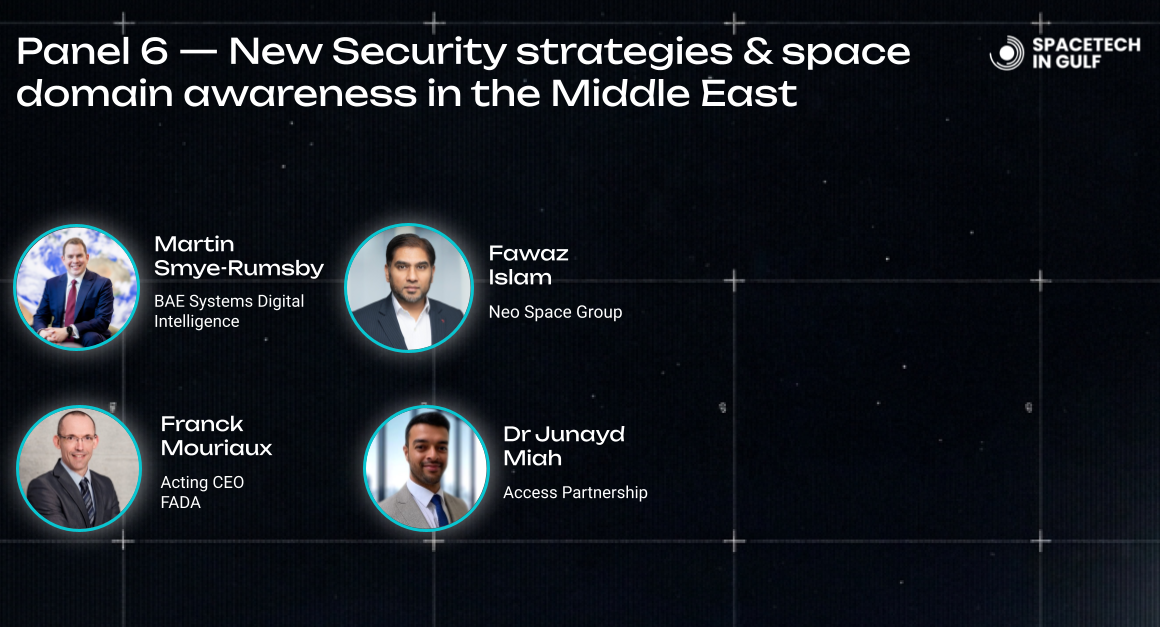
| Role | Name | Organisation |
| Moderator | Dr Junayd Miah | Access Partnership |
| Speaker | Fawaz Islam | Neo Space Group (NSG) |
| Speaker | Franck Mouriaux | FADA (EDGE Group) |
| Speaker | Martin Smye-Rumsby | BAE Systems Digital Intelligence |
Full Transcript
Opening and Aims
[00:00] Host:
Thank you for being with us today. We’re moving to our last panel, Panel 6, focused on security strategies in the Middle East. Dr Junayd, the floor is yours.
[00:16] Dr Junayd Miah:
Thanks, Alexei, and welcome everyone to our final session of the day. As Alexei said, we’re focusing on new security strategies and space domain awareness in the Middle East. My name is Dr Junayd Miah from Access Partnership and I have the privilege of moderating today’s discussion. We’ve covered a lot of ground in the event so far; this session brings those threads together with a focus on security.
[00:54] Dr Junayd Miah:
There is a clear shift underway from simply accessing space capabilities to building and sustaining them. Organisations like NSG and FADA reflect that ambition. The key question is whether this is translating into genuine sovereignty, or whether reliance on external partners still defines the model. Today we’ll explore: what sovereignty really means in practice across assets, data, tasking and design authority; how government demand, industrial strategy and partnerships shape outcomes; operational realities such as GNSS interference and talent challenges; and finally, what could still stand in the way of a truly self-sustaining space security capability in the GCC.
[02:10] Dr Junayd Miah:
Before we begin, I’d like each panelist to briefly introduce themselves, their organisations, and why this topic matters from their perspective. Fawaz, if you don’t mind going first.
Introductions
[02:29] Fawaz Islam:
Thank you very much, Junayd. It’s a pleasure to join this group of panelists. I’m Vice President for Commercial Satellite Communication Business at Neo Space Group (NSG). I started my career in satellite operations, working on geostationary satellite programmes at Arabsat, a pioneer regional operator. I then spent a few years at NorthStar in Canada, a startup that deployed the first commercial space-based capability for space domain awareness. Last year I moved back to the Kingdom and joined NSG.
[03:21] Fawaz Islam:
NSG was launched two years ago by PIF as the national space champion of Saudi Arabia, mandated to deliver sovereign space capabilities, scale the domestic ecosystem and become a key regional and global player. We work across three main domains: geospatial, satellite communications and PNT. We acquired Taqnia ETS (now NSG Geospatial), the largest geospatial company in the region, and we acquired UP42 from Airbus, launching a local Saudi EO marketplace based on that technology. In satellite communications, we operate national space and ground assets for critical government services. On the commercial side, we acquired French company Display Interactive to enable multi-orbit in-flight connectivity, and recently announced a partnership with Saudia as flag carrier. In PNT and IoT, we’re developing a roadmap for smart cities and autonomous mobility under Vision 2030.
[05:47] Dr Junayd Miah:
Perfect, thanks Fawaz. Franck, if you could go next.
[05:53] Franck Mouriaux:
Hi everyone, I’m Franck Mouriaux, Acting CEO at FADA. I started my career as a mechanical engineer in France at Thales Alenia and spent most of my career at RUAG Space (now Beyond Gravity) in Switzerland and Europe, working on many ESA and UAE programmes. I led RUAG’s greenfield factory in Florida for the OneWeb constellation, then moved to the US to work in additive manufacturing, and later joined Rocket Lab as programme manager for the Globalstar constellation. I then moved to the UAE to join FADA, a space-focused company launched in 2024 as part of EDGE Group. Our objective is to achieve national sovereignty in space technologies and become a global provider of space services. We are prime contractor of the SARB programme led by the UAE Space Agency, a SAR satellite mission. We are also developing Zenit, a multi-sensor, multi-constellation data-orchestration platform to support our future satellites and wider space services ambitions.
[08:00] Dr Junayd Miah:
Thanks, Franck. Martin, over to you.
[08:07] Martin Smye-Rumsby:
As-salam alaykum everyone. My name is Martin Smye-Rumsby from BAE Systems. I’m Head of International Space Business Development for BAE Systems. I’ve worked in defence and security for two decades, with both space-enabled capability and space systems themselves. BAE has two large space divisions: one in the US, focused mainly on the US sector, and our UK division, Digital Intelligence, where I sit. We’ve been in the space sector for many decades, supporting tracking, telemetry and command processors and ESA’s ground station network. Importantly for this audience, our Digital Intelligence portfolio sits outside ITAR, though still subject to UK export controls.
[09:30] Martin Smye-Rumsby:
Behind me is cluster one of AZALEA, our new RF-sensing and SAR product. The first cluster launched at the end of last year. RF in space and radar in space are not new, but flying these spacecraft together with on-board processing gives a richer picture of what’s happening in a congested, contested war-fighting domain. This constellation is privately financed by BAE — self-investment that shows we also have entrepreneurial zeal, not just government-contractor DNA. We’ve been in Saudi Arabia for around 60 years and have provided capability across the GCC. Space now sits alongside land, air, maritime and cyber as a war-fighting domain; without a robust space capability, nations face a massive vulnerability. Sovereignty is therefore central.
Is True Sovereignty Emerging in the GCC?
[11:21] Dr Junayd Miah:
Let’s go straight into sovereignty. Being blunt: is sovereignty happening now in the GCC, or are we still some way off, given the long history of importing defence technology? Franck, can I start with you, then Fawaz, then Martin?
[12:29] Franck Mouriaux:
From my perspective it’s definitely more than a concept; it’s already a reality. In the UAE, sovereign capability development started quite some time ago. One of the first satellites built in-country launched around 2009, and if we look at the wider ecosystem — Space42, MBRSC and others — there are many players that have built and operated satellites. Things are accelerating, driven by technology, geopolitics and the strategic nature of space. Industrial groups like EDGE are entering the sector and going deeper into sovereignty — from owning satellites, to assembling subsystems, to manufacturing key components. We’re already at that level and moving further.
[14:30] Fawaz Islam:
Yes. The shift started about a decade ago, from the region being security consumers to becoming sovereign security producers. In Saudi Arabia this is visible in defence: under Vision 2030 the target is to localise more than 50 percent of military equipment and services spending, and about half of that had been achieved already by 2024. For space, we’ve seen national institutions emerge and evolve — from the Saudi Space Commission to the Space Agency — and NSG was established two years ago under PIF for a specific reason: to set national priorities, inject capital, stimulate the sector and create demand signals that attract private capital.
[16:08] Fawaz Islam:
Over the past two years we’ve focused on building local capabilities, attracting international talent and blending it with local talent, partnering internationally where it makes sense, and acquiring strategic capabilities such as UP42 to localise proven tech quickly. Progress is visible and accelerating, but space is a generational industry; it takes time to build industrial bases and capabilities. The next big milestone is deepening design authority — designing, building and manufacturing systems in-country and growing local supply chains so indigenous capabilities become increasingly sovereign.
[17:58] Martin Smye-Rumsby:
I echo the sentiment. The UAE and Saudi Arabia are pre-eminent GCC actors and mirror broader trends: regions without legacy industrial bases are now building them. Countries with larger bases can invest more in people and infrastructure. As Rasha Al-Ahmad mentioned in an earlier panel, there is also regional leadership; other Arab countries may prefer suppliers from within the region. From BAE’s side, localisation and partnership are how we operate, not just slogans. In Saudi’s aerospace sector, over 80 percent of our workforce is now Saudi nationals. Identifying and growing industrial bases and supply chains takes time and investment; we take partners where they are, respect national visions and work with them to increase capability accordingly.
What Does ‘Sovereignty’ Actually Mean?
[20:24] Dr Junayd Miah:
Sovereignty can mean many things. Initially, people thought it meant owning and building satellites, but that hits a wall when you can’t produce all components domestically. What, in your view, are the priorities that really define sovereign space security?
[21:24] Fawaz Islam:
At NSG we published a sovereignty classification framework in late 2024, inspired by TRL levels. We defined six sovereignty levels. Level 1 is where you only have licences and permits to operate. Higher levels include having exclusive software capacity as a reseller or value-added provider using others’ technology; owning and operating command-and-control systems and procured satellites. Historically the region was around the level where assets were owned and operated locally but major technology came from abroad. The ongoing shift is towards building design authority: skills and training to design, model, simulate, manufacture, assemble and integrate systems, while still relying on global supply chains. The next levels are where you start having custody of the supply chain and value chain — including launch — and ultimately a resilient sovereign ecosystem like those of the US or China.
[23:34] Fawaz Islam:
For KSA, ambition should be at least to design national missions, build, assemble and test them domestically, and manufacture critical subsystems such as antennas, RF components and key electronics, while developing launch-related capabilities over time.
[26:17] Franck Mouriaux:
I fully agree. Sovereignty includes owning satellites, controlling data and tasking, but essentially it is about being able to design what you need based on your own requirements and integrate it seamlessly into your systems. Buying off-the-shelf often means accepting average solutions. Full sovereignty lets you design exactly what you want, increasing efficiency and ensuring end-to-end integrity of data and operations, and avoiding intentional or unintentional disruption. In the SARB programme, one objective is to localise almost every step of the lifecycle: design, manufacturing, integration, testing, operation and even deploying our own encryption to protect information end-to-end. Rather than a fixed bar, each country must identify its critical components and infrastructures — what is truly non-negotiable — and focus on localising those, while procuring and integrating lower-risk elements from outside.
[30:47] Martin Smye-Rumsby:
From BAE’s perspective, people are central. You can map a product tree, then have a risk discussion: what components demand diversification of supply, and what level of risk are you comfortable with? We put knowledge and technology transfer at the heart of our proposals. Sometimes rapid turnkey solutions are needed, but the enduring goal is co-design, co-creation and building local principal investigators, chief engineers and AIT leads. In an era of open publishing and AI, information is easy to get; the real value is institutional memory of what worked and what failed. Full autarky is rarely economically viable; sovereignty is about informed, risk-based decisions on where you must be independent and where trusted partners are acceptable.
Supply-Chain Risk and Data Access
[33:07] Dr Junayd Miah:
We’ve touched on blockers to higher sovereignty, notably supply-chain risk. We’ve seen in Europe how the Ukraine-Russia war affected ESA launches. How significant is supply-chain risk for you now in the GCC, and has it been exacerbated by recent events?
[34:08] Fawaz Islam:
Recently some commercial EO providers stopped supplying data over the region. That’s a very concrete example of why custody of the supply chain — components or data — is critical. As the regional market grows and local manufacturing scales, demand signals will naturally attract component suppliers to the region. It’s already happening, but recent geopolitical changes have increased emphasis on building indigenous capability to ensure critical missions can continue even if access is denied from outside. Localisation would have happened anyway, but recent events have accelerated timelines and strengthened the case for alternative, in-country options.
[37:34] Franck Mouriaux:
FADA itself hasn’t been heavily affected, but EO data restrictions did have an impact. Fortunately, we had core capabilities and could continue to operate and deliver information, even if not optimally. Any dependency is a risk. You can’t eliminate it entirely, but you can manage it. The growing availability of commercial off-the-shelf components and mass-produced technology helps reduce dependencies and increase competition. Within EDGE we benefit from a broad technology and industrial ecosystem, re-using components across systems and leveraging group production capabilities and know-how. The strategy is to identify critical technologies and know-how, lead their development in-house or in-country, and mitigate residual risks via diversified external partnerships.
Talent, Programmes of Record and Long-Term Resilience
[42:05] Dr Junayd Miah:
Let’s turn to workforce. To build long-term resilience, where should GCC countries prioritise upskilling, and what are the blockers? Martin, could you start?
[42:56] Martin Smye-Rumsby:
Programmes of record are essential. At each academic level — undergraduate to doctoral — people need meaningful projects, labs and missions to work on. If students don’t see viable careers in space because they don’t see visible programmes, they’ll go into finance or automotive instead. It’s not for industry to dictate programmes, but signalling clear long-term missions is probably the single most important thing governments can do to grow talent.
[44:05] Fawaz Islam:
I fully agree. Talent is a major factor — not just engineers, but programme managers, commercial leaders, legal, regulatory and policy experts, and people who have lived through full mission cycles. Under Vision 2030, human capability development is a priority. In space we’ve seen many initiatives from the Space Agency and CST — for example the SpaceUp Challenge, which attracted hundreds of applications from local universities, startups and SMEs. These initiatives connect talent and technology with real market opportunities and help build national human capital. The GCC’s young, educated and ambitious population is one of the region’s strongest long-term advantages if we can connect them to clear career paths in a growing space ecosystem.
Five-Year Outlook: What Could Still Block Self-Sustaining Security?
[46:21] Dr Junayd Miah:
Final question: looking five years ahead, what single factor could still prevent the GCC from achieving genuine, self-sustaining space security and sovereignty? Brief answers, please.
[46:50] Martin Smye-Rumsby:
An absence of programmes of record — without them, the sector can’t grow its people or industry.
[47:03] Franck Mouriaux:
I’ll be bold and say: probably nothing major. There are many initiatives and a lot of traction. The GCC is one of the most active regions globally in space, with huge potential in industry, knowledge and resources. I don’t see anything fundamental preventing the GCC from taking a leading position in space activities.
[47:39] Fawaz Islam:
I fully agree with Franck. There’s so much happening that we are sometimes struggling to keep up with national needs. Over the next five years I expect sustained growth in the space sector.
Conference Closing
[47:59] Dr Junayd Miah:
Thank you all for your insights. We’ve only scratched the surface, but it’s been very valuable to hear your perspectives. That was me, Junayd Miah from Access Partnership. Alexei, back to you.
[48:21] Host:
Thank you so much. We’re finishing the conference, and it’s a bit sad because it’s been a very cool event with lots of topics discussed. Thank you again to Access Partnership and to partners Orbitworks, D-Orbit, MB Sat and Saudi Space Community for supporting and sponsoring the event.
[49:20] Dr Junayd Miah:
Thank you, Alexei, and thank you for organising this event. It’s been fantastic to see SpaceTech in Gulf deliver again. Over the past two days we’ve covered strategic ambitions for national space programmes, capital flows shaping next-gen capabilities, and now the security aspects and how governments must confront them. What strikes me most is the shift from ambition to tangible progress. A few years ago we heard big objectives; now they are being converted into reality: strategies written, investments made, capabilities built.
[50:46] Dr Junayd Miah:
The GCC is no longer debating whether to be a space power; it is deciding what kind of space power to be. The answers developed here will have global impact. On behalf of Access Partnership, thanks to all speakers, panelists and moderators, and especially to the audience. I hope conversations from this event continue in bilateral calls, new partnerships and decisions in ministries, boardrooms and control centres across the region.
[52:00] Host:
Thank you so much.
Panel Summary
Panel 6 brought the GCC Space & Security Online Conference 2026 to a close with a focused discussion on the practical realities of space sovereignty and security in the Middle East. Moderated by Dr Junayd Miah (Access Partnership), the panel featured leaders from NSG, FADA, BAE Systems Digital Intelligence, and Airbus Defence and Space. The session examined whether GCC sovereign space ambitions are translating into reality, what sovereignty truly means in practice, how supply-chain risks are being managed, and what workforce investments are needed for long-term resilience.
1. Is Sovereignty Happening? The Answer is Yes — and Accelerating
- Franck Mouriaux (FADA): Sovereignty is not just a concept — it is already a reality. The UAE’s first domestically built satellite launched around 2009. The ecosystem has grown significantly since: Space42, MBRSC, FADA, and others have built and operated satellites. EDGE Group is now going deeper — from satellite ownership to subsystem assembly and component manufacturing.
- Fawaz Islam (NSG): Saudi Arabia’s shift began a decade ago. Under Vision 2030, the target is to localise more than 50% of military equipment and services spending — about half had been achieved by 2024. NSG was established by PIF specifically to set national priorities, inject capital, stimulate the sector, and create demand signals that attract private investment.
- Martin Smye-Rumsby (BAE Systems): The UAE and Saudi Arabia are pre-eminent GCC actors. In Saudi Arabia’s aerospace sector, over 80% of BAE’s workforce is now Saudi nationals — demonstrating that genuine localisation is achievable at scale.
- The consensus: progress is real and accelerating, but space is a generational industry. The next frontier is deepening design authority — designing, building, and manufacturing systems in-country with growing indigenous supply chains.
2. Defining Sovereignty — NSG’s Six-Level Framework
- NSG published a sovereignty classification framework in late 2024 — inspired by Technology Readiness Levels — defining six levels of space sovereignty:
- Level 1: Licences and permits to operate only.
- Level 2-3: Reseller or value-added provider using others’ technology; owning and operating command-and-control systems with procured satellites.
- Level 4: Building design authority — designing, modelling, simulating, manufacturing, assembling and integrating systems in-country.
- Level 5-6: Custody of the full supply chain including launch capability; a fully resilient sovereign ecosystem comparable to the US or China.
- The GCC is currently transitioning from Levels 2-3 to Level 4. KSA’s ambition: design national missions, build and test domestically, manufacture critical subsystems (antennas, RF components, key electronics), and develop launch capabilities over time.
- Franck Mouriaux: True sovereignty means being able to design what you need based on your own requirements — not accepting off-the-shelf average solutions. FADA’s SARB programme aims to localise every lifecycle step: design, manufacturing, integration, testing, operations, and end-to-end encryption.
- Each country must identify its truly non-negotiable critical components and focus localisation efforts there, while procuring lower-risk elements from trusted external partners.
- Martin Smye-Rumsby: The real value in sovereignty is institutional memory — knowing what worked and what failed through full mission cycles. In the AI era, information is abundant; the scarcity is in experienced people who have actually built and flown systems. Full autarky is rarely economically viable; sovereignty is about informed, risk-based decisions on where independence is essential.
- BAE Systems positions knowledge and technology transfer at the heart of every proposal — with a long-term goal of co-design, co-creation, and building local principal investigators, chief engineers and AIT leads.
4. Supply-Chain Risk — Data Restrictions as a Wake-Up Call
- Fawaz Islam: The most concrete recent example of supply-chain risk: some commercial EO providers stopped supplying satellite data over the region entirely. This proved why custody of the data supply chain — not just hardware — is critical for sovereign operations.
- Recent geopolitical events have accelerated localisation timelines that would have happened anyway, but are now treated with greater urgency. Building indigenous capability to ensure critical missions can continue even if external access is denied is now a strategic imperative.
- Franck Mouriaux: Any dependency is a risk, but it can be managed. FADA’s strategy within EDGE Group: identify critical technologies, lead their development in-house or in-country, and mitigate residual risk through diversified external partnerships — not single-supplier dependencies.
- The growing availability of commercial off-the-shelf components and mass-produced space technology is helping reduce single-source dependencies and creating a more competitive supplier landscape.
5. Talent — The Single Most Critical Long-Term Investment
- Martin Smye-Rumsby: Programmes of record are the essential foundation for talent development. Without visible, long-term missions at every academic level, talented people choose finance, automotive or other sectors instead.
- Governments signalling clear, sustained programme commitments is ‘probably the single most important thing’ they can do to build a space talent pipeline.
- Fawaz Islam: The talent need extends far beyond engineers — programme managers, commercial leaders, legal experts, regulatory and policy specialists, and people who have lived through complete mission cycles are equally essential.
- Saudi Arabia’s SpaceUp Challenge attracted hundreds of applications from universities, startups and SMEs — demonstrating the appetite that exists when clear opportunities and career pathways are signalled.
- The GCC’s young, educated, and ambitious population is identified as one of the region’s most powerful long-term assets — if connected to clear career trajectories in a growing space ecosystem.
6. Five-Year Outlook — What Could Still Prevent Success?
- Martin Smye-Rumsby: The absence of programmes of record — without them the sector cannot grow the people or industry it needs.
- Franck Mouriaux: Boldly, probably nothing major. The GCC is one of the most active regions globally in space, with the industry, knowledge and resource base to take a leading global position.
- Fawaz Islam: Agreed. There is so much happening that NSG is sometimes struggling to keep pace with national demand. Sustained growth over the next five years is expected.
- Dr Junayd Miah’s closing observation: ‘The GCC is no longer debating whether to be a space power; it is deciding what kind of space power to be. The answers developed here will have global impact.’
Key Takeaway: The GCC has moved decisively from ambition to execution in space security and sovereignty. The shift is real, accelerating, and increasingly well-structured — with frameworks like NSG’s six-level sovereignty model providing clear roadmaps. The critical variables now are: sustained programmes of record to grow indigenous talent; continued deepening of design authority beyond satellite ownership; and active management of supply-chain risk — particularly for data access, where recent restrictions have served as a powerful wake-up call. The region is not asking whether it will become a space power. It is building one.
GCC Space & Security Online Conference 2026 | Organised by SpaceTech in Gulf | www.spacetech-gulf.com | alex@spacetech-gulf.com