

Speakers
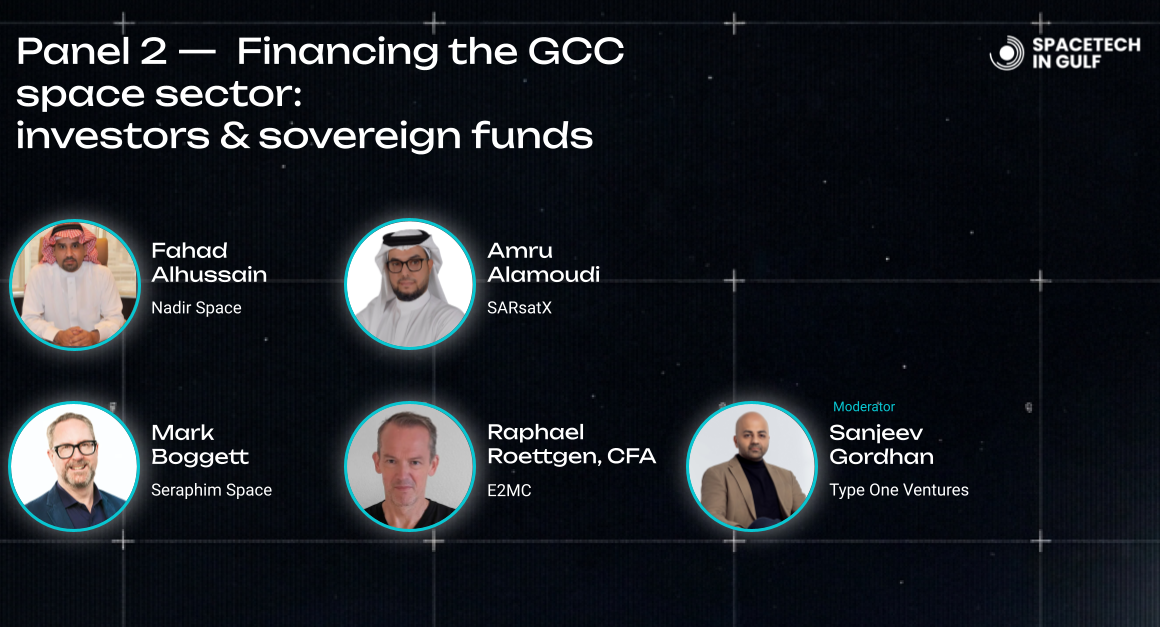
| Role | Name | Organisation |
| Moderator | Sanjeev Gordhan | Type One Ventures |
| Speaker | Mark Boggett | Seraphim Space |
| Speaker | Raphael Roettgen, CFA | E2MC |
| Speaker | Amru Alamoudi | SARsatX |
| Speaker | Fahad Alhussain | Nadir Space |
Full Transcript
Opening and Introductions
[00:00] Alexei Cresniov:
We’re moving to our next panel discussion focused on investments and financing in the GCC region. We have distinguished speakers today, and I’m giving the floor to your moderator, Sanjeev, for 45 minutes.
[00:31] Sanjeev Gordhan:
Thank you so much. We’ll take 35 minutes for the panel and then leave 10 minutes at the end for Q&A as well. Thank you very much for the invite, Alex.
[00:48] Sanjeev Gordhan:
It’s a very interesting time for the region. We’re seeing the UAE consolidating Bayern into Space42, Oman opening up Etlaq and signing partnerships with Northstar, Bahrain having launched Light-1 into orbit, and Saudi Arabia building a space economy worth about 8.7 billion with 253 domestic companies. This is against the backdrop of a global space market hitting over 12 billion dollars last year and the pending SpaceX IPO driving momentum globally. I’m joined by a strong panel of specialists from the region and more globally.
[02:14] Sanjeev Gordhan:
I’ll open the floor for quick introductions. Mark, starting with you.
[02:20] Mark Boggett:
Thanks, Sanjeev, and thank you for inviting me on to the panel today. I’m Mark Boggett, CEO and co-founder at Seraphim. We’re a space-thematically focused investment firm based in London, with offices in San Francisco and Berlin. We have a space accelerator program that runs a couple of times a year with 10 companies, a space venture fund that invests at seed and Series A, and a publicly listed growth fund on the London Stock Market. Across all of that, we’ve got 150 space tech companies.
[03:15] Sanjeev Gordhan:
Thank you very much. Raphael, coming to you next.
[03:21] Raphael Roettgen:
Happy to be here. I’m Raphael Roettgen, Founding Partner of E2MC, which, like Seraphim, is a purely space-focused early-stage investment fund investing globally. We’re based in Arlington, Virginia, just outside Washington DC, but we have investments in eight countries around the world. We’re very interested in the GCC region, and very excited about the leadership there being excited about space, which opens up long-term strategic development opportunities.
[04:03] Sanjeev Gordhan:
Amru, coming to you.
[04:09] Amru Alamoudi:
Thanks, Sanjeev. Glad to be here and thanks for the invitation. I’m Amru Alamoudi, CEO and co-founder of SARsatX. I’ve worked in several space companies, including Boeing and the Saudi Space Agency, and I’m honored to be on this panel.
[04:42] Fahad Alhussain:
Hi, my name is Fahad Hussain. I’m the co-founder of Nadir Space along with Frank Salzgeber. Previously I was in another VC firm focused on the space sector, where we invested in companies including SpaceX, Axiom, and Voyager.
[05:16] Sanjeev Gordhan:
I’m Sanjeev from Type One Ventures. We’re a VC firm headquartered in Los Angeles with offices around the world, and we’re opening our first office in the region soon. Type One invests across the stack from pre-seed to pre-IPO, and we invest in two core pillars: space and computation.
Sovereign Capital
[05:50] Sanjeev Gordhan:
One of the first things I want to address is the difference in objectives between sovereign capital and VC funds. VC funds have fiduciary duties to investors and returns, while sovereign capital often has different objectives around sovereign capability. Mark, I’ll come to you first.
[06:38] Mark Boggett:
We’re pragmatic about this. We don’t try to put a notional number on sovereignty and add it to the IRR. Instead, we ask whether the strategic value actually makes the business more durable. Data sovereignty, local IP, and skills matter only if they improve long-term outcomes, such as stickier customers, better contract visibility, or protection from regulatory shocks. If they do, they improve the return profile. Where it goes wrong is when strategic value only shows up after something hasn’t worked. If unit economics don’t hold or governance is weak, then ‘strategic importance’ becomes an excuse. Sovereignty should enhance value, not replace discipline.
[07:52] Raphael Roettgen:
Sovereign support can be a wonderful thing. A sticky customer can also be the first customer, and that can shorten development cycles in a deep-tech industry. It can help with business development because the first customer can act like an anchor or lighthouse customer, encouraging other non-government customers to come in. Government support can also extend runway through grants or investment contracts. There is another side to this, though. We do not want companies to become addicted to government customers, especially if policy changes. We usually avoid single government customer or single government investor companies unless there is strong confidence in long-term demand. If done well, sovereign support can be very helpful for everyone. But it can also lead to poor discipline if companies become dependent on support.
[09:50] Sanjeev Gordhan:
In Europe we have created and seen ‘grant junkies,’ companies that use grants as milestones. We want to move away from that because grants are not true validation. We need sovereign capital to produce real returns.
[10:36] Amru Alamoudi:
Geopolitics plays a dynamic role in sovereign capital and where it goes. To attract sovereign capital from outside the GCC, you need geopolitical alignment and similar interests. GCC venture capital can also help attract foreign sovereign capital by co-funding and matching investments. We have a good example in Saudi with Seraphim and Arabs, where venture capital can help bring in sovereign capital into the region.
[13:01] Fahad Alhussain:
Being between the US and Saudi, there is a big difference between the two ecosystems. The space economy in the region is still emerging. Even in the US, if it wasn’t for government and NASA, we would not have SpaceX, Lockheed Martin, or Boeing. We are at a stage where patient capital is needed to carry the industry to maturity. It is not in our KPI as private firms to build local capability or sovereignty. That is government’s job. Government should build the infrastructure and then private firms can help grow the market.
Patient Capital
[14:29] Sanjeev Gordhan:
Do you think government capital is still filling that gap, or are governments reducing their time horizons?
[15:07] Fahad Alhussain:
Governments have the intention to do this, but budgets and shifts to more urgent areas can change priorities. There have been bigger plans in Saudi for space and deep tech, and eventually support through grants or matching funds will help the private sector grow. Patient capital from the government is a must if the plan is to grow the industry.
[15:52] Raphael Roettgen:
For us, when partnering with sovereign investors, it is important to understand their underlying strategic objectives, their mandate, and where those objectives come from. We also look at how geopolitical shifts may affect those objectives. We take a step back and understand the larger context before we are comfortable co-investing.
[17:35] Mark Boggett:
Investors around the world are embracing space. Over the last five years there has been a rapid understanding of the opportunity. Investors are now prepared to take more risk in this market. The risk appetite of investors globally has changed, and with that the time period they expect for returns has also changed. Private investors have become more patient, while governments in some regions are going in the opposite direction and creating more uncertainty. When we invest, we focus on whether companies can survive if subsidies are removed. We need to know the business still works if the second tranche does not come through.
[19:50] Raphael Roettgen:
Liquidity is also important. People like Mark and I run 10-year funds, so we have to think about how to get capital back. Solutions include secondaries and public markets. I think public markets should increasingly be involved in the space sector. We have already seen several IPOs this year, and I IPO’d a $230 million NASDAQ vehicle in January.
GCC Financial Structures
[20:31] Sanjeev Gordhan:
What can the GCC region learn from this, coupled with the financial structures they are trying to create?
[21:20] Raphael Roettgen:
The GCC has everything needed to make this happen. It is a sophisticated financial center where the rule of law holds. It can use the full financial toolkit. So far, space has been built mostly on equity, but there is no reason not to expand into debt, derivatives, and performance bonds. Over time, the full toolkit will be phased in, and the GCC can benefit from that.
[22:16] Mark Boggett:
The focus needs to be broader than domestic. The ambition should be to create global champions born out of the GCC but competitive on the global stage. That is the mindset needed to build sustainable, large-scale space companies. That is not fully where the mindset is today.
[23:09] Sanjeev Gordhan:
I was in Riyadh early last year and was blown away by the Vision 2030 momentum. That vision exists across the GCC, but how do you make it investable?
[24:09] Amru Alamoudi:
Government support is very critical because it adds credibility. In Saudi, startups that get grants from programs such as NDTB make venture capital more comfortable to invest. The ecosystem also needs tools that help startups survive and reach milestones, such as subsidies, salary support, and free access to labs. Space companies, especially hardware companies, cannot look only domestically. They need global markets and global presence to achieve financial solvency and attract investors. Investors become more willing to take risks if they see an ecosystem that can produce a few potential unicorns and support them properly.
[26:43] Mark Boggett:
Germany is a good example. Its large budget has had positive second-order effects, with foreign companies partnering with local companies to develop local capabilities.
[28:49] Fahad Alhussain:
Space is global by nature. Companies should not only have domestic ambition; they need a global niche and capability. There are many examples of international partnerships building infrastructure for the space economy. D-Orbit is one company we are looking at closely, with plans for manufacturing in Saudi. We are seeing strong international collaboration and momentum building around the space industry, which is very good for the region.
Ecosystem Gaps
[30:13] Sanjeev Gordhan:
Where are the gaps in the market? What do we need more of for true localization?
[30:35] Amru Alamoudi:
We need consolidation of direction in government-led space technology programs. A mega-program with clear focus and large budget would help. We also need a clearer distinction between space and data. If something is just data, then it is a data company. If it is hardware and sensors going to orbit, that is space. That education needs to reach the region.
[31:47] Sanjeev Gordhan:
Ten years ago, venture capital mostly avoided hardware. Now, are we seeing a split between downstream data companies and hardware companies, or more vertical integration?
[33:23] Mark Boggett:
When we set up our fund 12 years ago, we thought most investments would be downstream capital-efficient businesses. In reality, 90 percent of what we invested in was hardware and upstream, higher-risk, more capital-intensive businesses. Vertical integration pays. It helps companies build a more domestic ecosystem because they rely more locally. There will absolutely be a bifurcation. Many investors do not want to touch hardware, but there is more money willing to focus on data and software.
[35:21] Amru Alamoudi:
We also see downstream companies receiving data from many satellites and serving customers through software. Many startups are entering the downstream scene because so much satellite data is still not being used.
[36:43] Sanjeev Gordhan:
When we talk about sovereign capital, the product is sovereign data, and that only comes if you play in upstream systems. That helps create sovereign data, which then justifies sovereign capital.
Lightning Round
[37:27] Sanjeev Gordhan:
If you had no restrictions on time or capital, what would you want to see in the space industry?
[37:40] Raphael Roettgen:
Education. That means education of young people in the GCC about the space opportunity, but also educating non-aerospace customers about the value of space products and services.
[38:24] Fahad Alhussain:
I would like to see more competition in launch. I want five or ten SpaceXs around the world so that space becomes more affordable and payloads are easier to launch.
[38:57] Mark Boggett:
For me, it would be space energy — solar farms in space delivering clean, reliable energy to Earth and helping with the transition away from oil.
[40:07] Amru Alamoudi:
I want a better environment to attract VC funds from outside the region to the region, and I want to see more unicorns from the region becoming global champions.
Questions and Closing
[40:30] Sanjeev Gordhan:
We’ll open the floor to questions.
[41:17] Audience:
What are your thoughts on the upcoming SpaceX IPO in the short and long term?
[41:34] Fahad Alhussain:
The valuation is huge, and it’s very good for the space industry. It may leave less room for other IPOs, but I hope it stays sustainable.
[42:26] Mark Boggett:
It’s net positive in the short and long term. It will bring more capital into the sector and lift all boats. SpaceX is likely to remain one of the world’s most valuable businesses.
[43:45] Raphael Roettgen:
This may be the biggest wealth generation event ever. If it goes well, the potential for capital recycling is enormous.
[44:36] Sanjeev Gordhan:
Anyone who thinks they can make a quick buck from this will have a rough ride. Long-term investors may still see upside even at a high valuation.
[45:05] Amru Alamoudi:
We are only touching the surface. The valuation reflects the next generation and the one after. SpaceX’s ambition is about creating a Martian village on Mars, which justifies the valuation.
[45:43] Sanjeev Gordhan:
Thank you to the panelists. The opportunity within the GCC is huge, and the momentum on the global stage is strong. We need better aligned objectives and more collaboration. Thank you again to the panelists, and thanks Alex for putting this on.
[46:21] Alexei Cresniov:
Thank you so much.
Panel Summary
Panel 2 brought together five leading space investors and entrepreneurs to explore financing dynamics in the GCC space sector. Moderated by Sanjeev Gordhan (Type One Ventures), the discussion covered sovereign capital, patient investment, GCC financial structures, ecosystem gaps, and the global space investment outlook.
1. Sovereign Capital vs. VC Discipline
- Sovereign capital and VC funds have fundamentally different objectives — sovereign capital seeks capability building, while VC funds have fiduciary duties to deliver returns.
- Mark Boggett (Seraphim): Sovereignty should enhance business value — not replace financial discipline. Data sovereignty, local IP, and skills only matter if they improve long-term outcomes such as stickier customers and better contract visibility.
- Raphael Roettgen (E2MC): Government can be a powerful first customer — acting as an anchor to attract commercial customers and extend runway. However, companies must not become addicted to government contracts, especially given policy change risk.
- Sanjeev Gordhan warned against ‘grant junkies’ — companies that treat grants as milestones rather than genuine commercial validation. Sovereign capital must drive real returns.
2. Patient Capital & Time Horizons
- Fahad Alhussain (Nadir Space): Patient government capital is essential at this stage — just as NASA was essential to the birth of SpaceX, Lockheed Martin, and Boeing. Government should build infrastructure; private capital should grow the market.
- Private investor risk appetite has grown significantly over the last five years — investors now accept longer time horizons for space returns.
- Concern was raised that some governments are moving in the opposite direction — shortening time horizons and creating uncertainty for long-term investment planning.
- Mark Boggett stressed testing for subsidy independence: ‘We need to know the business still works if the second tranche does not come through.’
- Raphael Roettgen: Liquidity solutions including secondaries and public markets are increasingly important for 10-year fund structures. He recently IPO’d a $230M NASDAQ vehicle in January 2026.
3. GCC Financial Structures & Making Vision 2030 Investable
- Raphael Roettgen: The GCC is a sophisticated financial centre with all the tools needed — but space has so far been built almost entirely on equity. Expanding into debt, derivatives, and performance bonds will unlock the full financial toolkit.
- Mark Boggett: The ambition must be global — to create world-class champions born in the GCC but competitive globally. This mindset shift is still in progress.
- Amru Alamoudi: Government credibility (e.g. NDTB grants in Saudi) is a powerful signal to VC — it makes private co-investment more comfortable. Startups also need subsidies, salary support, and lab access to reach milestones.
- Germany was cited as a model: a large government budget created positive second-order effects by attracting foreign companies to partner locally.
4. Ecosystem Gaps
- The GCC needs a mega-programme with clear direction and large budget to consolidate government-led space technology development.
- Amru Alamoudi highlighted the need for clearer distinctions between space companies (hardware/sensors in orbit) and data companies — this education gap is limiting investment clarity.
- Seraphim’s experience: 90% of investments ended up in upstream hardware — not the capital-efficient downstream businesses originally anticipated. Vertical integration pays dividends.
- A bifurcation is emerging: hardware-averse investors moving toward data/software, while a smaller group focuses on deep upstream and hardware bets.
- Sovereign data was identified as the end product of sovereign capital investment in upstream space systems — making the investment rationale self-reinforcing.
5. Lightning Round — If You Could Change One Thing
- Raphael Roettgen: Better education — of young people in the GCC about space careers, and of non-aerospace customers about the value of space data.
- Fahad Alhussain: More launch competition — five to ten SpaceX equivalents globally to drive down costs and democratise access to orbit.
- Mark Boggett: Space-based solar energy — farms in orbit delivering clean, reliable energy to Earth, supporting the energy transition away from oil.
- Amru Alamoudi: A better investment environment to attract global VC to the region, and more GCC-born unicorns competing on the world stage.
6. SpaceX IPO — Audience Q&A
- All panelists agreed the SpaceX IPO is net positive for the space industry — it will bring significant new capital into the sector and validate space as an asset class.
- Raphael Roettgen described it as potentially ‘the biggest wealth generation event ever,’ with enormous capital recycling potential if successful.
- Caution was raised about short-term speculation — long-term investors may still see upside even at high valuation multiples.
- Amru Alamoudi: The valuation reflects not just today but the next two generations of space development, including SpaceX’s Mars ambitions.
Key Takeaway: The GCC space investment ecosystem is at an inflection point. Sovereign capital has laid critical foundations, but the region must now develop globally competitive companies, expand its financial toolkit beyond equity, and foster the commercial discipline needed to attract and retain international VC. The opportunity is enormous — but alignment between government objectives and private sector incentives remains the critical unlock.
GCC Space & Security Online Conference 2026 | Organised by SpaceTech in Gulf | www.spacetech-gulf.com | alex@spacetech-gulf.com