



Speakers
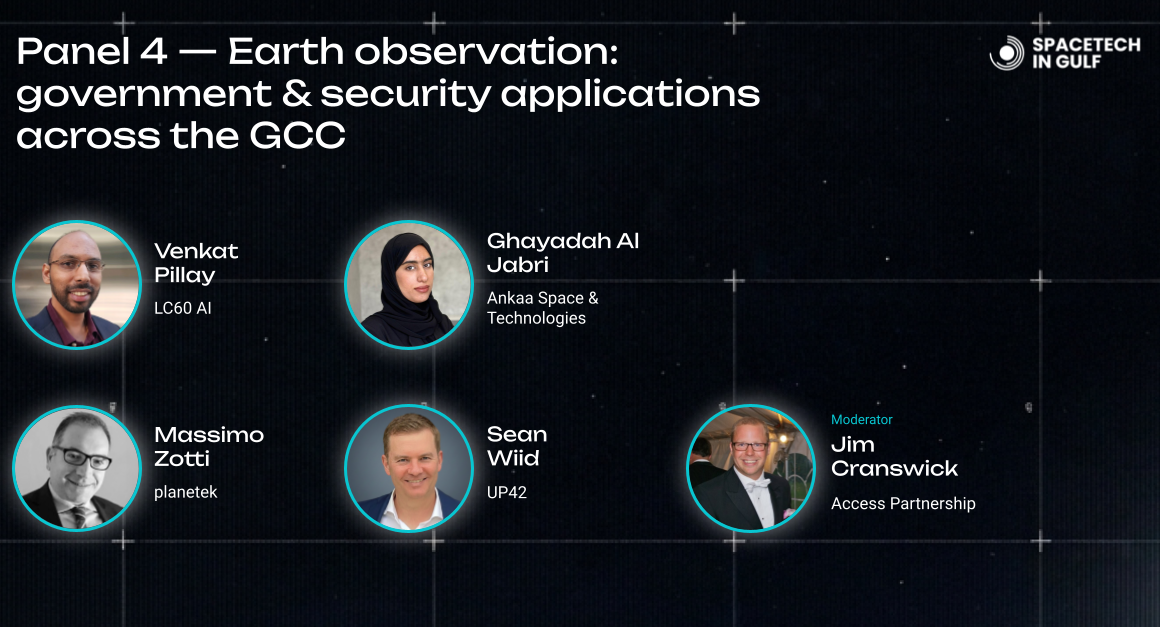
| Role | Name | Organisation |
| Moderator | Jim Cranswick | Access Partnership |
| Speaker | Massimo Zotti | Planetek Italia |
| Speaker | Ghayadah Al Jabri | Ankaa Space & Technologies |
| Speaker | Sean Wiid | UP42 / Neo Space Group |
| Speaker | Venkat Pillay | LC60 AI |
Full Transcript
Opening and Scene-Setting
[00:00] Alexei Cresniov:
Our first panel today is on Earth observation and security applications in the GCC. Jim, the floor is yours.
[00:13] Jim Cranswick:
Thank you very much, Alex. Good morning, good afternoon, good evening wherever you are. It’s a pleasure to moderate this panel with people who have worked across the industry for so long.
[00:32] Jim Cranswick:
Today we’ll talk about how Earth observation is being adopted across the GCC and what that means for sovereignty and resilience in an increasingly changing and conflicted world.
[00:53] Jim Cranswick:
Over the last few years we’ve seen Gulf countries move from EO customers to EO architects: launching satellites, building space agencies, investing in data, AI and local capabilities. The drive is to turn pixels into decisions and strengthen EO resilience without creating new dependencies or vulnerabilities.
[01:28] Jim Cranswick:
EO is no longer a niche tool. I’ve worked in geospatial and remote sensing for about 30 years, and I’ve seen it move from a siloed specialty to something used in decision-making from C-suite strategy down to operational deployments.
[02:42] Jim Cranswick:
Industry trends such as reusable rockets, cheaper launches, data centres and cloud computing allow us to process information quickly and shorten the decision cycle.
[03:22] Jim Cranswick:
We’ll frame the discussion around three themes: (1) Sovereignty — who controls the data and how it’s gathered; (2) Resilience — the difference between owning assets and having resilient control and access; (3) Acceleration — the impact of AI, and if time allows, orbital data centres and off-world processing. The session format: each panelist will introduce themselves, their company and initial views on those themes, then we’ll move into Q&A.
Introductions
[04:59] Jim Cranswick:
First, Massimo Zotti from Planetek, Head of Government and Security Strategic Business Unit. Massimo, over to you.
[05:13] Massimo Zotti:
Thank you, Jim, and thank you for the invitation. I’m Massimo Zotti, Head of the Government and Security Strategic Business Unit at Planetek Italia. Planetek is part of the wider GEOSAT/Planetek group ecosystem. Our group operates across the full space value chain: Earth observation, AI-driven geospatial intelligence and orbital infrastructure. When we say orbital infrastructure, we refer to onboard processing in space. We provide on-board processing and have delivered downstream services for government and defence users for more than 30 years. We’re investing strongly in the GCC region. Planetek operates a regional branch in the Gulf and recently established Deorbit Saudi, aiming to support development of local sovereign space capabilities. Our vision is to contribute to building a regional ecosystem through technology transfer, industrial cooperation, local capacity building and, in the longer term, satellite manufacturing and operational know-how within the GCC. We believe the region is moving from being a consumer of space services to becoming a global space actor in its own right.
[07:24] Massimo Zotti:
One of the most interesting developments we see is the transition from simply using EO data to building full intelligence capability. That means controlling the entire information chain: acquisition, secure transmission, processing, AI-based analytics and operational dissemination to government and security users. Across the region there is a strong focus on resilience, autonomy, rapid decision-making and trusted information flows. The GCC is in a unique position because it combines strategic ambition, strong institutional leadership and the ability to invest in long-term sovereign infrastructure.
[08:53] Massimo Zotti:
From a government and security perspective, the opportunity is enormous. EO is becoming part of the operational backbone for border security, maritime domain awareness, critical infrastructure protection, environmental resilience, disaster response and defence ISR. The key challenge is no longer simply accessing imagery. The real issues are latency, sovereignty and trust. Governments want to know where data comes from, who processes it, where it is stored, who can access it, and whether integrity can be guaranteed end-to-end. We see the evolution as a combination of sovereign EO architectures, AI-enabled analytics and on-orbit processing. Our group has launched four satellites with pre-operational onboard processing. Instead of sending huge raw data volumes to the ground, satellites become intelligent nodes that detect events, filter relevant information and trigger autonomous tasking, dramatically reducing the time from observation to decision. For government and defence users in the GCC this can create a major operational advantage.
[11:07] Jim Cranswick:
Thank you, Massimo. Next, Ghayadah Al Jabri from Ankaa Space, Head of Space Department.
[11:20] Ghayadah Al Jabri:
Thank you for inviting me to this panel. I am Ghayadah Al Jabri, Head of the Space Department at Ankaa. Ankaa is based in Oman and works across several sectors. In space we provide integrated solutions using Earth observation empowered by AI. We also run capacity-building programmes for companies, delivering lectures and workshops in space-related areas. We work with drone technologies and integrate Earth observation from drones and satellite imagery to provide end-to-end solutions. Our software development team delivers full platforms to support decision-making for clients. We have GIS and remote sensing teams for data processing from satellites and drones. We are proud to have run the OSAP space accelerator programme, graduating several companies in upstream and downstream areas. Many are working on Earth observation and even building or manufacturing rockets. Ankaa aims to improve its EO capabilities and AI-based data processing to serve government bodies with solutions in different domains.
[13:45] Jim Cranswick:
Thank you very much. I’ll now hand over to Sean, CEO of UP42 and EVP Global Marketplaces at NSG.
[13:52] Sean Wiid:
Thank you, Jim. My name is Sean Wiid. I’m here in two capacities: CEO of UP42 and EVP Global Marketplaces at Neo Space Group (NSG). UP42 was created in 2019 as a corporate venture under Airbus Defence and Space, with the goal of making commercial imagery easier to access — not only satellite imagery but also aerial and drone data. As we expanded, we realised that technical, commercial and contractual barriers to using commercial satellite data affect everyone, from startups to large enterprises and public authorities, including defence and intelligence customers. Today our platform includes about 80 providers — half data, half algorithms — with more than 300 datasets connected. Customers can, via console or API, access archive data or task satellites from multiple providers, which is critical for resilience.
[16:14] Sean Wiid:
In mid-last year UP42 was acquired by NSG, a PIF-owned company based in Riyadh. UP42 is headquartered in Berlin. We were acquired to support NSG in delivering the CST-mandated national Earth observation platform for Saudi Arabia. That platform, launched around March/April last year, provides the same technology as UP42 globally but deployed sovereignly in the Kingdom. It secures supply for critical government agencies and stimulates an ecosystem of companies that can use data for value creation and capacity building. For me, sovereignty means controlling access to assets and ensuring no one can unilaterally take away or see your data. Resilience means having multiple redundant assets; if one fails or becomes restricted, you have backups. Our sovereign platform in the Kingdom, staffed by Saudi nationals, connects multiple providers. In recent months some commercial providers applied restrictions over the region, but our customers still accessed data via other assets on the platform. This proves why a meta-operator platform is critical for sovereign resilience in space.
[19:23] Jim Cranswick:
Thank you, Sean. Lastly, Venkat Pillay, CEO and Founder of LC60 AI.
[19:35] Venkat Pillay:
Thanks, Jim, and good day to all. LC60 AI is a Western Australian company headquartered in Perth. We’ve been operating for seven years and have over 45 people. We are an Earth observation ‘lights’ provider and also operate our own EO constellation. We currently have two satellites with very-high-resolution shortwave-infrared (SWIR) sensor capability, with more going into orbit in 2027. We set out to tackle both ends of the EO value chain: generating novel datasets in orbit through novel sensors, and delivering last-mile downstream insights. We saw SWIR from space as underserved and developed capability there. On the downstream side, we focus on converting pre-processed EO data into actionable insights for users in agriculture, defence and resources. We concentrate on three ‘securities’: food security, climate security and defence & security.
[21:37] Venkat Pillay:
LC60 has delivered several AI products to government, particularly the Government of Western Australia, serving 13 departments with data from more than 30 satellite types (optical, infrared, SAR, SIGINT, hyperspectral, GNSS-R). Internationally we have a strong footprint in Southeast Asia and the Gulf. In Malaysia we work with the National Rice and Grain Agency, powering a smart farming app used by 125,000 farmers, where EO is invisible in the background and farmers simply receive advice on watering and fertiliser. In the Gulf we have a wholly owned subsidiary in Abu Dhabi working on next-generation SWIR sensors and platforms, plus a joint-venture in Saudi Arabia after being shortlisted for the Saudi SpaceUp Challenge. We take a balanced approach, building upstream capability where there is a data gap, and delivering last-mile downstream insights. On sovereignty and localisation, we embed source code and tech transfer into government workflows so that downstream analytics become fully autonomous in-country. On the upstream side we localise licensing, tech transfer and know-how around sensors and on-orbit compute, particularly in the Gulf.
Sovereignty, Resilience and AI
[26:10] Jim Cranswick:
We’ve heard the breadth of EO components and why the GCC is important. I want to stay on sovereignty and resilience a bit longer. Recent events have included slower access or temporary removal of services due to national interests, and we see AI and large models emerging in EO. Sean, you are uniquely placed between German heritage and a GCC-owned company — how do you see this?
[28:01] Sean Wiid:
First, commercial EO is a dual-use technology, whether we like it or not. Many argue for more open access, and there are good reasons for that, but there are also strong reasons to maintain control and be responsible with the data. Some commercial companies faced government-imposed restrictions, and there was backlash. Our view is that such controls exist for a reason; we must work with national governments to find the right approach. Resilience comes from having a platform that provides seamless access to multiple assets and constellations from different jurisdictions. If one country slows access, you are not blocked because you have options. We also work with providers to define conditions and customer types under which data access is allowed, ensuring an auditable, trusted chain of control and responsible use. If a reseller cannot protect the national interests of operators, they shouldn’t be in this business.
[30:05] Sean Wiid:
On AI, we’ve had algorithms on the platform from day one for tasks like feature extraction. Going forward, AI plays a bigger role across the stack: building models, foundational models, and changing how users interact with data. Some customers now interact with our platform mainly through agents or chat interfaces, asking about tasking status or data availability. This new interaction model makes EO more accessible and accelerates adoption. But there is a responsibility element. We’ve seen targeting systems driven by AI where mistakes had serious consequences. For high-impact use cases, we still need validation, security layers and often a human-in-the-loop.
[32:12] Jim Cranswick:
Venkat, from the perspective of a sensor-builder from outside the GCC, how do you view sovereignty and localisation?
[32:34] Venkat Pillay:
We’re trying to blur the line between non-GCC and GCC by shifting more design and development into the region. Basic tech transfer might be buying a sensor abroad and integrating it with a Gulf-built satellite; that already happens. We want to go further: design and development of sub-systems in a GCC country, with parts assembled or sub-assembled locally, creating resilience in sensor development itself. Assembling EO sensors requires decades of experience and the right talent, but we see willingness among experienced providers to work with LC60 teams based in the Gulf, using local clean rooms to assemble sensors. Local IP around how the sensor is packaged, spectral band selection and atmospheric science is important. It’s not only manufacturing; remote sensing science should also be localised. That’s what we’re actively working on in the Gulf.
[34:43] Jim Cranswick:
Ghayadah, related to sovereignty is the question of local skills. Which technical skills should GCC engineers focus on for the next phase of commercial space growth?
[35:32] Ghayadah Al Jabri:
Capacity building is highly needed. We see big gaps in EO data processing and image processing after acquisition, especially in computer vision. Engineers are needed who can write AI algorithms that run on satellites. Hyperspectral analysis also requires specialised physics-based machine learning to build signatures for specific uses. This is computationally expensive and needs advanced expertise. On small-sat manufacturing there is still heavy dependence on foreign components. During our accelerator we saw a company working on 3D printing rocket components — a good step to lower costs and support local manufacturing. We also need skills in space business and ecosystem management: strategic sourcing, procurement and managing complex international supply chains, plus technical experts to support newspace technologies. Cybersecurity for space-to-ground links and digital infrastructure is another area.
[37:48] Ghayadah Al Jabri:
Overall, EO data processing and analytics are the most urgent needs now, especially for environmental applications where demand for processing and analysis is high. From running accelerators we learned that technology is often ready, but securing contracts and market maturity are the big challenges. There is a lack of awareness of space data usage among government bodies and the wider market. Governments are investing in capacity building and awareness, but readiness of the market and contract security remain difficult parts of doing business.
Orbital Data Centres and End-to-End Sovereignty
[40:12] Jim Cranswick:
We have about five minutes left, so I’d like to indulge one topic I’m very interested in: orbital data centres and large-scale on-orbit processing. Massimo, how do you see this affecting the industry and users?
[41:15] Massimo Zotti:
We’ve been talking about this concept for decades, and now we actually have four satellites in orbit with this capability, with more coming. Planet’s new constellations also demonstrate onboard analysis. This reduces time to information but changes the paradigm. If we accept analytics directly from satellites within minutes, we must also accept that we might not get the images themselves — we must trust on-board AI. That raises questions similar to what Sean mentioned: can we fully trust AI, or do we need human control? There are many issues to discuss. Owning sovereign assets is another layer of access. Sovereignty isn’t just about data; it’s about priority tasking, operational independence, protected information flows, mission customisation and national control of the intelligence cycle. Our group strategy is relevant because we span the whole value chain: orbital infrastructure, onboard computing, EO exploitation, AI analytics, secure dissemination and decision support. We can help countries not just consume EO services but progressively build sovereign, end-to-end capabilities. The key transition in the space sector is moving from buying images to building resilient, sovereign intelligence infrastructure.
Closing
[44:12] Jim Cranswick:
That’s a great way to close. When I agreed to moderate, I wondered how we’d fill 45 minutes; in reality we could have talked for days, especially with such knowledgeable panelists working deeply in EO and across the GCC. I’d like to thank Venkat, Massimo, Ghayadah and Sean for their time, and Alex for organising and bringing us together. The future for Earth observation in the GCC is certainly very exciting.
[45:05] Panel:
Thank you.
Panel Summary
Panel 4 explored the rapidly evolving role of Earth observation in government and security applications across the GCC. Moderated by Jim Cranswick (Access Partnership), the session brought together experts from Planetek Italia, Ankaa Space, UP42/NSG, and LC60 AI to examine three core themes: sovereignty, resilience, and the acceleration of EO capabilities through AI and orbital data centres.
1. The GCC’s Transformation — From EO Consumer to EO Architect
- Jim Cranswick framed the key shift: GCC countries are no longer just buying EO services — they are launching satellites, building space agencies, investing in AI, and developing local capabilities.
- The goal is to ‘turn pixels into decisions’ — embedding EO into operational decision-making from C-suite strategy down to field deployments.
- Industry tailwinds — reusable rockets, cheaper launches, cloud computing — are dramatically shortening the decision cycle and making EO accessible at scale.
- Massimo Zotti (Planetek): EO is becoming the operational backbone for border security, maritime domain awareness, critical infrastructure protection, environmental resilience, disaster response and defence ISR.
2. Sovereignty — Controlling the Full Intelligence Chain
- Massimo Zotti: The real issues are no longer access to imagery — they are latency, sovereignty and trust. Governments demand to know where data comes from, who processes it, where it is stored, and who can access it.
- Sean Wiid (UP42/NSG): Sovereignty means controlling access to assets and ensuring no one can unilaterally restrict or access your data. UP42’s Saudi national EO platform — deployed sovereignly in the Kingdom and staffed by Saudi nationals — proved this model works: when commercial providers applied regional restrictions, Saudi customers maintained access via other providers on the platform.
- Venkat Pillay (LC60 AI): Sovereignty goes beyond data — LC60 embeds source code and tech transfer into government workflows, enabling fully autonomous in-country analytics. On the upstream side, localising sensor design, spectral band selection, and atmospheric science is equally important.
- Planetek recently established Deorbit Saudi — a regional entity to support local sovereign space capabilities through technology transfer, industrial cooperation, and local capacity building.
3. Resilience — Multi-Asset, Multi-Jurisdiction Platforms
- Sean Wiid: Resilience requires access to multiple redundant assets from different jurisdictions. A meta-operator platform (like UP42) that connects 80+ providers across 300+ datasets ensures no single political decision can block access.
- Commercial EO is inherently dual-use — responsible data governance and auditable chains of control are essential for any reseller operating in sensitive regions.
- Venkat Pillay: Resilience in sensor development itself is the next frontier — designing and assembling EO sensors in-country using local clean rooms, rather than full dependence on foreign-manufactured components.
- Ghayadah Al Jabri (Ankaa Space): Ankaa integrates EO from satellites and drones into end-to-end decision-support platforms, and runs the OSAP space accelerator — graduating companies in upstream and downstream EO applications.
4. AI in EO — Acceleration and Responsibility
- AI is reshaping how users interact with EO platforms — from feature extraction algorithms to conversational interfaces and agent-based tasking. Sean Wiid noted that some UP42 customers now interact entirely via chat interfaces.
- Massimo Zotti: Planetek has launched four satellites with pre-operational onboard processing. Satellites become intelligent nodes — detecting events, filtering relevant data, and triggering autonomous tasking — dramatically reducing observation-to-decision latency.
- Critical caution: AI-driven targeting systems have caused real-world harm when errors occurred. For high-impact defence and security use cases, human-in-the-loop validation remains essential.
- Ghayadah Al Jabri: The GCC urgently needs engineers skilled in computer vision, physics-based machine learning for hyperspectral analysis, and AI algorithms that can run onboard satellites. These are the most critical capability gaps today.
5. Orbital Data Centres — The End-to-End Sovereign Future
- Massimo Zotti: Onboard processing is no longer theoretical — Planetek has four satellites with this capability in orbit today, with more planned. Planet’s new constellations are also demonstrating the model.
- The paradigm shift: accepting AI-generated analytics from orbit within minutes means governments must trust on-board AI — raising profound questions about validation, accuracy, and human oversight.
- True sovereignty in EO is not just about owning data — it encompasses priority tasking, operational independence, protected information flows, mission customisation, and national control of the full intelligence cycle.
- Planetek’s strategy spans the entire value chain: orbital infrastructure → onboard computing → EO exploitation → AI analytics → secure dissemination → decision support. This positions them to help GCC nations build complete sovereign EO architectures.
6. Skills & Capacity Building
- Ghayadah Al Jabri identified the most urgent skill gaps: EO data processing, computer vision, AI for satellites, hyperspectral analysis, space business management, supply chain management, and cybersecurity for space-ground links.
- A key insight from running Ankaa’s OSAP accelerator: technology is often ready, but market awareness among government bodies and contract security remain the biggest barriers for EO startups.
- 3D printing of rocket components — observed in the OSAP programme — was highlighted as a promising route to reducing dependence on foreign components for small-sat manufacturing.
Key Takeaway: The GCC is at a pivotal inflection point in Earth observation — transitioning from buying images to building sovereign intelligence infrastructure. The combination of AI-enabled onboard processing, multi-asset resilience platforms, and deep tech transfer into local ecosystems represents the most credible pathway to genuine EO sovereignty. The region’s strategic ambition, institutional strength, and investment capacity make it uniquely positioned to lead this transition — but urgent investment in local talent, particularly in AI, computer vision, and onboard systems engineering, is the critical enabler.
GCC Space & Security Online Conference 2026 | Organised by SpaceTech in Gulf | www.spacetech-gulf.com | alex@spacetech-gulf.com