



Participants
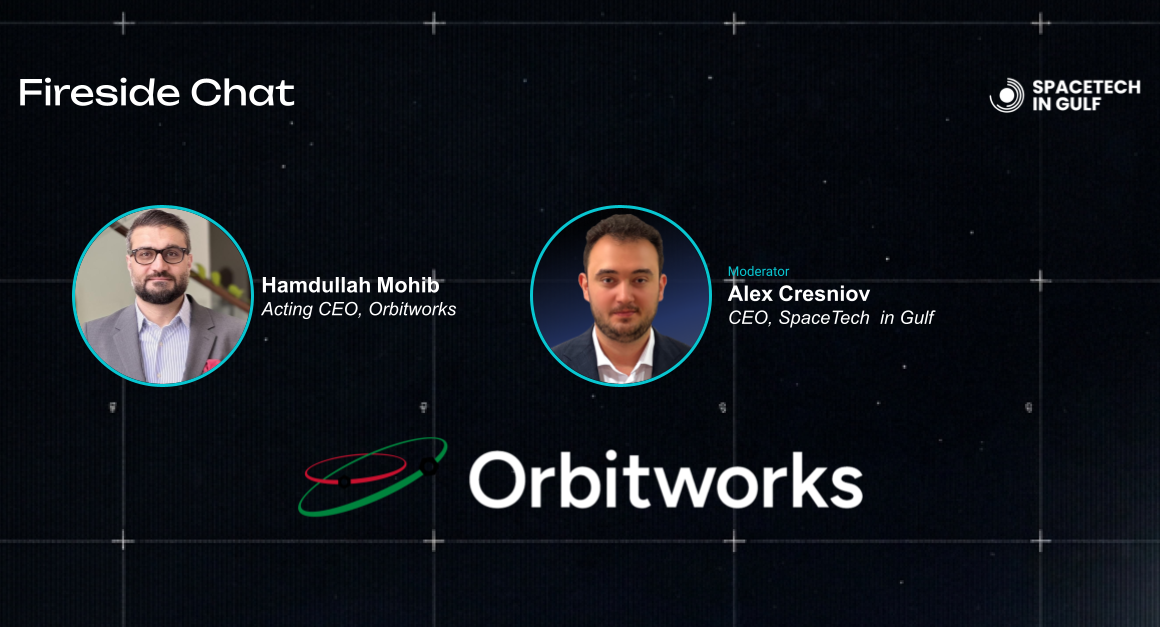
| Role | Name | Organisation |
| Moderator | Alex Cresniov | SpaceTech in Gulf |
| Guest | Hamdullah Mohib | Orbitworks |
Full Transcript
Opening and Context
[00:00] Moderator (Alex Cresniov):
Thanks Dr Mohib for joining and for Orbitworks’ support of the event and the next panel. Most attendees are not from the region, so the first request is for an introduction to Orbitworks and its activities in the region. Orbitworks is described as the region’s first and only commercial satellite manufacturer, focused on satellite production, partnerships and local talent development.
Orbitworks Introduction
[01:36] Hamdullah Mohib:
My name is Hamdullah Mohib and I’m the CEO of Orbitworks, the region’s first commercial satellite integrator, based in Abu Dhabi’s KIZAD commercial zone, roughly equidistant between Abu Dhabi and Dubai. The location was chosen to make it easier for staff and partners to live and commute. Orbitworks inaugurated its facility in November last year.
[02:16] Hamdullah Mohib:
The company is finalising its first satellite, due for launch in October, as part of a 10-satellite constellation Orbitworks is building itself. Orbitworks also aims to work with other partners in the region and globally to build bespoke satellites and payloads. They have already signed several customers who want custom satellite integration and testing. The constellation is a multi-sensor system with on-board compute designed to solve problems in the immediate region and beyond, including Europe and Southeast Asia.
Why the UAE Backed Orbitworks
[03:21] Moderator (Alex Cresniov):
Why did the UAE invest in and support Orbitworks?
[03:31] Hamdullah Mohib:
The UAE has long aimed to diversify its economy from oil into advanced industries. Space is one of the areas where the UAE wants to become an export hub. There has been significant effort since the 1990s, so Orbitworks is not starting from scratch. It is building on work by institutions such as Mohammed bin Rashid Space Centre and NSSTC, as well as universities like Khalifa University, NYU Abu Dhabi, Abu Dhabi University and Sharjah University. The ecosystem and environment created by these actors enabled the next step: commercialisation and the creation of a commercial manufacturing ecosystem. Orbitworks is a natural entrant focused on satellite manufacturing and exports from Abu Dhabi.
Manufacturing Capability and Facilities
[05:04] Moderator (Alex Cresniov):
Tell us more about your manufacturing capabilities and annual capacity.
[05:16] Hamdullah Mohib:
Orbitworks has built for scale and can manufacture up to 50 satellites per year. It is starting with the first 10-satellite constellation, with plans to scale as local and international customers come on board. The site includes full integration and testing facilities and a large 15,000-square-foot cleanroom, plus a full test facility capable of testing satellites up to around 800 kg.
[06:09] Moderator (Alex Cresniov):
Many attendees work in satellite manufacturing, so they could partner with Orbitworks and use the facilities to test their own satellites.
[06:15] Hamdullah Mohib:
Orbitworks is, to my knowledge, the only such facility in the region. Universities and other players building small satellites usually send them abroad for testing, and Orbitworks is happy to offer local testing services.
Partnerships and Customers
[06:34] Moderator (Alex Cresniov):
You’ve signed several partnerships in the last six months, including with CNES and local UAE organisations such as Abu Dhabi Ports. Why are these important?
[07:34] Hamdullah Mohib:
As an integrator, Orbitworks’ role is to provide upstream services to organisations in the UAE that want to build capabilities. Many partners have mid-stream and downstream services, while Orbitworks provides the upstream manufacturing and integration. One partnership is with FADA to help build and integrate the SER SAR payload, which will be integrated and tested at Orbitworks.
[08:15] Hamdullah Mohib:
Through the Alter constellation, Orbitworks provides Earth-observation services using multiple sensors — optical, hyperspectral, thermal, short-wave infrared and RF antennas — plus onboard compute. Orbitworks is providing EO services to the Abu Dhabi Fund for Development (ADFD), which will use satellite data to monitor and track its development projects globally. Currently, ADFD does inspections manually by sending people to remote sites; satellite imagery will help them track progress, assess impact on communities and decide which projects to expand.
[09:37] Hamdullah Mohib:
Another contract is with Abu Dhabi Maritime Academy, which wants to understand the origins and routes of shipments. Alter will help them track the full journey of cargo from mineral suppliers to arrival in Abu Dhabi, improving visibility into supply chains and maritime efficiency. Orbitworks also has a partnership with CNES, which will use the Alter constellation for French services. This is significant because it shows a constellation built in Abu Dhabi being used by a sophisticated European space actor, validating that Orbitworks’ technology is at the forefront of current capabilities and supporting its export ambitions.
Export Projects and Competition
[11:44] Moderator (Alex Cresniov):
The CNES project seems to be the first of its kind from the region to such an external customer. Are there similar projects on the horizon?
[12:11] Hamdullah Mohib:
Orbitworks is talking to other governments who will also use the Alter constellation. Discussions are at various stages, but the goal is to provide services in an already crowded global EO market. The company is entering a saturated market with established, respected competitors. That makes the journey challenging, but Orbitworks focuses on the unique value it adds, especially through multi-sensor capabilities and on-board processing tailored to regional decision-making needs.
Challenges for the UAE Space Ecosystem
[13:09] Moderator (Alex Cresniov):
What challenges do you see in the UAE that either slow or support space-industry evolution?
[13:31] Hamdullah Mohib:
The industry is new, and Orbitworks is trailblazing in many ways. Globally there are established players with strong reputations and networks, so building a new marketplace is challenging. When designing the Alter constellation, Orbitworks studied the market and chose a multi-sensor system with on-board compute to add clear value, especially where decision time is critical — for maritime security, border security and disaster response. The aim is to deliver information within minutes rather than hours. Satellites will not replace detailed ground-based image analysis, but they can provide rapid, critical insights when time can be lifesaving. Orbitworks is entering a competitive market but introducing a product aligned with current needs that addresses problems many countries and organisations face, effectively carving out its own niche.
Emirati Talent and Capability Development
[16:00] Moderator (Alex Cresniov):
How do you see talent development in the region, particularly Emirati talent? Are people ready to work on satellites or is there still heavy reliance on international support?
[16:35] Hamdullah Mohib:
The UAE started early, so there is already significant talent in satellite operations. Operators such as Yahsat and Thuraya have been active for decades, and Mohammed bin Rashid Space Centre has been building bespoke satellites for government use. Universities and the NSSTC research centre have also built capabilities. Orbitworks recruits from all of these institutions. Many recruits have experience, though perhaps not yet at commercial-scale operations, but enough to get started and then build on. Part of Orbitworks’ mission is to enhance the talent pool and contribute to the ecosystem by training new specialists who can later build capabilities elsewhere in the sector. It is the beginning for Orbitworks, but not for the UAE space industry as a whole.
Use of Alter Beyond Traditional EO
[18:04] Moderator (Alex Cresniov):
A chat question asks how Alter can be used beyond traditional Earth observation, for example in border security, maritime awareness, infrastructure monitoring, environmental risk and other areas.
[18:23] Hamdullah Mohib:
Many satellite manufacturers and constellation operators focus on defence customers and their own ministries of defence, which can limit attention to other commercial and civilian use cases. As shown with ADFD and Abu Dhabi Maritime Academy, it is not only defence ministries that need satellite services. Satellites are becoming more powerful and able to address problems that previously were not even considered.
[19:38] Hamdullah Mohib:
For border security, being able to identify what is approaching — whether animal migration, human migration or hostile forces — allows deployment of appropriate responses. Environmental applications include agriculture, disaster and weather monitoring. Farmers often use satellite data without realising its origin, and satellites play a key role in tracking environmental change and extreme events. Municipalities use satellite services for city planning, maintaining services and monitoring illegal settlements. Applications are limited only by imagination.
[21:19] Hamdullah Mohib:
With onboard compute, Alter aims to become an ‘app store in the sky’. Customers can run their own applications on the constellation’s sensors, and Orbitworks is open to helping develop those applications. As understanding grows, customers are increasingly approaching Orbitworks with specific problems and asking whether satellites can solve them — a shift from basic questions like ‘how are you different from Starlink?’ to more sophisticated use-case discussions.
[22:37] Hamdullah Mohib:
The constellation name ‘Alter’ references the Altair computer for which Microsoft wrote BASIC, marking a pivotal moment when personal computing opened space for new applications. Orbitworks hopes Alter will similarly enable more customers to imagine and use satellite services. Technically, short-wave infrared can detect shapes, hyperspectral imaging can detect gas leaks, oil spills, fumes, mines and maritime issues, thermal imagery detects heat from humans and animals, and optical cameras provide visual imagery. Combined, these sensors can address problems we can only partially imagine today.
Partnerships with Regional EO Companies
[24:34] Moderator (Alex Cresniov):
In a region where many Earth-observation companies are emerging and seeking clients, what is your message to them? Would Orbitworks be interested in partnering, and how could that work?
[25:19] Hamdullah Mohib:
From the outset, Orbitworks’ model has been based on partnerships and complementary services. As an upstream provider, the company can help EO firms build constellations and satellites and work together on payloads and testing. Orbitworks offers its platform to anyone wanting to expand services in space. Collaboration is part of its DNA. The company itself began as a joint venture with Loft Orbital, chosen deliberately to signal a partnership-oriented approach rather than standing alone. Joint ventures and collaboration help complement capabilities and advance the objective of turning the UAE into a space hub.
Closing
[26:50] Moderator (Alex Cresniov):
Thanks Dr Mohib for this conversation and for your time.
[26:57] Hamdullah Mohib:
Thank you for having me, and thanks for organising this important conference.
Fireside Chat Summary
This fireside chat between Alex Cresniov (SpaceTech in Gulf) and Hamdullah Mohib (CEO, Orbitworks) explored the GCC’s emergence as a space power through the lens of Orbitworks — the region’s first commercial satellite integrator. The conversation covered Orbitworks’ manufacturing capabilities, partnerships, use-case vision for the Alter constellation, talent development, and the company’s ambition to make Abu Dhabi a global satellite manufacturing and export hub.
1. Orbitworks — The Region’s First Commercial Satellite Integrator
- Orbitworks is based in Abu Dhabi’s KIZAD commercial zone — equidistant between Abu Dhabi and Dubai — with a facility inaugurated in November 2025.
- The company is finalising its first satellite for launch in October 2026, as part of a self-built 10-satellite Alter constellation. It has already signed multiple customers for bespoke satellite integration and testing.
- Orbitworks is not starting from scratch — it builds on decades of UAE investment in space institutions including Mohammed bin Rashid Space Centre, NSSTC, Khalifa University, NYU Abu Dhabi, and Sharjah University. Orbitworks represents the commercialisation phase of a long institutional journey.
- The company began as a joint venture with Loft Orbital — a deliberate signal that partnership and collaboration are central to its model, not an afterthought.
2. Manufacturing at Scale — A First for the Region
- Orbitworks can manufacture up to 50 satellites per year — a scale capacity unique in the region.
- Facilities include a 15,000 sq ft cleanroom and a full test facility capable of testing satellites up to approximately 800 kg.
- Orbitworks is the only such facility in the GCC — universities and other players currently send satellites abroad for testing. Orbitworks is actively offering local testing services to regional partners.
- The facility is open to partners — any organisation building satellites or payloads in the region can use Orbitworks’ integration and testing infrastructure.
3. The Alter Constellation — Multi-Sensor, Onboard Compute
- Alter is a 10-satellite multi-sensor EO constellation combining optical, hyperspectral, thermal, shortwave infrared (SWIR), and RF antenna capabilities — with onboard compute for in-orbit processing.
- The design philosophy: deliver actionable intelligence within minutes, not hours — especially for time-critical applications in maritime security, border security, and disaster response.
- The name ‘Alter’ references the Altair computer — the machine for which Microsoft wrote BASIC and which democratised personal computing. Orbitworks hopes Alter similarly opens satellite services to users who previously could not access or imagine them.
- Technical capabilities by sensor: SWIR detects shapes and heat signatures; hyperspectral detects gas leaks, oil spills, fumes, mines and maritime issues; thermal detects humans and animals; optical provides visual imagery. Combined, they address problems that are still being imagined.
4. Key Partnerships — From Government to European Space Agencies
- FADA: Orbitworks is integrating and testing the SER SAR payload for FADA’s SARB programme — a concrete example of UAE sovereign capability development flowing through commercial infrastructure.
- Abu Dhabi Fund for Development (ADFD): Using Alter to monitor and track development projects globally — replacing manual field inspections with satellite data to track progress, assess community impact, and prioritise project expansion.
- Abu Dhabi Maritime Academy: Using Alter to track cargo shipments from source to arrival in Abu Dhabi — improving supply chain visibility and maritime efficiency.
- CNES (French Space Agency): Orbitworks’ most significant external validation — a major European space actor using the Alter constellation for French services. This confirms the technology is at global frontier standards and directly supports Orbitworks’ export ambitions.
- Multiple government discussions ongoing for use of the Alter constellation — at various stages of negotiation.
5. Beyond Traditional EO — The ‘App Store in the Sky’ Vision
- Orbitworks explicitly targets civilian and commercial use cases beyond defence ministries — a deliberate differentiation from most constellation operators.
- With onboard compute, Alter is designed as an ‘app store in the sky’: customers can deploy their own applications on the constellation’s sensors — enabling use cases that do not yet exist.
- The maturity of customer conversations is increasing: from ‘how are you different from Starlink?’ to specific problem statements — a positive signal of growing ecosystem understanding.
- Applications identified: agriculture monitoring, disaster and weather tracking, city planning, illegal settlement detection, border security (human/animal/hostile force detection), environmental monitoring (gas leaks, oil spills), maritime supply chain tracking.
6. Talent Development — Building on Strong Foundations
- The UAE has an existing talent base in satellite operations — built through decades of work at Yahsat, Thuraya, MBRSC and NSSTC. Orbitworks recruits directly from these institutions.
- Orbitworks’ talent mission: train new specialists who can build capabilities not only at Orbitworks but across the broader UAE space ecosystem — multiplying the sector’s human capital.
- The framing is important: it is the beginning for Orbitworks, but not for the UAE space industry. The commercial era is launching from a solid institutional foundation.
Key Takeaway: Orbitworks embodies the answer to the fireside chat’s central question — ‘Where does the GCC stand as a space power?’ The answer is: building real infrastructure, at commercial scale, with international validation. A 15,000 sq ft cleanroom, 50 satellites/year capacity, a CNES partnership, and an ‘app store in the sky’ vision powered by multi-sensor onboard compute represent a qualitative leap from the region’s previous role as a space customer. The GCC is no longer asking whether it can build satellites. Orbitworks is already building them.
GCC Space & Security Online Conference 2026 | Organised by SpaceTech in Gulf | www.spacetech-gulf.com | alex@spacetech-gulf.com