


Speakers
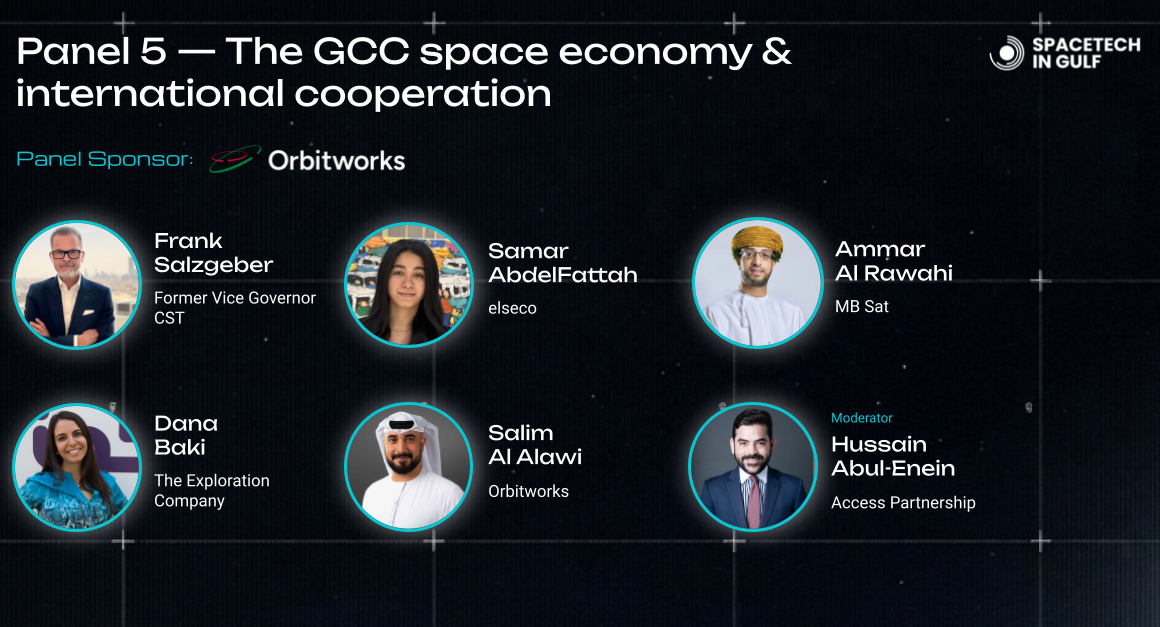
| Role | Name | Organisation |
| Moderator | Hussain Abul-Enein | Access Partnership |
| Speaker | Frank Salzgeber | Former Vice Governor, CST |
| Speaker | Salim Al Alawi | Orbitworks |
| Speaker | Dana Baki | The Exploration Company |
| Speaker | Samar AbdelFattah | elseco |
| Speaker | Ammar Al Rawahi | MB Sat |
Full Transcript
Opening and Objectives
[00:00] Host:
Our next panel is on the GCC space economy and cooperation, sponsored by Orbitworks. Hussain, the floor is yours.
[00:17] Hussain Abul-Enein:
Thank you very much, Alexei, and good morning, good afternoon or good evening depending on where you are joining us from. A very warm welcome to Panel 5, titled ‘The GCC space economy and international cooperation.’ The GCC space economy has taken a significant leap forward in the last few years. It’s not just about growth speed, but also how the GCC cements its place as a key player in the international space economy.
[01:15] Hussain Abul-Enein:
Today we will focus on two questions: How can we continue to expand the GCC space economy? And how can we boost international cooperation, public and private, in ways that help achieve national ambitions and cement the region’s role? Space is no longer a niche sector. National competitiveness is increasingly judged by strength across the space ecosystem. Many countries are turning to bilateral relationships and multilateral institutions to grow their share of the global space economy.
[02:02] Hussain Abul-Enein:
Over the next 40 minutes, with this stellar panel, we’ll discuss how the GCC moves from participation to a sovereign, commercially viable and internationally influential role. I’m pleased to be joined by Frank Salzgeber, former Vice Governor at the Communications, Space and Technology Commission (CST); Salim Al Alawi, Business Development Director at Orbitworks; Dana Baki, Chief Commercial & MENA Officer at The Exploration Company; Samar AbdelFattah, space client advocate at elseco; and Ammar Al Rawahi from MB Sat.
Global Partnerships and National Priorities
[05:40] Hussain Abul-Enein:
By 2035 the global space economy is projected to reach more than 1.8 trillion US dollars. GCC countries are partnering with the US, Europe, Japan and others. The strategic question is: how do these partnerships build sovereign capability rather than long-term dependencies? Frank, you’ve been very active in this area. As GCC governments deepen partnerships, how can they align relationships with national priorities and long-term capability building?
[06:38] Frank Salzgeber:
Salam alaikum to everybody. It’s a great question. Partnerships can be seen at several levels: government-to-government, agency-to-agency and industry-to-industry. Looking at Saudi Arabia, for example, we’re moving from around 5,000 jobs in the space sector to 26,000–27,000 by 2035, with sector growth of roughly 12–17 percent depending on whether you count jobs, GDP or revenue.
[07:20] Frank Salzgeber:
With big agencies, collaboration is mostly in R&D and multilateral forums such as ITU and UN bodies. But if we want to build an economy, we must work on talent. In KSA five universities now have aerospace programmes, 2,000 scholarships will be offered, and 200,000 school kids will be trained. To reach localisation targets of 60–67 percent, you need the right regulation and investment. Partnerships are therefore also strongly business-driven. Each GCC country has different aspects, but you must look where the customer is and how to serve them.
[08:24] Frank Salzgeber:
CST’s regulatory approach is important. Many large markets have vertically integrated space companies that create closed markets. The GCC — and KSA in particular — does not have legacy incumbents blocking new entrants. That’s an advantage, because you can set things up from scratch. At CST we opened the market, because smart applications will come from people we do not know yet. You need the right developer toolkits and platforms. That’s why CST awarded NSG/UP42 a ‘natural monopoly’ role to break vertical integration. Vertical integration is great when you build launchers; for most other parts of the value chain it’s a problem. You need a free market and deregulation until the market grows, as we saw in telecoms. Space is similar — space is business.
[09:53] Frank Salzgeber:
In the GCC we’re not trying to move existing headquarters from elsewhere; rather we focus on co-working, co-location and real partnerships. Regulators here play both coach and judge. CST has a digital sandbox for space and ideas for a high-altitude platform sandbox. First we must develop the market, then regulate it. My philosophy is: start, change, and hammer a dent into the universe — the rest will follow. Competition is good and healthy. Space is now the front line of national security and sustainable development, not just the ‘final frontier.’ You must be proactive and ambitious.
[09:53] Hussain Abul-Enein:
I really like how you broke partnerships into sub-themes and emphasised vertical integration and the regional dimension. Personally, I’d like to see a common GCC space economy one day.
Infrastructure, Development and Collaboration
[11:28] Hussain Abul-Enein:
Salim, do you agree with Frank? Where can international cooperation most realistically build local GCC capability, and do you have examples from the UAE or elsewhere?
[11:57] Salim Al Alawi:
Thank you for having me. I agree with Frank. Space is by design a collaborative environment. The ISS is a clear example of countries working together, with research institutes and multiple sectors benefiting from the science done there. We’ve barely scratched the surface of what we can do in space. Each segment of the supply chain needs its own development and has its own value chain. Before talking regulation, we should talk about development.
[12:33] Salim Al Alawi:
Development starts with infrastructure, not just individual solutions. At Orbitworks we decided to start with infrastructure building — the capacity to manufacture satellites at scale, which is unique in the region because it’s driven by private investment. We’re building manufacturing capacity and a constellation under the ‘Altar’ programme, with plans to expand. The aim is to enable other space players to develop their own solutions without owning the assets, lowering the barrier to entry. Companies can develop software or payload capabilities and test, deploy and commercialise them using someone else’s space infrastructure. If someone wants to put their first payload in orbit, they don’t need to know how to build a satellite — they define the required capabilities and we handle the rest.
[14:54] Salim Al Alawi:
Regionally we see Oman investing in launch services, the UAE building manufacturing capacity, and Saudi Arabia focusing on downstream capabilities. This is the right approach: no one can invest in everything at once, so each country should understand its position in the journey and invest sustainably based on commercial viability. When newspace became active around five years ago, it changed how vertically integrated companies operated. Venture capital started investing in space, betting on profitability. The growth we saw in the last 50 years will likely be surpassed tenfold in the next 50 years because of new commercial vehicles.
[17:31] Frank Salzgeber:
We must distinguish science and business. Science is collaborative; the rest is business, and space business is brutal.
Making Partnerships Commercially Meaningful
[17:40] Hussain Abul-Enein:
Dana, from the Exploration Company side, what makes a space partnership commercially meaningful, and how does it tie into Frank’s and Salim’s points about ROI and anchor customers?
[18:54] Dana Baki:
You have to look from both a company and country perspective. It starts with GCC countries deciding which programmes they want to lead and which capabilities they want to hold sovereign. Once that is clear, they need programmes where they act as anchor clients for commercial companies. International partners can then work with local capabilities and phase in transfer of science, technology and development in-country. The government funding acts as an anchor, but it cannot be the only customer. Whatever is developed must be commercially viable globally — either sold to industry, used in barter with other countries or sold to other governments. In most cases a purely national demand base cannot sustain a company indefinitely. So governments should put in the first dollars, bring in trusted partners aligned on building local capability, and work towards business models that can scale elsewhere.
[22:03] Hussain Abul-Enein:
Frank, you wrote in the chat that ‘the best partner starts without a first contract.’ What do you mean?
[22:20] Frank Salzgeber:
I was on the selection board when The Exploration Company got its first 50k from ESA. You need partners who are willing to start without an anchor customer. Companies like Astroscale or operators entering KSA come with full commitment. If a ‘hunting dog’ only runs when carried into the forest, it’s not the partner you need. We see many proposals that demand big contracts and offsets upfront; those are not the partners we’re looking for. We need partners who run on their own and share the risk.
[23:10] Dana Baki:
I agree. When I said we need the right partners, I meant those with aligned goals in building local capability, not just chasing government money. But governments still need to support them so they can justify expansion to their boards. It’s a dance: partners show commitment without waiting for everything to be guaranteed, and governments provide enough clarity and support to make the move rational.
[24:15] Hussain Abul-Enein:
Ultimately, governments should show long-term plans so investors and companies know there will be a mature market in 10–15 years. Products, even sovereign ones, should have use cases elsewhere with customisation.
From Customer to Partner: GCC Governments and Sovereignty
[24:57] Hussain Abul-Enein:
Ammar, how can GCC governments navigate sensitive sovereign needs while building dual-use cooperation with private companies and foreign governments, moving from customer to partner?
[25:37] Ammar Al Rawahi:
If we look back a decade, GCC governments largely behaved as customers, seeing space as an add-on technology. Space is inherently international. Over the last five years most GCC countries realised that international cooperation and partnership is a must for quick wins in knowledge transfer, localisation and talent development. I liked Frank’s and Dana’s synergy. International partners will find it difficult to come to the region without any contracts, but at the same time the GCC is now a very attractive and promising area globally. The key is for international partners to see real appetite and commitment from governments to move from being mere customers to genuine partners — whether as offtakers, investors or talent-development partners.
Sovereignty, Risk and the Insurance Lens
[28:00] Hussain Abul-Enein:
Samar, elseco sits in the finance and insurance ecosystem. From your vantage point, how does sovereignty evolve as the region moves beyond simply owning assets to also managing risks and meeting international obligations under cooperation agreements?
[29:26] Samar AbdelFattah:
It has been interesting to listen and observe — that’s part of what we do in insurance. I wouldn’t say the GCC is moving away from owning assets; rather, it has designed a unique entry point into a highly competitive industry for new players. This entry point emerged due to visible shifts in the global industry. One is the move from purely government- and defence-driven activities to a more commercial, private-sector-led space economy. Another is technical: breakthroughs in launch, especially reusable vehicles such as Falcon 9 since 2015, have dramatically increased access to space and reduced launch costs. Other players — Blue Origin, Rocket Lab and Chinese firms — are following.
[30:34] Samar AbdelFattah:
These changes make asset ownership more accessible and open new entry points, which is a massive opportunity for the GCC. The region has done well in the penetration stage by preparing infrastructure for regional operations and enabling global operations. For private companies globally, government or defence contracts provide an ethical and financial guarantee to scale technology and business. The GCC has shown a strong, unique proposition by building infrastructure and leveraging its history of constructing smart, sustainable systems from scratch. As underwriters we insure global assets. We’ve seen significant progress in the region, led by national projects and new players like Orbitworks and others building assets. Insurers must be close to such projects early, to understand the vision and supply chain and assess risk fairly.
Launch, Regulation and the Omani Experience
[36:24] Hussain Abul-Enein:
Let’s shift to stimulating growth beyond cooperation. Etlaq Spaceport in Oman is positioning itself as a commercial launch site for the Gulf. Salim, what key commercial and regulatory conditions will help such launch sites grow and attract customers?
[37:19] Salim Al Alawi:
It all starts with vision. Space is collaborative, and you need to know what you’re asking for. You will procure technologies from around the world, so you must understand which adjacent segments you want to develop and build larger collaborations from the outset. Capacity building of this kind requires international cooperation, patience to build talent and market, and the right knowledge to create differentiated services — whether in launch or other areas. The goal is not to copy existing global services solely for sovereignty, but to build knowledge and then develop differentiated offerings that are globally competitive and sustainable as businesses.
[38:55] Hussain Abul-Enein:
Ammar, your response from an Omani perspective?
[39:04] Ammar Al Rawahi:
When we developed the space policy and strategy, the focus was to give investors opportunities in upstream and to energise entrepreneurs downstream. Oman has strong infrastructure — well-connected east-west via more than 20 submarine cables — making it a good base for downstream quick wins. Since the national space programme launched in 2020, growth has been rapid, supported by an established regulatory framework. GCC countries generally have strong regulatory regimes, which incentivise private sector participation and complement government efforts. Etlaq Spaceport is a good example: a purely private-sector investment facilitated by government, identified as an opportunity in Oman’s space policy. Similarly in satellite communications, MB Sat — a private operator — is filling a gap before the government’s sovereign satellite launches around 2028–2029. Private sector complements government and helps attract international partners once the ecosystem takes shape.
Making the Region Even More Attractive
[42:27] Hussain Abul-Enein: Dana, beyond strategy, policy and regulation, how can the region become even more attractive for companies like yours?
[42:49] Dana Baki:
It all starts with a project. If you build it, they will come. For example, The Exploration Company is building a vehicle and testing it in the UAE. As we work, we learn what is available locally and what isn’t, identify gaps in suppliers and talent, and feed that back to agencies and universities: here are ecosystem gaps, here are potential startup ideas, and here are companies that should be attracted to establish locally. One or two companies cannot fill all gaps. Starting with tangible projects reveals where local startups and international partners can plug in, helping build a true ecosystem.
[44:13] Hussain Abul-Enein: Frank, you wanted to comment and perhaps link this to CST’s work with startups.
[44:20] Frank Salzgeber:
This is my second time building an ecosystem. At ESA I started supporting startups in 2003; by 2006 we had the first incubation centres. Today ESA supports about 2,000 newspace companies, including The Exploration Company. In KSA we’re doing something similar with dozens of concept review approvals. We must recognise that space has changed: it’s no longer just the final frontier, but the front line of national security and sustainable development, underpinning the digital economy. In KSA, 62 percent of the population is under 30. It’s a G20 country with 3,400 kilometres of shoreline. If you want 5G-like connectivity everywhere, space is the only solution. Companies go where the customers are, and the customers are in the GCC — especially Saudi Arabia. From KSA you can serve Africa and Southeast Asia. Europe is fragmented; the Kingdom offers a unique, unified opportunity, which is why many of us are investing our time and money here.
Closing
[46:05] Hussain Abul-Enein:
To wrap up, across the region, each country is building its own comparative advantage while contributing to a shared story of opportunity. There is space in the value chain for research institutions, private companies, insurers and many others. Regulations must not block market evolution toward an open, investment-friendly environment. With the right vision and partnerships, I believe this region will not only compete globally but eventually set the tone for the next decades in space. My name is Hussain Abul-Enein, Director for the Middle East at Access Partnership. It was a pleasure to moderate this conversation. I hope to see you all again soon.
[48:06] Host: Thank you so much. Thank you, dear speakers.
Panel Summary
Panel 5 explored how the GCC space economy can expand and deepen its role in international cooperation. Moderated by Hussain Abul-Enein (Access Partnership) and sponsored by Orbitworks, the session brought together a former Saudi space regulator, a satellite infrastructure pioneer, a European newspace company, a space insurance specialist, and a regional satellite operator. The discussion focused on two core questions: how to grow the GCC space economy, and how to build genuinely transformative international partnerships.
1. Partnerships — Three Levels, One Goal
- Frank Salzgeber: Partnerships operate at three levels — government-to-government (R&D, multilateral forums), agency-to-agency, and industry-to-industry. For building a space economy, the industry level is where real value is created.
- Saudi Arabia’s space sector is targeting 26,000–27,000 jobs by 2035 (up from ~5,000 today), with 12–17% sector growth, 5 universities with aerospace programmes, 2,000 scholarships, and 200,000 school children in space education.
- The GCC’s key advantage: no legacy vertically integrated incumbents blocking new market entrants. This allows the region to build open, developer-friendly platforms from scratch — as demonstrated by CST’s awarding of the national EO platform mandate to NSG/UP42.
- Frank’s philosophy: ‘Start, change, and hammer a dent into the universe — the rest will follow.’ Competition and open markets are the engine of growth.
2. Infrastructure First — Orbitworks’ Model
- Salim Al Alawi (Orbitworks): Before regulation, focus on development. Before development, focus on infrastructure. Orbitworks is building private-investment-driven satellite manufacturing capacity — the first of its kind in the region.
- The Altar constellation programme will enable other space players to deploy payloads without owning satellites — dramatically lowering the barrier to entry for regional startups and international partners.
- Regional division of labour is emerging organically: Oman focusing on launch services (Etlaq Spaceport), UAE building satellite manufacturing capacity, Saudi Arabia focusing on downstream capabilities and data platforms.
- Newspace’s commercial revolution — VC funding, reusable rockets, lower launch costs — will drive tenfold growth in the next 50 years compared to the last 50.
3. What Makes a Partnership Commercially Meaningful
- Dana Baki (The Exploration Company): Meaningful partnerships start with GCC governments defining which capabilities they want to hold sovereign, then acting as anchor clients for commercial companies developing those capabilities locally.
- Government funding must be an anchor, not the only customer. Whatever is developed must be commercially viable globally — sold to industry, bartered with other governments, or exported — because national demand alone cannot sustain a space company indefinitely.
- Frank Salzgeber’s principle: ‘The best partner starts without a first contract.’ Partners who demand large upfront contracts and offsets are not the right partners. The right partner runs on their own and shares the risk — as The Exploration Company demonstrated when it received its first EUR 50k from ESA with no guarantees.
- The partnership ‘dance’: international companies show commitment and move into the region without guaranteed contracts; governments provide enough long-term visibility and support to make the commitment rational for company boards.
4. From Customer to Partner — The GCC’s Evolution
- Ammar Al Rawahi (MB Sat): A decade ago, GCC governments were space customers — treating it as an add-on technology. Over the last five years, the shift has been dramatic: international cooperation is now seen as essential for knowledge transfer, localisation and talent development.
- The GCC is now genuinely attractive to international partners — but governments must signal real appetite and long-term commitment to move from purchasing to partnering, whether as offtakers, investors, or talent-development hosts.
- Oman’s model: MB Sat (private) filling the satellite communications gap before the sovereign government satellite launches in 2028–2029. Private sector complements, not competes with, government programmes.
5. The Insurance & Risk Perspective
- Samar AbdelFattah (elseco): The GCC has designed a unique entry point into the global space industry — timed perfectly with two major shifts: the commercialisation of space (away from government/defence dominance) and the dramatic reduction in launch costs (Falcon 9 reusability since 2015, followed by Blue Origin, Rocket Lab, Chinese providers).
- The GCC’s competitive strength: a proven ability to build smart, sustainable infrastructure from scratch — without legacy constraints. This is a strategic asset in attracting international capital and partnerships.
- Insurers must engage early with new space asset programmes to understand the supply chain and vision, and to assess risk fairly — enabling better coverage terms that support project viability.
- elseco has been present in Dubai for two decades, observing the region’s space journey firsthand. Asset ownership is growing rapidly, complemented by strategic data and infrastructure capability development.
6. Launch, Spaceports and Ecosystem Building
- Etlaq Spaceport (Oman) was cited as a model public-private partnership: a purely private-sector investment identified in Oman’s national space policy and facilitated by government — not funded by it.
- Oman’s strategic infrastructure advantage: 20+ east-west submarine cable connections making it an ideal hub for downstream space data services and quick commercial wins.
- Dana Baki: ‘If you build it, they will come.’ Tangible projects — like The Exploration Company’s vehicle testing in the UAE — reveal ecosystem gaps in real time, feeding specific gap analysis back to agencies, universities and potential investors.
- Frank Salzgeber: Saudi Arabia’s demographic and geographic fundamentals make it uniquely attractive — 62% of the population under 30, G20 status, 3,400km of coastline, and the need for space-based 5G-equivalent connectivity across a vast territory. ‘Companies go where the customers are, and the customers are in the GCC.’
Key Takeaway: The GCC is transitioning from space customer to space partner — and the conditions for success are in place: open markets without legacy incumbents, long-term government vision, rapidly growing talent pipelines, and a uniquely attractive commercial proposition for international companies. The critical unlock is for governments to make long-term commitments visible, and for international partners to show genuine skin-in-the-game rather than waiting for guaranteed contracts. The region that builds the best ecosystem infrastructure — in manufacturing, launch, data, and insurance — will set the global agenda for the next 50 years of space development.
GCC Space & Security Online Conference 2026 | Organised by SpaceTech in Gulf | www.spacetech-gulf.com | alex@spacetech-gulf.com