


Speakers
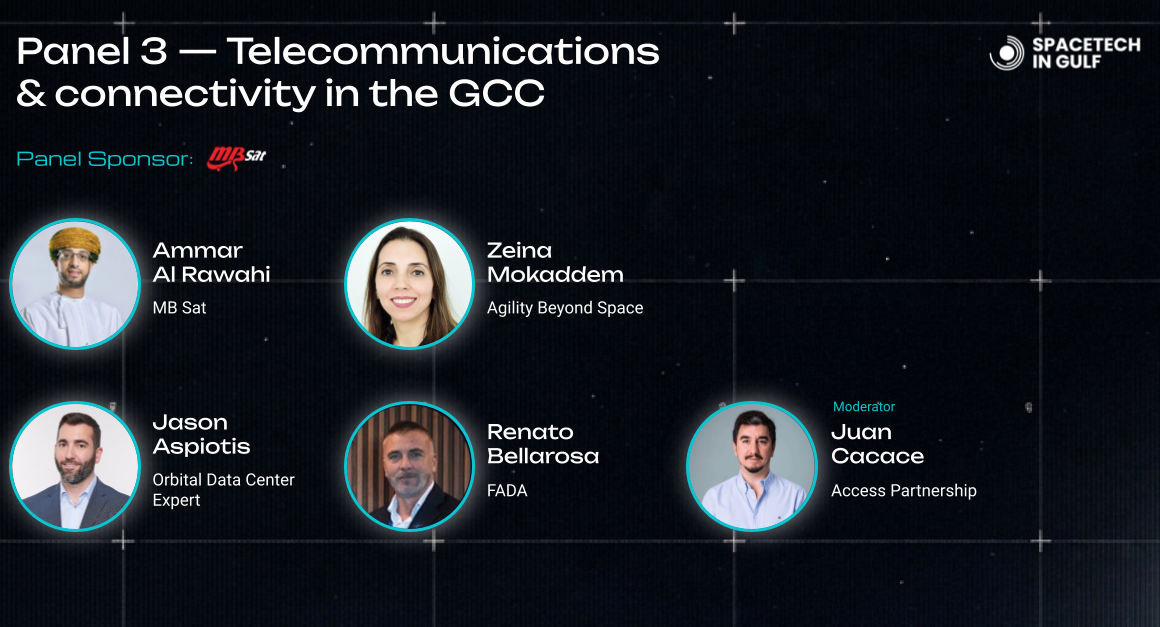
| Role | Name | Organisation |
| Moderator | Juan Cacace | Access Partnership |
| Speaker | Ammar Al Rawahi | MB Sat |
| Speaker | Zeina Mokaddem | Agility Beyond Space (ABS) |
| Speaker | Jason Aspiotis | Orbital Data Center Expert |
| Speaker | Renato Bellarosa | FADA |
Full Transcript
Opening and Housekeeping
[00:00] Alexei Cresniov:
Thank you to MB Sat for sponsoring this panel and supporting us. Juan, the floor is yours. You have 45 minutes.
[00:26] Juan Cacace:
Excellent, thank you, Alex. Can I confirm that Kamal is here?
[00:33] Host:
Kamal will not join today unfortunately. Everyone who confirmed is present.
[00:46] Juan Cacace:
Perfect, thank you very much, Alex. It was interesting to listen to the previous panel and I’ll try to connect a little of that discussion with ours. We’re going to focus on telecommunications and connectivity in the Gulf, specifically space and satellite communications. We have an excellent panel representing different views, trends and challenges across Gulf countries. My name is Juan Cacace. I work at Access Partnership, a consultancy specialising in government affairs and regulation. I’ll ask each of you to introduce yourselves — name, title, company and a few words about your organisation.
Introductions
[02:11] Juan Cacace:
Renato, let’s start with you.
[02:19] Renato Bellarosa:
Good afternoon everybody. It’s a pleasure to be here with you. My name is Renato Bellarosa, Vice President Engineering at FADA. FADA is a space-based company, part of the EDGE Group, founded in 2024. Our main objective is to achieve national sovereignty in space technologies in the UAE and then scale up to become a global player. The previous panel was very relevant, talking about developing locally oriented capabilities and big programmes. FADA is currently running the SARB programme with the UAE Space Agency to develop SAR capabilities for the UAE. It is a broad programme covering the satellite segment (platform and payload), the ground segment and downstream. The objectives are to develop local capabilities and transfer knowledge with partners, using big budgets to drive a roadmap for local sovereign capabilities in the GCC. I joined FADA a week ago. Previously I worked 13 years at Airbus and then at 4iG Space and Defense Technologies in Hungary, which is an interesting example of building sovereign capability through large programmes. From what I’ve seen in the GCC so far, the pace is astonishing. Things are moving very fast, and I’m thrilled to have joined EDGE and to contribute to this panel.
[04:51] Juan Cacace:
Thank you, Renato. Let’s continue with Ammar.
[04:58] Ammar Al Rawahi:
Thank you. This is Ammar. My background covers several key aspects of space. I started in astronomy, astronomical observation and technologies, then shifted to space technologies more than a decade ago. We played a role in building Earth observation satellites and were one of the key players in Oman, and also contributed to the national space programme. Recently I worked with a satellite communications service provider. Today I am at MB Sat, which aims to be a regional satellite operator across the GCC.
[05:58] Juan Cacace:
Thank you, Ammar. Jason, please.
[06:04] Jason Aspiotis:
Good afternoon everyone, thanks for having me. I’m Jason Aspiotis, currently an independent consultant and orbital data centre (ODC) expert. I started as an astrophysicist in 2000 and have been in the space industry for 20+ years, working at Raytheon, Booz Allen and most recently Axiom Space in the US. Around 2021, I coined the term ODCs — orbital data centres — and have spent the last five years maturing both the technology and the market for ODCs. I’m excited about developments in the US, and the potential for sovereign orbital cloud capabilities in Europe and worldwide. I’m particularly interested in orbital cloud in the context of telecommunications, non-terrestrial networks and the infrastructure use cases that will emerge over the next 5–10 years.
[07:17] Juan Cacace:
Thank you, Jason. Last but not least, Zeina.
[07:24] Zeina Mokaddem:
Hi, thank you for having me. My name is Zeina Mokaddem. I’m Chief Government Affairs and Regulatory at Agility Beyond Space (ABS), which previously was Asia Broadcasting Company. ABS is a geostationary satellite operator — not a newspace LEO player, but still GEO. I came from Inmarsat, where I led regulatory and market access efforts. In my new role, the scope is broader. The company focuses on maritime, enterprise and government for critical communications, as well as broadcasting.
[08:34] Juan Cacace:
One thing I noticed in your resumes is that Zeina spent about 13 years at Inmarsat, the same number Renato spent at Airbus, and Ammar also spent 13 years with the Omani radio astronomy society. You all bring a lot of experience across industry and government affairs, which should make this a very interesting discussion.
Strategic Models for GCC Connectivity
[09:27] Juan Cacace:
I’d like to start by connecting with the previous panel. They finished talking about a possible SpaceX IPO and the way that company has disrupted the space and satellite communications industry. Beyond SpaceX, many companies are building new systems and technologies, and governments are investing in their own programmes with sovereignty and security as key buzzwords. What do you think is the right model for the Gulf region in satellite connectivity and space? Should countries focus on national/domestic capabilities, or continue relying on global players like SpaceX and leasing capacity?
[11:16] Zeina Mokaddem:
It’s an interesting question. One clear thing is that the GCC no longer sees space as niche. I’ve been here over 15 years and call the UAE home. The UAE has led in investment, innovation and commercial appetite. Oman is another example — when I was at Access Partnership, we met the ministry in Oman back in 2009 and the ambition was already there. Today there is Omansat as the national sovereign satellite project. Saudi Arabia is another example with its Vision and investments in players like NSG. The main caution I would offer is that one size does not fit all. Many regulators feel a ‘FOMO’ when they speak with a GEO operator and immediately ask about LEO plans or strategies. We shouldn’t think of one technology as the solution. We need to start from the use case and the application we want to achieve, then choose the technology. So we must adapt technology to the use case, understand government needs and geopolitics, and then develop solutions accordingly.
[14:21] Ammar Al Rawahi:
The vision to have a national satellite has been there since 2007. My role later was as expert/adviser to help enable the team on space policy and strategy. Now I’m back in the private sector with MB Sat. Our vision is to complement government, not compete. A few months after the announcement of Omansat, MB Group announced MB Sat. This shows how private sector can jump in and incentivise space investments. MB Group has been around since the 1980s, originally focused on oil and gas services and later diversified into maritime, mining, cybersecurity, real estate and hospitality. When the group shifted to technology and ICT, space was seen as the new era. Together with our partner Astranis, we studied next-generation micro-GEO satellites. MB announced a $200 million US dollar investment in this micro-GEO satellite. Our analysis showed a gap in KA-band capacity in the region — existing capacities but still a lack and a huge demand, plus interest in next-generation software-defined technology and faster deployment. This will provide sovereign digitalisation and connectivity capabilities, with integration between GEO satellites and future LEO satellites. Launch is targeted for the end of this year, in partnership with Astranis. The satellite network will become operational next year.
Sovereignty, ITAR and Partnerships
[20:03] Juan Cacace:
Renato, what do you think about the right model for the region?
[20:16] Renato Bellarosa:
MB is a very good example of incremental sovereignty — the ability to start with more agility and get into space assets via a smaller 500-kg platform. A question I ask myself is how to deal with ITAR when working with US companies like Astranis, Northrop Grumman, Lockheed Martin, Boeing or L3. Relying on US technology can introduce ITAR constraints. How do you deal with that? Do you accept it at the beginning and then move step-by-step toward full sovereignty?
[21:39] Ammar Al Rawahi:
In our due diligence, the most important thing as a private industry was to have a sovereign satellite network. Astranis controls the satellite vehicle (TT&C, health and status), but for us the critical point is the satellite network being controlled by an Omani entity with a gateway in Oman. Today there are multiple gateways and providers in Oman, but the space segment is not owned by Oman. Owning the satellite network was crucial to provide sovereign satellite services for government, security and enterprise. Through negotiations we ensured TT&C will be in Oman in partnership with Astranis, while the satellite network will be fully managed and integrated by MB Group.
[24:01] Renato Bellarosa:
This is one of the key topics when partnering with US companies. SpaceX is not the only big player; there are several others. In general, sovereignty is especially important for critical applications such as defence. Today we look at multi-orbit orchestration rather than independent layers — GEO and LEO are both needed, each with its own strengths. These assets must be developed with a footprint in the UAE. Sovereignty cannot be achieved overnight, but joint ventures, acquisitions and M&A can accelerate access to capabilities with more agility.
Conflict, Demand and Sovereignty Pressure
[30:00] Juan Cacace:
Given the conflicts and tensions around the Gulf, what challenges are you facing for satellite communications? Is this accelerating demand and investments, or complicating your work?
[31:01] Zeina Mokaddem:
From an ABS perspective, demand has increased. In events like this, unfortunately, demand always spikes. It also drives governments to seek more sovereignty. If ‘sovereign’ is understood as owning the asset, I hope we don’t end up with each GCC administration owning its own satellite constellation — that would be massive and inefficient. There is a middle ground where trusted partners are acceptable. We see some shift in that direction. There is now higher demand for sovereign control rather than full ownership, and increased resilience requirements across governments.
[32:42] Ammar Al Rawahi:
If we look back a decade, many countries wanted satellites partly for pride and sovereignty. Now it’s much less about pride or backup connectivity, and more about sovereignty, especially with current geopolitical events. It’s a red flag for the GCC and neighbouring countries that they need more sovereign capabilities and in-house control. Localisation of technology is still developing, but controlling and operating the network is key. Regulatory entities in Oman require that anything related to networks and telecoms lands in Oman — gateways must be here. That’s a good aspect, but we also need more agility in processes and development, because telecoms technologies evolve rapidly. Another challenge is cost. Some government and enterprise customers focus primarily on price and may not prioritise control, which leads to comparisons between terrestrial networks and non-terrestrial networks.
[35:58] Renato Bellarosa:
On ownership, I was thinking about regional infrastructure. Individual states can own their assets, which then form part of a regional mesh for some applications. This links to regulation and fragmentation. A regional mesh could improve efficiency because assets will communicate across orbits and platforms using inter-satellite links.
[37:24] Jason Aspiotis:
On ownership, one model for ODCs is federated ownership. A large ODC satellite could host several enclaves of compute, with different sovereigns owning different segments for their data and processing. That maximises asset value while keeping sovereignty and avoiding prohibitive costs of fully independent systems for each government. In recent conflicts, ground data centres became targets. From a resilience perspective, space provides a natural extra layer of resilience for data transport, communications, storage and processing.
[38:36] Zeina Mokaddem:
Juan, please invite Renato to some future GCC meetings to propose his regional mesh idea — I think it’s a good one, even if not straightforward.
[39:00] Juan Cacace:
I was going to ask if anyone knows of GCC-level conversations on shared space infrastructure. There was a plan for a joint constellation, but I’m not sure it took off. We should do some digging.
Direct-to-Device (D2D)
[40:59] Juan Cacace:
Let’s move to another topic. A recent buzzword in satellite communications is direct-to-device or direct-to-cell. Is this getting traction in the region or is it still long-term?
[42:01] Zeina Mokaddem:
From a regulatory perspective, D2D is a hot topic. Regulators are looking at how to handle it — balancing ITU rules, national regulation and consumer expectations. There have been a few demos; I was involved in a couple a year or two ago. There is traction, but we’re still figuring out the right business models. You don’t need D2D in the middle of a fully connected city. But in topographies like Oman, or remote hiking areas in the UAE, it can be very useful.
[43:05] Renato Bellarosa:
I think the GCC is a very good example where D2D and non-terrestrial networks could be interesting. If 80% of national assets operate in areas where fibre is difficult, deploying 5G cells via satellites could be important.
[44:21] Ammar Al Rawahi:
I agree there is demand. From a consumer perspective, we often get questions like ‘Can our phones connect to your satellite?’ People in remote areas are suffering from lack of connectivity. In Oman, more than 96% of residential areas are covered by fibre or microwave, but 30–40% of people in remote areas still struggle. If they get a better solution, they will explore it immediately. D2D competes with GEO satellites in some respects, and our satellite is GEO, but from a broader perspective we are B2B/B2G, not direct consumer. In future we want integration between GEO and LEO and may expand beyond GEO. MB Group’s partner announcement said this is our entry to space.
Orbital Data Centres & Future Outlook
[47:25] Juan Cacace:
Jason, before we close, specifically in the Gulf, is there an opportunity for orbital data centres?
[47:50] Jason Aspiotis:
I believe at least one company is looking at sovereign ODCs for Gulf use cases. Personally, I can’t wait for the intersection of ODCs and D2D. Imagine connecting directly from a phone to an ODC satellite router and accessing cloud and AI services directly from space. That’s the future I’m excited about, and it’s something everyone should try to be part of.
Closing
[49:04] Juan Cacace:
The idea was to focus on telecommunications and connectivity, but the space economy is incredibly broad, with many issues and opportunities. It was a pleasure to moderate your views and ideas. Thank you to the panelists for your time, and thank you, Alex, for the invitation.
[49:43] Alexei Cresniov:
Thank you so much.
[49:48] Panel:
Thank you. It was a pleasure.
Panel Summary
Panel 3 explored the evolving landscape of satellite telecommunications and connectivity across the GCC. Moderated by Juan Cacace (Access Partnership) and sponsored by MB Sat, the discussion brought together a GEO satellite operator, a sovereign space manufacturer, a private satellite operator, and an orbital data centre pioneer to examine strategic models for connectivity, sovereignty, ITAR challenges, direct-to-device technology, and the emerging opportunity for orbital data centres in the Gulf.
1. Strategic Models for GCC Connectivity
- Zeina Mokaddem (ABS): One size does not fit all — the GCC must start from use cases and applications, then select the right technology. ‘Technology FOMO’ among regulators risks poor investment decisions.
- The GCC has moved well beyond viewing space as niche: UAE has led investment and commercial appetite; Oman has launched a national satellite programme (Omansat); Saudi Arabia has built a space economy worth $8.7B+ with NSG and Vision 2030 at its core.
- Ammar Al Rawahi (MB Sat): Private sector can complement — not compete with — government. MB Sat’s $200M micro-GEO satellite investment (with Astranis) was triggered directly by the announcement of Omansat, filling a KA-band capacity gap in the region. Launch is targeted for end of 2026.
- Renato Bellarosa (FADA): Incremental sovereignty is the right approach — start with smaller, more agile platforms and build capability progressively. FADA’s SARB programme with the UAE Space Agency is a flagship example of this model.
2. Sovereignty, ITAR and Partnership Models
- ITAR constraints were identified as a central challenge when partnering with US companies (Astranis, Northrop Grumman, Lockheed Martin, Boeing, L3). The question of whether to accept ITAR dependency initially and move toward full sovereignty over time is a key strategic decision.
- MB Sat’s approach: Astranis controls TT&C (health and status of the satellite), but all satellite network operations are controlled by an Omani entity with a gateway in Oman — ensuring sovereign service delivery even with a US-built platform.
- Multi-orbit orchestration (combining GEO and LEO) was identified as the future model — not independent layers, but integrated systems that leverage the strengths of each orbit.
- Joint ventures, acquisitions and M&A were highlighted as faster paths to sovereign capability than greenfield development.
3. Geopolitical Tensions & Demand Acceleration
- Regional conflicts and tensions have accelerated demand for satellite communications and sovereign connectivity — ABS reported a clear spike in demand.
- The motivation for sovereignty has shifted: a decade ago it was partly national pride; today it is driven by hard security requirements and geopolitical risk.
- Zeina Mokaddem cautioned against full ownership duplication — each GCC country owning its own constellation would be inefficient. A model of sovereign control over trusted shared assets is more practical.
- Renato Bellarosa proposed a regional mesh model — states own assets that interconnect via inter-satellite links, creating a shared regional infrastructure with sovereign nodes.
- Jason Aspiotis raised federated ODC ownership as a solution — a single large satellite hosting sovereign compute enclaves for multiple governments, maximising asset value while preserving data sovereignty.
4. Direct-to-Device (D2D) Technology
- D2D (direct-to-cell satellite connectivity) is a regulatory hot topic across the GCC, with active discussions on balancing ITU rules, national regulation, and consumer expectations.
- Real commercial traction is still emerging — business models are not yet fully established, but demos have been conducted.
- The GCC is an ideal candidate for D2D adoption: Oman has 30–40% of remote area residents still struggling with connectivity despite 96%+ fibre/microwave coverage in residential areas.
- Renato Bellarosa: If 80% of national assets operate in areas where fibre is difficult, deploying 5G cells via satellite becomes strategically important.
- MB Sat’s strategy is B2B/B2G for now, with future plans to integrate GEO and LEO capabilities and potentially expand into consumer connectivity.
5. Orbital Data Centres (ODCs) — The Next Frontier
- Jason Aspiotis coined the term ‘Orbital Data Centres’ in 2021 and has spent five years developing the technology and market concept.
- At least one company is actively exploring sovereign ODCs for Gulf use cases.
- Ground data centres have become targets in recent conflicts — space-based compute offers a fundamentally more resilient architecture for data transport, storage and processing.
- The intersection of ODCs and D2D was identified as a transformative future scenario: direct phone-to-ODC-satellite connections enabling cloud and AI services from orbit — bypassing terrestrial infrastructure entirely.
Key Takeaway: The GCC satellite communications sector is undergoing a fundamental transformation — from capacity leasing to sovereign asset ownership, from single-orbit to multi-orbit orchestration, and from government-only to public-private models. The region’s unique combination of geopolitical urgency, Vision 2030 investment appetite, and connectivity gaps in remote areas makes it one of the most dynamic satellite markets globally. The next frontier — orbital data centres and direct-to-device connectivity — could position the GCC as a global pioneer if the right regulatory and investment frameworks are established.
GCC Space & Security Online Conference 2026 | Organised by SpaceTech in Gulf | www.spacetech-gulf.com | alex@spacetech-gulf.com