


A rocket’s propellant is chosen as much for what a team can safely learn from as for what it can lift.

On 18 August 2026, the Chinese company LandSpace set the first stage of its Zhuque-3 rocket back on solid ground after an orbital launch, some 390 kilometers from where it had taken off, becoming the first private Chinese company to recover an orbital-class booster on land. A few hours later, the booster toppled over. A fire after touchdown had compromised one of its legs.
Far from a failure, there were insights to gain from both the landing success and subsequent fire. The landing was a genuine achievement, executed through a sequence of maneuvers that has to work in order and cannot be rehearsed at full scale. The topple is a reminder that recovering a booster and reusing one are separate problems, and that the distance between them is measured in accumulated engineering knowledge rather than in single successful flights.
Landing boosters is not new: SpaceX has been doing it since 2015. But to get to reliably reusing a rocket, a national space program or company must work on a more fundamental question: can they design, build, fly, and get back a rocket of any size at all entirely by themselves?
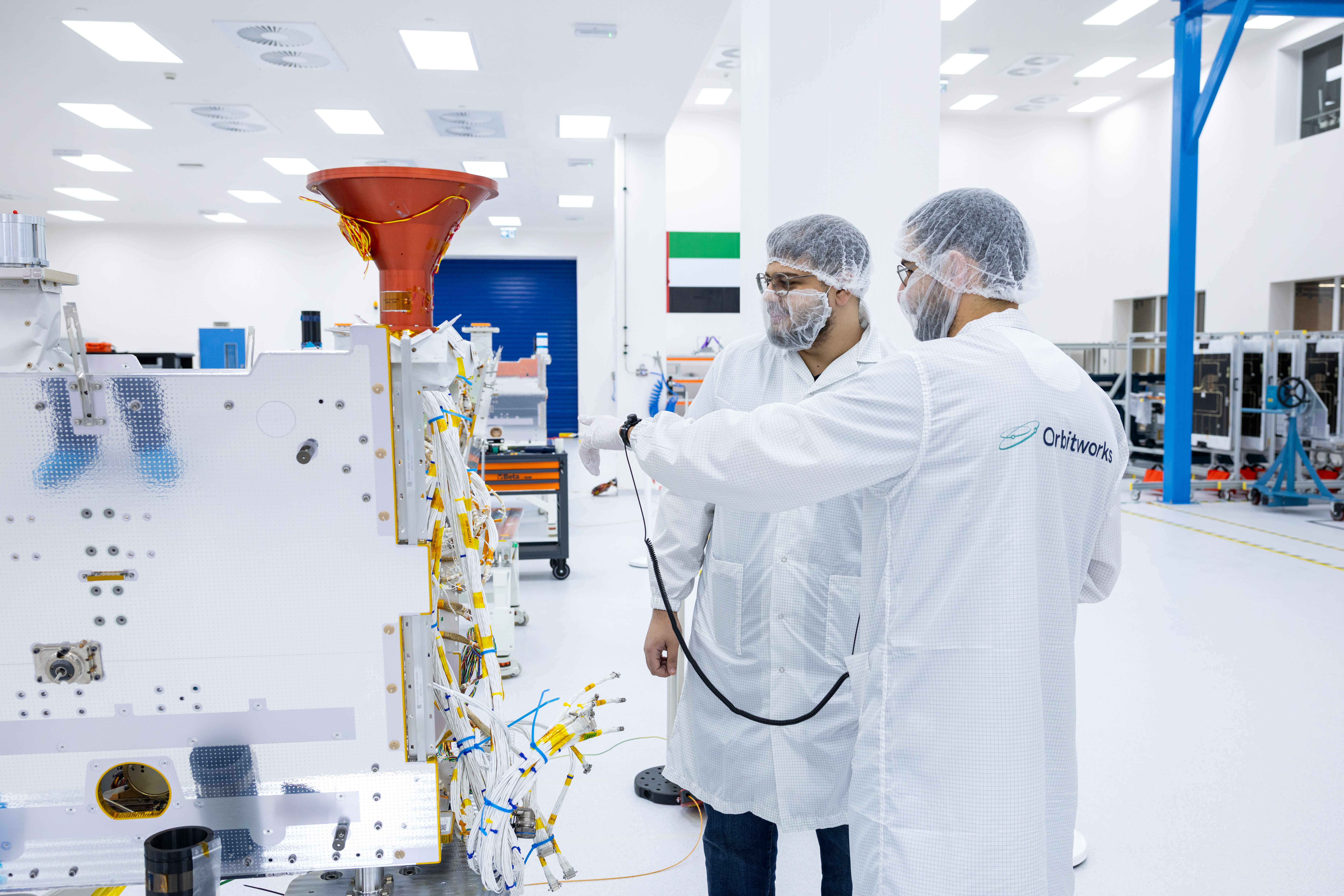
In mid-February, our Rocket Propulsion team at the Technology Innovation Institute in Abu Dhabi answered that question for the UAE. A hybrid sounding rocket lifted off, reached an altitude of about three kilometers, and returned under parachute. Its engine, injectors, tanks, control systems and avionics had all been designed, built and tested in the UAE. It was the first flight of a hybrid rocket with a fully UAE-designed and operated propulsion system.
Three kilometers is not orbit, and a parachute is not a landing leg. But our flight proves something very important: the chain from propellant choice through structure, control and recovery can be designed and executed in-house by a team building the expertise as it goes. This is clearly evidenced by our propellant choice. The motor burns nitrous oxide with high-density polyethylene as a hybrid fuel, a combination of two conventional options. Liquid propulsion offers performance and throttle control at the cost of needing turbopumps, cryogenic handling and considerable ground infrastructure. Solid propulsion, on the other hand, is mechanically simple but unforgiving: once lit, it cannot be shut down. A hybrid keeps the oxidizer and the fuel in different physical states, which makes it inherently harder to set off by accident and allows a burn to be throttled or stopped.
For an established program, that combination is a compromise on performance. For a new one, it is almost the point. A self-pressurizing nitrous oxide system needs no cryogenic handling and no elaborate launch infrastructure, which means a team can test frequently, iterate quickly and — perhaps most importantly, fail cheaply. Historically, the motor was the component a program at the stage would have had to source from abroad. Choosing a propellant a small team could develop, handle and refine domestically, rather than the one offering the best figures on paper, was the engineering decision.
Similarly, a parachute is a far simpler system than a propulsive landing but validating deployment and airframe integrity under real flight loads closes the development loop in a way no static engine test can. Besides, a rocket you don’t get back can’t tell you much about what happened to it.
Reusability is not something a country can buy its way into. It depends on years of accumulated data and that accumulation starts with sounding rocket programs — with vehicles small enough that a bad day is a setback, not a disaster.
The companies landing boosters this year are running on decisions made a decade ago about what to build in-house. LandSpace’s engineers will learn more from that failed leg in Gansu than from the seven minutes of flight before it. At every scale, the work is the same: get it in the air, get it back, and learn.
By Dr. Elias Tsoutsanis, Chief Researcher, Propulsion and Space Research Centre, Technology Innovation Institute