





How would you describe the strategic importance of space cooperation between France and Oman, particularly following the recent Declaration of Intent on cooperation in the space sector?
Space cooperation is becoming an important new dimension of the broader strategic relationship between France and Oman. The Declaration of Intent signed on 29 June 2026 provides a political and institutional framework through which our two countries can identify shared priorities and progressively develop concrete initiatives. It can help align institutional discussions with industrial developments already underway.
What makes Oman an important partner for France in the development of the Gulf and wider regional space ecosystem?
Oman is relevant because it is developing a national space strategy linked to economic diversification and infrastructure development. Its geographic position, including Duqm, may support regional connectivity, logistics, and launch-related activities. The country is also seeking to strengthen its role in satellite communications and space applications. For France, Oman represents a partner with specific industrial and operational interests. The relationship should therefore focus on areas where both sides have practical capabilities and needs.
France has a strong space industry, while Oman is developing its national space capabilities. Where do you see the greatest opportunities for complementary cooperation between the two countries?
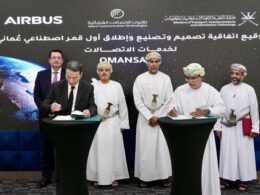
The strongest opportunities are in satellite communications, ground infrastructure, Earth observation, and launch services. OmanSat-1 illustrates the potential for cooperation on telecommunications systems and associated ground capabilities. In launch services, Latitude, the French startup, could be a potential customer and user of Etlaq Spaceport. This type of cooperation can help Etlaq test and develop its operational, regulatory, and logistical environment. The objective should be to combine commercial projects with gradual development of local capabilities.
How can French companies and institutions contribute to Oman’s ambition to develop a competitive and internationally connected space sector?
French companies can contribute through concrete industrial partnerships in satellites, ground systems, launch services, and space-data applications.
French institutions may support dialogue on technical standards, safety, training and international cooperation, where requested. The emphasis should remain on projects with a clear operational or economic purpose. It is important that partnerships include local implementation and skills development. France can also facilitate contacts with European industrial, academic and research networks.
Recent agreements involving Airbus, Etlaq–Latitude and MBsat–Telespazio demonstrate growing commercial cooperation. How does the Embassy view the potential for further French private-sector involvement in Oman’s space sector?
The Airbus, Etlaq–Latitude and MBSAT–Telespazio initiatives show that cooperation is developing across different segments of the value chain. They involve, respectively, satellite systems, launch-site access and ground-station or satellite-service activities. These examples provide a basis for further French private-sector engagement, but each project has a different legal and commercial status. The Embassy can support dialogue and connections between relevant stakeholders. The implementation of existing agreements will be the main indicator of future potential.
To what extent could cooperation in areas such as satellite communications, Earth observation, launch services and ground infrastructure contribute to Oman’s economic diversification goals?
Satellite communications, Earth observation, launch activities and ground infrastructure can support sectors beyond space itself. They may contribute to maritime services, environmental monitoring, logistics, connectivity, data processing and engineering. Their economic impact will depend on the development of local operators, trained personnel and viable commercial demand. Industrial partnerships can help create this ecosystem if they include local participation and long-term operational activity. Space should therefore be considered as enabling infrastructure for the wider economy.
How important is knowledge transfer and capacity building in the France–Oman space relationship? Are there opportunities for joint training, research or university cooperation?
Capacity building is essential if cooperation is to produce lasting benefits beyond individual contracts. Training should be linked to concrete projects such as OmanSat-1, ground infrastructure or Etlaq operations. There may also be scope for university links, internships and joint research initiatives. Such activities should be defined jointly and based on Oman’s identified requirements.
Could Oman potentially become a strategic platform for French and European companies seeking access to the wider Middle Eastern and regional space markets?
Oman could become a useful platform for some French and European companies seeking access to Gulf, Indian Ocean and East African markets. Duqm’s logistics infrastructure and Etlaq’s development are relevant in this regard. Companies such as Telespazio or Space Dreams can bring valuable expertise in launch ground systems. However, this potential will depend on predictable regulation, licensing, safety standards and access to qualified personnel. It will also depend on the ability to generate sustained regional demand. France can support this evolution through industrial connections, rather than through broad commitments.
What role do you see for France in supporting the development of Oman’s emerging spaceport and commercial launch ecosystem?
France has relevant experience in launch operations, range safety, mission preparation, and regulatory practices. The Etlaq–Latitude Letter of Intent offers a practical case through which operational cooperation can be explored. Latitude’s role is that of a prospective launch customer using Etlaq’s facilities for its own launch campaigns. Technical exchanges could therefore focus on interfaces, logistics, safety procedures and operational readiness. Any institutional support would need to respond to Oman’s requests and remain consistent with its sovereign responsibilities.
Looking ahead to the next five to ten years, what would success look like for France–Oman cooperation in space, and which areas do you believe have the greatest potential for deeper partnership?
Success would mean that current industrial agreements lead to operational and sustainable projects. This could include progress on OmanSat-1, ground infrastructure, satellite services, and launch campaigns from Etlaq. It should also include the development of Omani technical skills and local industrial participation. The most credible areas for deeper cooperation are telecommunications, launch-site services, ground systems, and Earth-observation applications.
A regular institutional dialogue can help keep these projects aligned with industrial and national priorities.