




A recent discussion in the space and defence community raised an important point: perhaps we are focusing too much on sensors and not enough on integration.
The argument is compelling. Modern military and security organisations already possess access to vast quantities of data collected from satellites, drones, signals intelligence, open-source intelligence, and numerous other sources. As demonstrated repeatedly in Ukraine, the ability to fuse multiple intelligence streams into a common operational picture and connect them directly to assets capable of taking action can dramatically increase effectiveness.
In this context, the advantage no longer comes from owning more sensors. It comes from connecting them.
I agree with this assessment.
However, I would argue that there is another challenge that appears even earlier in the chain.
Before data can be integrated, it must first be available.
The Missing Layer
When discussing space-enabled intelligence, we often assume that information is readily available and simply waiting to be integrated with other sources.
In reality, obtaining the right information at the right time remains one of the most difficult challenges in modern space systems.
For a satellite observation to become actionable intelligence, several things must happen:
- A satellite must be capable of observing the area of interest.
- The satellite must pass over that area within the required timeframe.
- The data must be collected.
- The information must be extracted from the raw data.
- The results must be transmitted to the user.
- Only then can the information be integrated with other intelligence sources and incorporated into the decision-making process.
Every one of these steps introduces delay. And in many operational scenarios, information loses value rapidly with time.
The challenge is therefore not only integration.
The challenge is moving information through the entire chain fast enough for integration to matter.
The Tyranny of Orbital Mechanics
Unlike drones or terrestrial sensors, satellites cannot simply be repositioned when a new target appears.
A satellite may possess exceptional imaging capabilities, but if it passes over an area of interest only once every few hours, the value of that capability becomes limited for time-critical operations. This challenge becomes particularly acute when dealing with:
- Mobile military targets
- Dynamic battlefield situations
- Border surveillance
- Maritime monitoring
- Critical infrastructure protection
- Disaster response
In these cases, the question is not simply whether information can be integrated.
The question is whether the information can be obtained quickly enough to support operational decision-making.
The objective is not collecting more data.
The objective is ensuring that the right information reaches the right user before it becomes obsolete.
From Satellite Systems to Information Networks
For decades, satellites have largely been viewed as observation platforms. A sensor observes the Earth. Data is transmitted to the ground. The information is processed and distributed. The process is fundamentally linear. Future architectures will look very different. Instead of treating satellites as individual assets, we will increasingly treat them as nodes within a distributed information network.
The user will no longer task a specific satellite. The user will task the network.
Multiple commercial, governmental and military constellations could operate together as virtual constellations, dynamically selecting the most appropriate sensor to satisfy a particular request. Artificial intelligence could continuously optimise tasking priorities, sensor allocation, observation schedules and information delivery pathways.
The network itself becomes the sensor.
Processing Information Where It Is Collected
Another important shift is occurring onboard the spacecraft. Historically, satellites collected data while the actual analysis occurred on the ground. This approach was appropriate when onboard computing resources were limited. Today, advances in space-qualified processors, AI accelerators and edge computing are changing the equation. Instead of transmitting raw imagery to Earth and waiting for analysts to interpret it, satellites can increasingly perform processing onboard.
Rather than sending gigabytes of data, they can transmit:
- Detected changes
- Identified vehicles
- Vessel movements
- Anomalous activities
- Threat indicators
- Automated alerts
The user receives information instead of raw data. The result is a significant reduction in bandwidth requirements and decision latency.
The Case for Ground Stations in the Sky
Perhaps the most interesting opportunity lies in the communications architecture itself.
One of the least discussed bottlenecks in Earth observation systems is the dependency on ground station access. A satellite may collect critical information within seconds. Yet that information may remain onboard for minutes or even longer while waiting for a suitable ground station pass. For many operational scenarios, this delay is unacceptable.
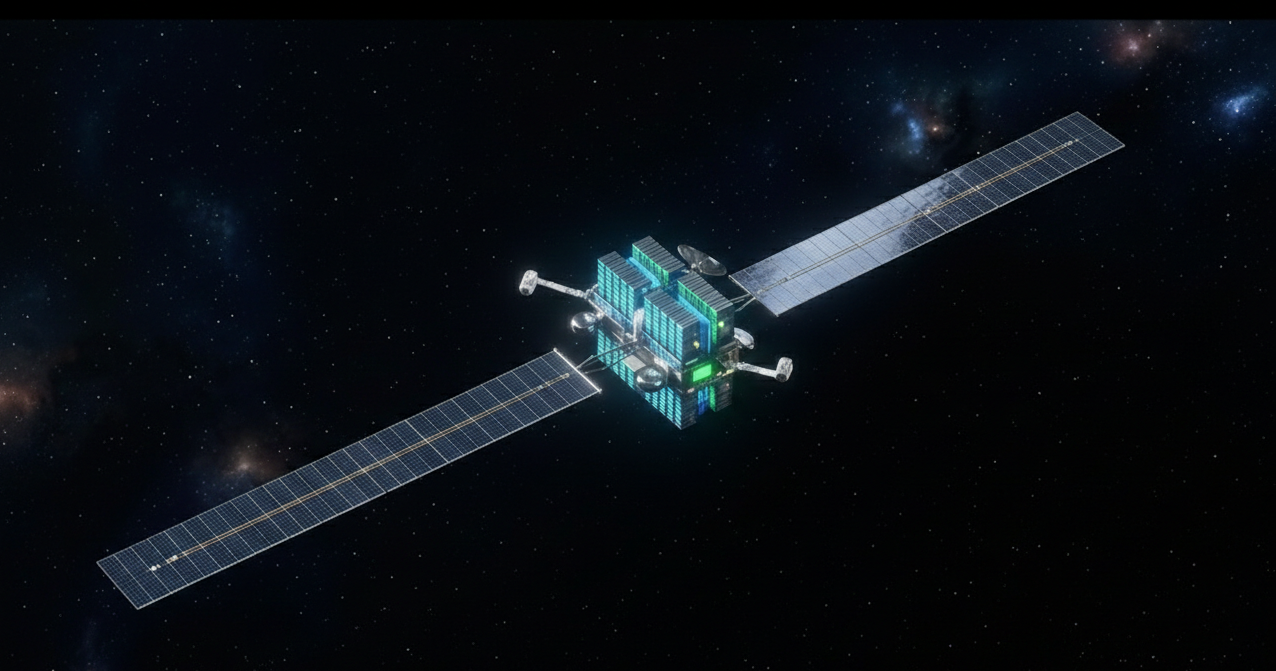
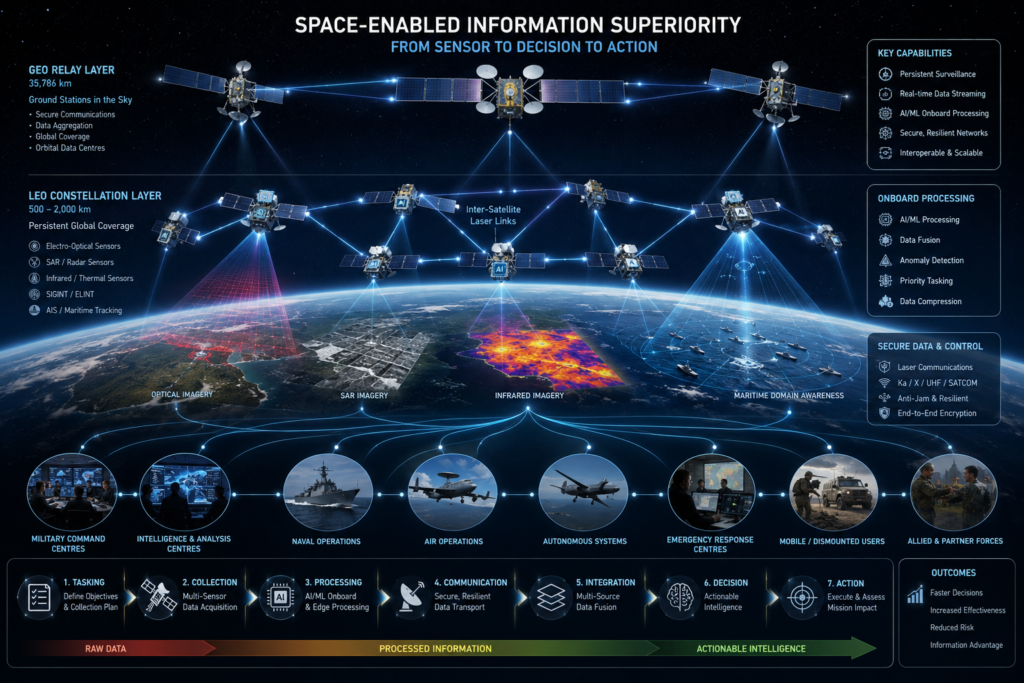
Inter-satellite links provide part of the solution. But another possibility is emerging: transforming higher-orbit satellites into persistent relay nodes. In effect, creating ground stations in the sky. Low Earth Orbit satellites could transmit information to relay satellites positioned in higher orbits, which would then immediately forward the information to users, command centres or other spacecraft.
In this architecture, the relay layer becomes an orbital communications backbone connecting thousands of distributed sensors.
A New Role for GEO Satellites
Interestingly, this concept may provide a new strategic purpose for geostationary satellites. For years, GEO systems have been associated primarily with television broadcasting and traditional communications services. As consumer behaviour shifts toward streaming platforms and terrestrial broadband networks, the demand for conventional broadcasting services continues to decline. As a result, much of the industry discussion has focused on whether GEO is losing relevance in an era increasingly dominated by Low Earth Orbit constellations.
The opposite may be true.
GEO satellites may become more valuable than ever, but in a different role.
A geostationary satellite continuously observes roughly one-third of the Earth’s surface and maintains uninterrupted connectivity with users within its coverage area. Rather than acting as broadcasters, future GEO platforms could serve as:
- Information relay nodes
- Data aggregation centres
- AI processing hubs
- Constellation management nodes
- Secure military communications gateways
- Space-based command-and-control infrastructure
In essence, they could become the backbone of a future orbital information network.
The Latency Debate
Critics often point to GEO latency as a limiting factor. For broadband internet services, this concern is valid. However, in intelligence and surveillance architectures, the comparison is often misunderstood.
The relevant comparison is not:
- GEO relay latency: approximately half a second versus
- LEO internet latency: a few tens of milliseconds
The real comparison is:
- GEO relay latency: less than one second versus
- Waiting for the next ground station pass: several minutes or even hours
From an operational perspective, the difference is profound. If information can be delivered within seconds rather than minutes, the additional latency introduced by a GEO relay becomes largely irrelevant. What matters is reducing the total time between observation and action.
The Future Advantage
The defence and space sectors frequently debate whether the future belongs to better sensors, more artificial intelligence, or improved integration. The reality is that no single element provides decisive advantage on its own.
A sensor that cannot rapidly deliver information has limited operational value.
An advanced command-and-control system is ineffective if the relevant information never reaches it. Likewise, artificial intelligence cannot analyse data that was never collected. The future advantage will belong to organisations capable of optimising the entire chain:
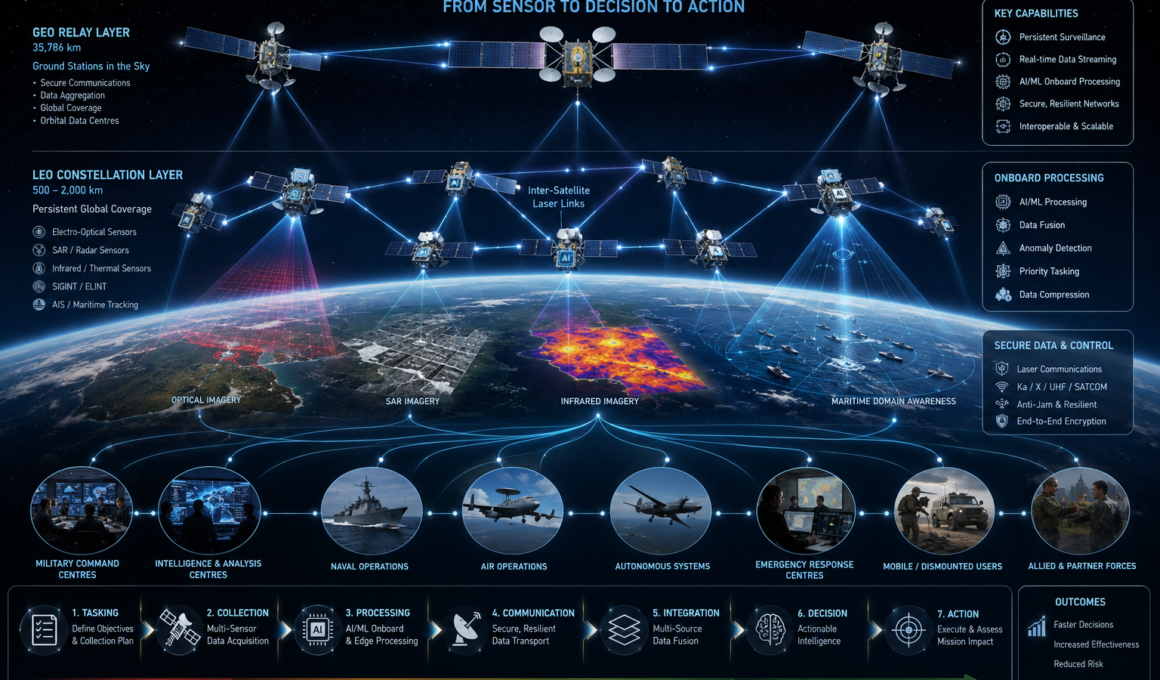
Tasking → Collection → Processing → Communication → Integration → Decision → Action
This is why the future of space systems may be less about observation and more about information logistics. The next revolution in space-enabled defence may not come from building more sensors. It may come from building an orbital information network capable of moving information from sensor to decision-maker faster than an adversary can react.
In that future architecture, satellites will no longer be isolated observation platforms. They will become interconnected nodes in a global information infrastructure. And the real competitive advantage will belong not to those who see the most, but to those who can move information the fastest.

Iulian Emil Juhasz is an aerospace engineer and space entrepreneur with more than 14 years of experience in leading teams and projects and working with various customers from governmental agencies to large space system integrators. Mentor in the European Innovation Council Scaling Club, Italian TakeOff Accelerator, ESA BIC Czech Republic and NATO DIANA.