



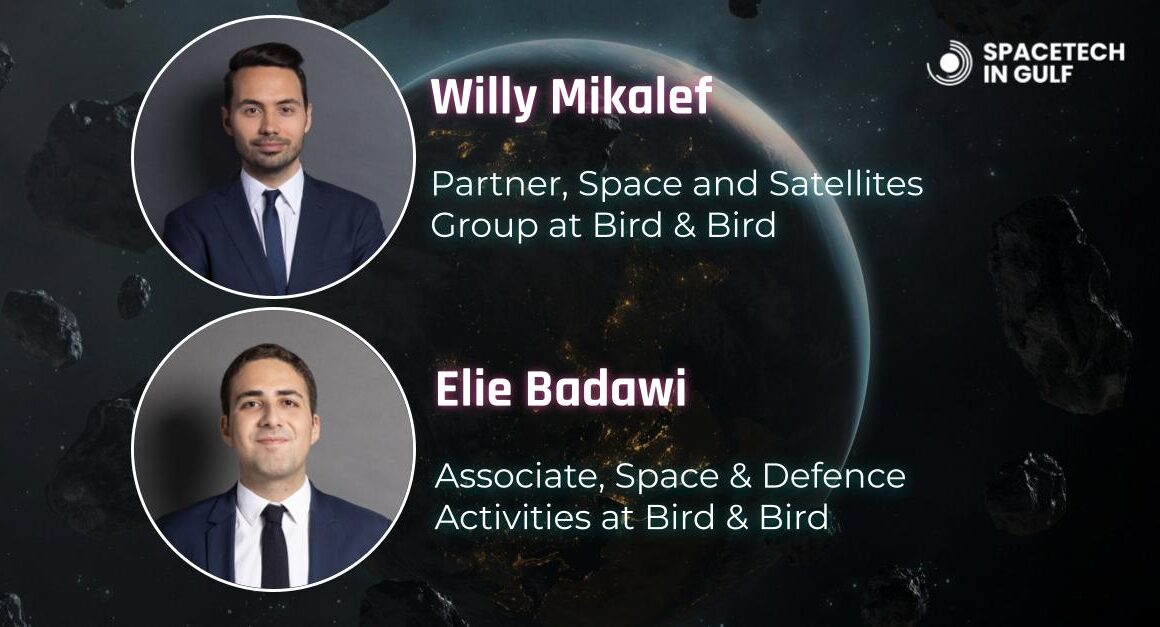

Partner, Space and Satellites Group at Bird & Bird
Willy Mikalef is a Technology Partner at Bird & Bird and a leading expert in Space and Satellite regulation, recognized by Who’s Who Legal since 2022. He has worked with top law firms in Paris and London, as well as major space institutions like the European Space Agency and Eutelsat. Willy advises space businesses on regulatory and commercial issues including licensing, debris mitigation, and cybersecurity, and teaches Space Law at Paris-Saclay University.

Associate, Space & Defence Activities at Bird & Bird
Elie Badawi is an Associate at Bird & Bird in the Aviation, Space & Defence team (Space & Satellites Group), his experience includes advising different clients (public and private entities) on a variety of commercial matters. He assists in drafting agreements and providing advice in several fields of expertise such as aerospace projects, export control regulations, cyber-security, telecoms, etc., in Europe and in the Middle East. Elie also delivers trainings for professionals and courses in academic institutions.
He is finishing a Ph.D. thesis at Université Paris-Saclay specializing in comparative Space Law with a focus on the Gulf region. His research is part of the Institute of Space and Telecommunications Law. He studied International and European Law with a background in Economics. Elie is fluent in French, English, Arabic and has advanced knowledge in Spanish.
Bird & Bird is known for its expertise in technology and innovation sectors. How has the firm adapted to the rapid changes in space and satellite law?
WM: As one of the first law firms to organize its expertise along sector lines our lawyers can build up considerable knowledge of the commercial drivers unique to the space and satellite industry, enabling us to deliver more targeted advice in a commercial context.
Bird & Bird is a global law firm with technology at its heart. Satellites and space are at the cutting edge of communications and aerospace technology, as well as being an enabler of other technological innovations. We therefore actively developed our expertise in this area. Bird & Bird has now a market leading practice, and regularly works with all kinds of satellite operators, manufacturers, businesses offering satellite-related or space technology products/services and governmental institutions and investors seeking to enter the industry.
EB: Our Space & Satellite group comprises a talented team of international specialists with a unique reputation and track record in the industry. Through many years of experience working in-house at regulators, in international institutions (like the European Commission, ESA) and in private practice, we have built an extensive footprint of expertise, with top-notch knowledge in areas like space and telecom regulations, export control and cybersecurity law.
Our industry focus has been consistently recognized by the main international legal directories over the years: for 2025 alone, our team is leading the Legal 500 tables for Telecoms, Data privacy and protection, and Aviation Finance, and Chambers has named us TMT Law Firm of the Year in France as well as Global Market Leader in AI. We are also one of the very few law firms recognized and ranked by the Lexology Index (Who’s Who Legal) as leading in Space & Satellite and Aviation Regulatory practices with specialists like Willy Mikalef, Thomas Jones, Marjolein Geus or Sven-Erik Heun.
WM: Bird & Bird continuously invests in the next generation of lawyers. Elie Badawi, for instance, is finishing a Ph.D. in comparative space law focused on Gulf countries. We have also hired Hayley Blyth who worked as in-house legal counsel for a national space regulator, and Roxane Olivier who worked for the European Commission.
What are the biggest legal challenges companies face when entering the space economy?
WM: Companies must navigate a complex and fragmented web of national, regional, and international regulations covering licensing, orbital slot allocation, spectrum usage, liability, export controls, and more. Spectrum management and ITU filings are particularly dynamic areas, as competition for orbital slots and radiofrequencies continues to intensify.
EB: We have been involved recently in the Gulf region in the negotiation of complex international agreements relating to the leasing of frequency assignments and orbital position and the review of ITU and national filings.
Investors may be cautious due to the high-risk nature of space ventures. Financing and contractual arrangements therefore play an important role, often underpinning the viability of satellite projects and influencing the structure of cross-border collaborations.
WM: Data regulation is another focus, especially in the context of Earth observation and satellite-derived data. Here, legal and technical teams must address concerns around privacy, cross-border data transfers, cybersecurity, and the potential dual-use nature of sensitive information.
Currently, client requests are typically highly specific and tailored to projects intended to stand out in a competitive market. This evolution demonstrates that the space sector is dynamic and reflects societal development. It also shows how law progresses in tandem with society.

Given the increasing commercialization of space, how is Bird & Bird advising clients on different scenarios and partnership models for innovative projects in the industry?
WM: Traditional market players are seeking growth and expansion and new entrepreneurial entrants are disrupting the industry like never before. This change is being driven by the lower costs of capital and tech thresholds required to participate, as well as the removal of administrative barriers that have traditionally posed significant barriers to entry.
We have advised on a broad range of partnerships between well established market players and New Space companies, public and private companies, providers of innovative space-based services and users. To do so, we combine space & satellite commercial and regulatory specialists, with other lawyers in corporate, M&A, IP, competition or finance.
EB: In the Middle East, we have advised companies in relation to the procurement and financing of different telecommunication satellites. Our legal guidance encompasses the full life cycle of such partnerships from initial feasibility studies, key legal, governance and procurement considerations to financing arrangements and operational contracts.
The firm’s involvement typically includes drafting commercial agreements, defining risk allocation mechanisms, securing regulatory approvals, and advising on other requested aspects of our clients, including negotiations. Per example, we are today part of the Bird & Bird/OXYGY team advising as a member of the consortium led by OHB System AG which has been selected by the European Commission Directorate-General for Defence Industry and Space to conduct a study aimed at developing reconnaissance capabilities at a European level.
What trends do you see in international collaboration in space law and governance?
EB: As space activities become more accessible and widespread, national space legislation has emerged as a key tool for states to assert sovereignty and manage the increasing involvement of private actors. The UAE, for instance, updates on a regular basis its space legislation to stay aligned with technological advancements, demonstrating its commitment to a dynamic, forward-thinking, and well-regulated space sector.
The space industry stands out for its multidimensional nature. It operates at the crossroads of legal, economic, civil, military, strategic, and infrastructural considerations. In this context, the concept of common investment and shared use of infrastructure, such as satellite constellations or launch facilities, has become increasingly important, encouraging cooperation and reducing duplication of efforts. It is not just a field of technological exploration, but a central hub of intersecting national and international interests making it both exciting and complex. Space has become a critical arena where numerous global challenges and ambitions converge.
What do you think of disputes related to satellite contracts, spectrum allocation, or intellectual property in the space industry?
WM: There are different types of disputes. commercial disputes between private companies or subjects, regulatory disputes and state-to-state disputes. We have experience assisting space companies in high-profile disputes, of a commercial nature or of a regulatory nature.
Disputes are rarer in the space sector than in other sectors. The high costs and risks associated with space missions incentivize parties to avoid disputes that could delay or jeopardize projects. The cooperative spirit and mutual interests which can be found in successful missions encourage parties to resolve issues amicably. This being said we observe a slight change of paradigm given the transformations that the space industry faced.
EB: It is worth noting that with increased increased commercialization and the complexity of satellite projects, arbitration is preferred due to its confidentiality and flexibility, cases around the word already per example exist involving satellite malfunctions (Insurers of Thuraya Satellite Telecommunications v. Boeing Satellite Systems), spectrum coordination/allocation (the Devas disputes or Eutelsat v. Mexico), and cross-border regulatory challenges (ABSG v. KT and KTSAT). We are fully engaged in monitoring developments from forums like the Permanent Court of Arbitration and the DIFC Courts’ “Courts of Space” initiative.
The UAE and Saudi Arabia are pushing for more private-sector participation in space. How is Bird & Bird helping companies navigate these evolving regulatory frameworks?
EB: With offices in the region and local teams on the ground, we’re able to hold meetings, coordinate directly with stakeholders, and provide hands-on support when needed. One of the key strengths of being part of an international law firm is our flexibility and responsiveness. While I am based in Paris, I travel regularly to the Gulf, over the past year alone, I’ve worked on-site in the UAE, Saudi Arabia, Qatar, and the UAE.
WM: This presence enables us to stay closely connected to the region’s developments, participate in key industry events and discussions, and respond swiftly to client needs. Our clients appreciate not only our legal expertise but also our proximity and understanding of the local context. Our clients also value our ability to provide support for business and organization modelling and transformation together with OXYGY, Bird & Bird’s consulting arm. We have supported the development of national space legislation, providing benchmarking insights and helping shape frameworks that align with each country’s strategic vision and international requirements. We also helped private entities navigate complex regulatory landscapes, securing authorizations, ensuring compliance, and structuring investments.
Are you seeing a growing demand from Gulf-based clients for legal support in satellite communications, Earth observation, or space-based data services?
EB: Yes, we are witnessing a clear and growing demand for legal support in the space sector from both public and private clients across the Gulf region. This is largely driven by national strategies that position space as a key pillar for economic leadership and diversification. Most GCC countries are excellent examples of emerging, ambitious space actors with rapidly expanding markets.
Overall, the space industry in the region is experiencing rapid growth, and with that comes a parallel increase in demand for specialized legal services. Gulf-based stakeholders are keen not only to participate in the evolving global space economy but also to be at the forefront of innovation, backed by robust legal and regulatory support.
Priorities emerging from national policies and strategies are generating increasing legal needs in areas such as satellite procurement, space-based data usage, cybersecurity, launching agreements and the development of advanced regulatory and licensing frameworks.
You can find more interviews and articles on the UAE space ecosystem in our latest magazine.