


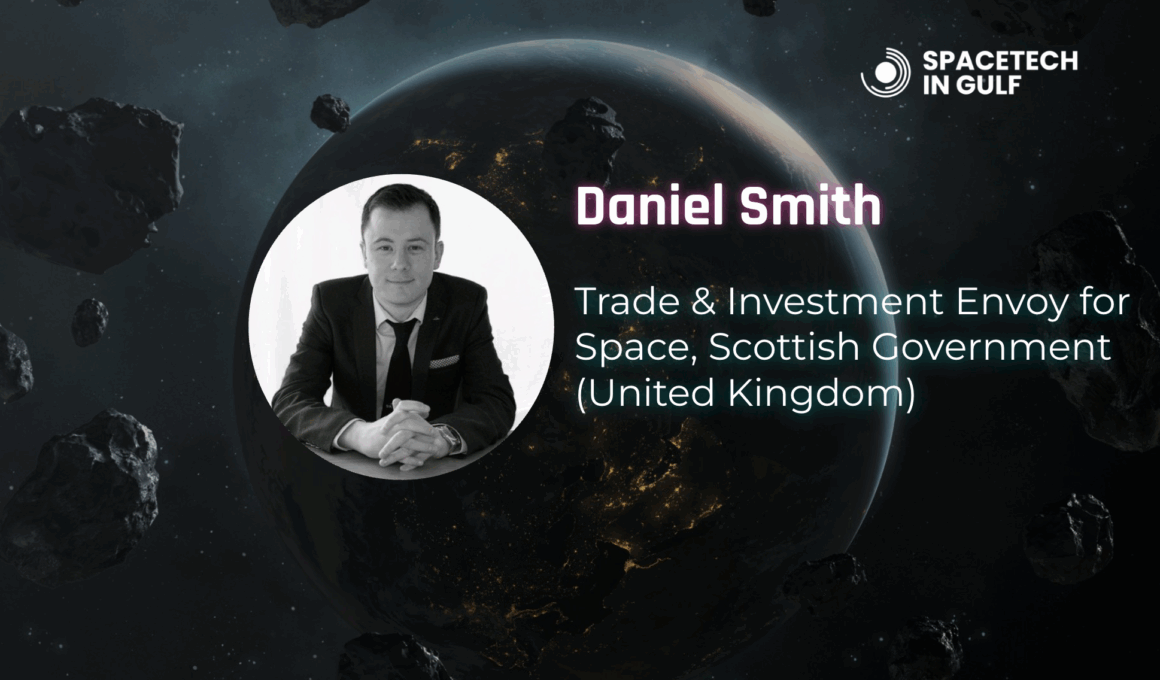

Trade & Investment Envoy for Space, Scottish Government
(United Kingdom)
Daniel Smith FRSA is the Scottish Government’s Trade & Investment Envoy for Space, working to strengthen international collaboration and promote Scotland’s fast-growing space sector. Appointed in 2024, he had previously played a leading role in developing Scotland’s national space strategy and the world’s first Space Sustainability Roadmap, as well as being a founding director of five space companies, including AstroAgency.
He sits on the UN High-Level Expert Group on Data & Frontier Technologies and is a producer of space documentary Fortitude: Forging the Trillion Dollar Space Economy.
Given that Scotland is a leader in small satellite manufacturing and data analysis, what are the government’s plans to ensure that this existing strength is fully leveraged to attract further international investment and partnerships?
Scottish Government agencies such as Scottish Enterprise champion these capabilities globally to drive new opportunities for export and inward investment, and the newly created Space Envoy role adds extra resources to those efforts. My appointment marked the first time a sector-focused government Envoy had been designated in Scotland, a show of intent from the Scottish Government. Of course, being part of the UK, the Department for Business and Trade also plays an important and valuable role in these efforts.
Whilst the satellite manufacturing side, with companies like Spire,AAC Clyde Space, Craft Prospect and Alba Orbital, is well-known within the space industry, the data analysis side is less so. Space data companies seek to reach non-space audiences and can often struggle to commercialise, due to the challenges of overcoming misconceptions around space technology, costs, investment returns and speed of delivery. The Government and its agencies are actively working to change this perception, championing space as a solution for a range of challenges and informing non-space bodies of the benefits of satellite data, in order to ensure procurement programmes capture this critical technology.
The UK Space Agency is working with the Scottish Government to find new ways to alert private sector investors of the opportunities of space data, as well as highlighting space as a supplier across multiple sectors. The Agency’s Unlocking Space for Business and Unlocking Space for Investment programmes are particularly important in addressing such challenges.

How does the Scottish Government’s “Team Scotland” approach—which brings together industry, academia, and public agencies—enhance the country’s ability to compete and innovate on the global stage?
Scotland may be a small country, but that is one of our strengths. It allows us to work closely together, share knowledge and support one another effectively. The “Team Scotland” approach, driven through Space Scotland and the regional clusters that feed into it, was designed to connect industry directly with academia and government.
In 2022, AstroAgency, together with Optimat, authored the Space Sustainability Roadmap to reflect the ETF’s growing ambitions, supported by Scottish Enterprise. This open-source, industry-led roadmap is not just words but a detailed, action-oriented framework of work packages aligned with the Scottish Government’s target of reaching Net Zero by 2045. Over the past five years, the ETF has worked to drive this forward, ensuring sustainability is integrated into the development of launch sites and satellite technologies across Scotland.
The roadmap has also generated significant international interest, with organisations such as UNOOSA, the Portuguese and Australian Space Agencies, the Korean Space Forum, Malaysia’s MASIC and the Secure World Foundation engaging with Scotland as a result. That recognition has given Scotland’s space community a seat at the table alongside leading space nations and demonstrates the credibility of our sustainability-first approach, designing our development with sustainability at its heart, rather than looking to bolt-on greener practices later. I’m looking forward to seeing the latest progress update on the Roadmap, to be presented by the ETF at Space-Comm Expo in Glasgow later this year. This embedding sustainability from the outset has resulted in many organisations looking at the environmental impact of their work early on, for example the spaceport developments in Scotland have all engaged with the ETF and each has a strong sustainability offering that goes far beyond their obligatory environmental impact assessment, leading by example globally, showing how the space industry (the launch aspect in this case) can enable sustainable space operations in a manner that is both environmentally sustainable and economically beneficial. We’ve also seen many Scottish space companies take part in carbon audits, as the ETF sought to understand the ‘baseline’ for space sustainability in the country. In order to measure change, you need to understand where you are beginning from, so this work has been important (and supported financially by Scottish Enterprise, the government’s economic development agency).
The Scottish Space Strategy aims for a £4 billion share of the global space market and significant growth in space-related employment. What key government policies and investments are in place to directly support this economic growth target?
Scotland’s Space Strategy is closely aligned with the UK National Space Strategy. Space is not devolved, so responsibility for policy and legislation sits with the UK Government.
However, because space underpins so many areas of our economy and daily lives, the Scottish Government has identified it as a priority application area, supporting industries such as maritime, energy, transport, agricultural, natural capital and more. Many of these sectors fall under devolved powers, and each can be strengthened through the use of satellite data.
Scotland is unique in Europe in being able to offer an end-to-end value chain for small satellites. With 4 satellite building companies and numerous companies building subsystems, we already manufacture more small satellites than anywhere outside the United States, and with orbital launch capability expected soon, we will be the only European nation to combine satellite production with launch. This in turn supports more than 30 Scottish firms applying satellite data across multiple industries.
Government support reflects this strength at every level. The Scottish Government and its agencies back the sector through resources, funding and support for grass-roots initiatives such as Space Scotland, as well as new technology development and business growth support. The UK Space Agency has been central in helping to grow Scotland’s organic “meta-cluster” into a structured national success. And at the European level, the European Space Agency provides another vital layer of collaboration and opportunity of which Scotland is proud to be part.

How is Scotland ensuring environmental goals are integrated into new launch sites and satellite technologies?
I was honoured to play a founding role in establishing Space Scotland’s voluntary Environmental Task Force (ETF) in 2020, bringing together industry, academia and organisations such as Friends of the Earth and ESA to explore how Scottish companies and universities could embed environmental responsibility both on the ground and in orbit.
This triple-helix model ensures we are not just promoting individual businesses but raising the entire sector, which now includes more than 180 companies underpinned by world-class universities and colleges. That sense of community has also enabled the creation of new companies and collaborations. Personally, I have been fortunate to serve as a founding director in five Scottish space firms, and each has benefitted from the camaraderie, openness and desire to collaborate that defines our ecosystem. This approach makes Scotland stronger internationally, as our delegations abroad reflect a sector that is cohesive, cooperative and eager to build global partnerships. In space, no nation can achieve everything alone, and Scotland’s collective spirit makes us an ideal partner.
What public-led initiatives are in place to develop a skilled workforce and a talent pipeline that will be crucial to meeting the ambitious job creation targets in the space sector?
Government agencies like Skills development Scotland and Education Scotland work closely with Space Scotland’s Skills and also its New Voices in Space working groups to stay informed on the direction of the industry and both its current and future workforce pipeline requirements. There are more than 90 countries around the world carrying out space activities and there is no doubt that this is a challenge for many of the emerging space nations. Scotland’s space ecosystem is so broad and its activities so diverse, that knowing whether we will need more ‘upstream’ engineers for propulsion, avionics and mechanics or ‘downstream’ computer scientists for data analysis is difficult, plus there are so many opportunities for supporting roles across marketing, business development, design, law, recruitment, market intelligence and technology transfer consultancy. I don’t envy the role of those responsible for figuring out how we ensure that the skills of future generations align neatly with what space businesses will need, but I know how important it is to engage with Scotland’s SMEs in order to map out what that will look like. It’s also vital to ensure that those already in employment and looking to transition careers are aware that space is not some ethereal sector that is out of touch or in some way flimsy, but a well established industry backed by decades of achievement and already crucial to supporting the economy, environment and wider society. Reports state that 1⁄5 of the UK economy is directly supported by space, and 2⁄3 of environmental monitoring is carried out from orbiting space satelites – space isn’t going anywhere and it offers viable careers for anyone interested in being part of an exciting and growing industry.
In your role as Scotland’s Space Envoy, you made the UAE a priority country to build new bridges with. Planned cooperation between the two nations covers advanced technology, innovation, sustainability, and research. What are the next steps in these conversations?
I knew from past experience on multiple space trade delegations to the UAE and from what many of Scotland’s small-medium businesses were asking me when I was appointed, that the UAE was a country of significant interest for Scotland, not just for space but more broadly. After we had written Scotland’s inaugural space strategy and successfully took it through all of the various stakeholder engagement required, we chose Expo Dubai in 2021 as our platform to launch the document. We held a space day in the UK Pavilion and it was incredibly well received. Publishing overseas was symbolic of our desire to forge new international relationships, but also to grow closer to the UAE’s space initiatives. The UAE therefore played a major role in that key moment for announcing Scotland’s space ambitions.
At COP28 in the UAE I travelled with the First Minister in my previous role as a Director of Space Scotland to speak on a blue zone panel with Scottish space firms attending the event and locally located AzurX, led by an exceptionally talented GlobalScot. I also presented on an ESA panel and took part in many visits to places like the Mohammed Bin Rashid Space Centre (MBRSC). I had been there in the past, as AstroAgency has led a UK Space Agency funded Bilateral initiative between the UK, UAE and Bahrain, so I already had some ideas on ways the wider Scottish and UK community could benefit from closer engagement.
At the start of this year, I again met with MBRSC, together with my UAE-based colleague Dennis from Scottish Development International, who specialises in representing Scottish space interests in the Gulf. This time we were joined by the CEO of Scottish Enterprise and the Deputy First Minister of Scotland, who were in the country for the newly launched Scotland Week. From that moment, it really felt like our collaboration was about to move to a new level and we couldn’t have been made to feel more welcome. The next steps will be bringing Space Scotland and its member companies, as well as its International Working Group, into the engagement to bring focus and ensure tangible outcomes.
How is the collaboration with the UAE expected to enhance Scotland’s international standing in the space sector and create new opportunities for the Scottish space ecosystem?
Both our Space Strategy and our Space Sustainability Roadmap clearly call for international collaboration, so finding a partner like the UAE where we have different strengths but are working towards many similar goals, is important. Collaboration with the UAE provides Scotland with a valuable platform to showcase its strengths as one of the most complete and connected space ecosystems in Europe, while aligning with a nation that has demonstrated remarkable ambition and delivery in space within a short timeframe. By working together, we can combine Scotland’s expertise in small satellites, data analysis, research and sustainability with the UAE’s strengths in investment, global connectivity, space science and deep space missions. It also means we can find gaps to plug, for example the UAE can consider including Scottish companies’ data insights as part of its wider tools for addressing local challenges, while Scotland’s desire to increase interaction with private investors means that the UAE investment community can be given swift, easy access to exploring exciting opportunities among Scotland’s space scale-up ecosystem. Growing our channels for collaboration will enhance visibility of opportunities and challenges on both sides, while also opening doors to the wider European and Gulf ecosystems respectively. All of this creates new commercial, research, and skills opportunities for organisations across our ecosystem, from upstream manufacturing to downstream applications that benefit everyday life on Earth.
What are the most significant shared challenges in the space sector that both the UAE and Scotland are working to address together?
There are lots of opportunities. Both Scotland and the UAE recognise that space sustainability is one of the defining challenges of our time, from reducing orbital debris and emissions linked to launch, to ensuring satellite data is applied effectively to address climate change and environmental protection. We also share the challenge of building a skilled workforce to support rapidly growing space clusters, ensuring that young people see space as a viable and inspiring career path. By tackling these challenges together, we can pool expertise, share best practices, and accelerate solutions that benefit not only our two nations, but the global space community.
You can find more interviews and articles on the UAE space ecosystem in our latest magazine.