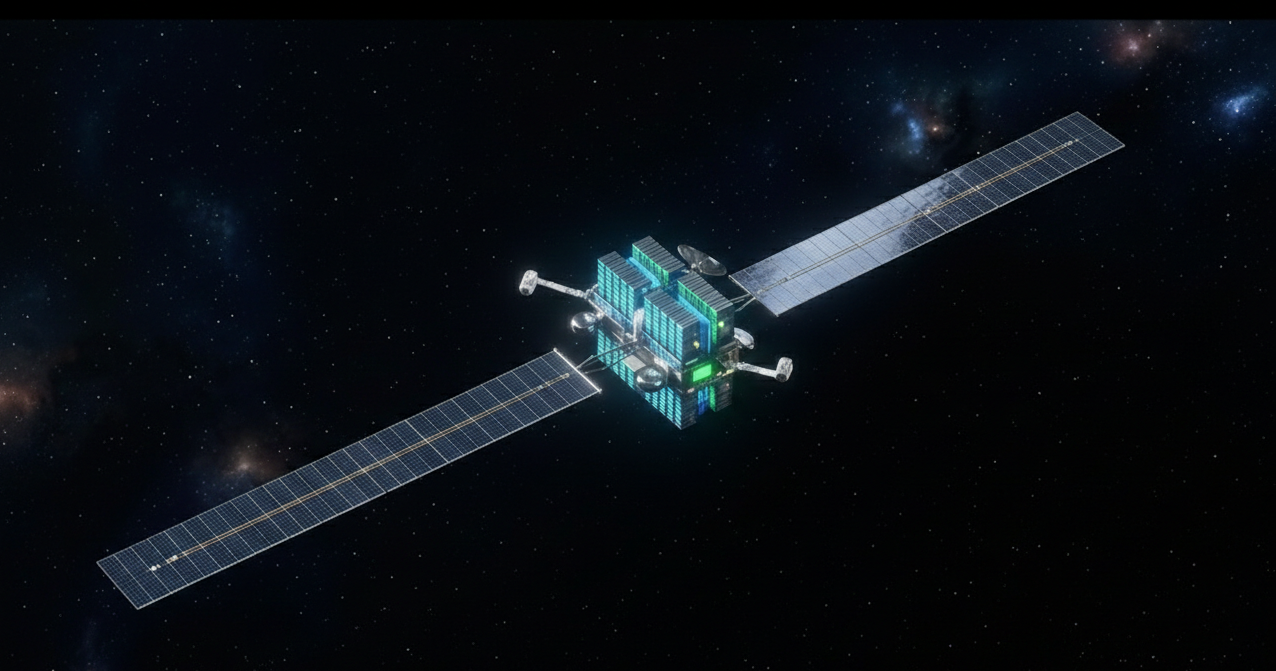






Beyond its home market in the UAE, the satellite operator now known as Space42 has built a meaningful international footprint — spanning Africa, Asia, Europe, and North America — largely inherited from Yahsat’s pre-merger satellite communications business. New financial disclosures reveal a consistent underlying international revenue base that was temporarily obscured by the accounting effects of the 2024 merger between Yahsat and Bayanat, and is now being reinforced by new partnerships and market entries across several regions.
What Yahsat was doing internationally
Before the merger, Yahsat operated as a global satellite communications provider, with international revenue built primarily around its Thuraya mobile satellite services and Al Yah satellite capacity leasing. Thuraya’s L-band mobile broadband and IoT/M2M services had long-established reach across Africa, Asia, and Europe, while partnerships such as YahClick’s collaboration with NIGCOMSAT extended broadband connectivity across Sub-Saharan Africa. This gave Yahsat a diversified — if UAE-centered — revenue base, with international markets consistently contributing roughly 15-20% of total revenue in 2022 and 2023.
The numbers
| Region | Yahsat 2022 | Yahsat 2023 | Space42 2024 (actual) | Space42 2025 (actual) | Space42 Q1 2025 | Space42 Q1 2026 |
|---|---|---|---|---|---|---|
| UAE | 370,299 | 375,437 | 309,890 | 516,682 | 105,125 | 106,180 |
| Asia | 21,355 | 36,834 | 14,694 | 24,061 | 4,197 | 3,891 |
| Africa | 16,806 | 20,227 | 3,833 | 23,534 | 2,842 | 1,809 |
| Europe | 19,194 | 19,785 | 1,963 | 9,432 | 2,062 | 2,796 |
| North America | 3,729 | 3,346 | 662 | 2,653 | 674 | 879 |
| Others | 1,157 | 1,109 | 167 | 305 | 166 | 0 |
| Total | 432,540 | 456,738 | 331,209 | 576,667 | 115,066 | 115,555 |
All figures in USD ‘000.
A consistent international base, briefly masked by merger accounting
Under Yahsat, every major international region grew steadily between 2022 and 2023. Africa rose from $16.8 million to $20.2 million (+20%), Asia grew from $21.4 million to $36.8 million (+72%), and Europe edged up from $19.2 million to $19.8 million. Together, these regions — plus a smaller North American contribution of around $3.3-3.7 million — formed a stable international base alongside the dominant UAE market. This aligns with separately reported figures showing Africa accounted for roughly 4.3% of Yahsat’s revenue in the first half of 2023.
2024 was the year Yahsat merged into Bayanat to form Space42, with the transaction completing on 1 October 2024. Because the 2024 actuals only consolidate three months of Yahsat’s results alongside a full year of Bayanat, the reported figures for that year show a sharp pullback across every international region: Africa fell to $3.8 million, Europe to $2.0 million, Asia to $14.7 million, and North America to $0.7 million. This pattern points to an administrative effect of the merger rather than a genuine shift in demand — international operations, largely inherited from Yahsat, often see activity pause briefly during a major integration, as teams focus on consolidating legal entities, billing systems, and contracts around the transaction date. Read this way, the 2024 figures are best understood as a snapshot of a transition period, not a reflection of underlying business activity.
A return to form — likely reflecting Yahsat’s legacy international business
2025 marked the first full year of the combined Space42 group, and every international region recovered substantially: Africa reached $23.5 million (above its 2023 peak), Asia returned to $24.1 million, Europe rose to $9.4 million, and North America to $2.7 million. While none except Africa fully matched 2023 levels, the broad-based recovery across all regions — happening simultaneously — strongly suggests this is Yahsat’s pre-merger international business resuming at something close to its normal pace, now fully consolidated for 12 months within Space42.
This recovery coincided with a flurry of new international activity that builds on, rather than replaces, that legacy footprint. In Africa specifically, Space42 saw the commercial rollout of the Thuraya-4 satellite in South Africa (its first entry into that market), a five-year strategic partnership with Angola to expand SpaceTech and AI collaboration, and a major new geospatial data initiative spanning the continent.
In July 2025, Space42 signed a memorandum of understanding with Microsoft and Esri to deliver the Map Africa Initiative, a project to provide high-resolution geospatial base maps across 54 African countries — roughly 30 million square kilometers, or about 30% of the world’s habitable land, serving more than 1.4 billion people. The five-year partnership is designed to support infrastructure development and investment decisions across the continent, while expanding the reach of Space42’s Smart Solutions business and its AI-powered geospatial intelligence platform, GIQ.
While Map Africa is a long-term, multi-year initiative rather than an immediate revenue driver, it signals an additional growth layer on top of Yahsat’s existing connectivity business — combining satellite communications with data and analytics across the continent.
Looking ahead
The first quarter of 2026 showed a mixed picture across regions: Africa came in at $1.8 million (down from $2.8 million a year earlier), while Europe rose to $2.8 million (up from $2.1 million) and North America grew to $0.9 million (up from $0.7 million). Quarterly figures for satellite and mobility revenue can be lumpy and contract-driven, so a single quarter is unlikely to be representative of the full-year picture for any one region — particularly with new initiatives like South African operations and the Map Africa Initiative both still in their early stages. As these programs mature over the coming quarters, they should provide a clearer signal of each region’s trajectory under the unified Space42 platform.
The bottom line
Beneath the accounting noise of a major corporate merger, Space42’s international business — inherited largely from Yahsat’s pre-merger satellite communications operations — has been a quietly consistent contributor across Africa, Asia, Europe, and North America. The 2024 figures look like operations briefly on hold during integration rather than lost business, and the 2025 recovery across every region looks like a return to that underlying Yahsat-era footprint, now reinforced by new investment. With the Map Africa Initiative set to deliver foundational geospatial data across 54 countries over the next five years, and satellite connectivity expanding into new markets like South Africa, Space42’s international footprint — and Africa in particular — looks set to deepen considerably in the years ahead.
You can read the interview with Yuliya Tarabalka, Vice President of Geospatial Solutions at Space42, here.
Sources:
SPACE42 PLC Report and Condensed Consolidated Interim Financial Statements 2026
SPACE42 PLC Report and Condensed Consolidated Interim Financial Statements 2025
Securing the future, Enabling SpaceTech solutions
SPACE42 PLC (formerly BAYANAT AI PLC) Pro forma Financial Information and Consolidated Financial Statements 2024