

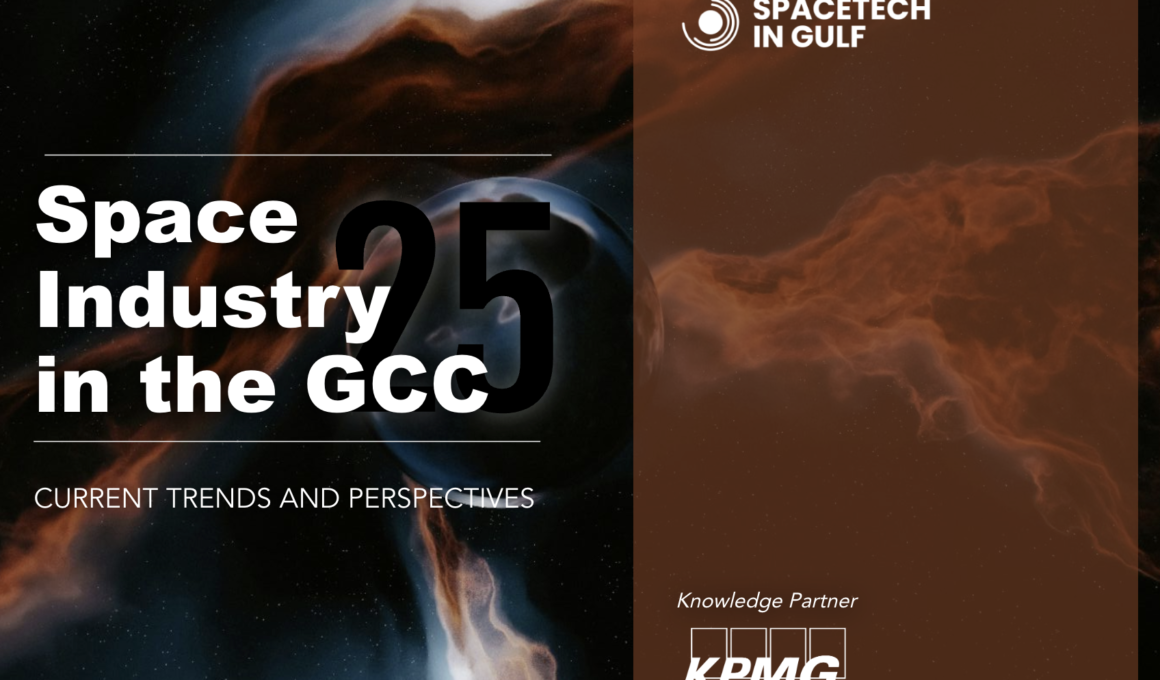
New landmark study by SpaceTech in Gulf, with knowledge partner KPMG, reveals a GCC space sector in strategic transition. The region is moving decisively to build autonomous launch capability, AI-integrated operations, and a space economy now integral to national security and economic visions.
The Gulf Cooperation Council (GCC) space sector is undergoing a decisive transformation, moving beyond landmark missions to construct a sustainable, sovereign, and commercially-driven industrial ecosystem. This strategic pivot is captured in the flagship 2025 magazine released today by SpaceTech in Gulf, developed with KPMG Middle East as Knowledge Partner.
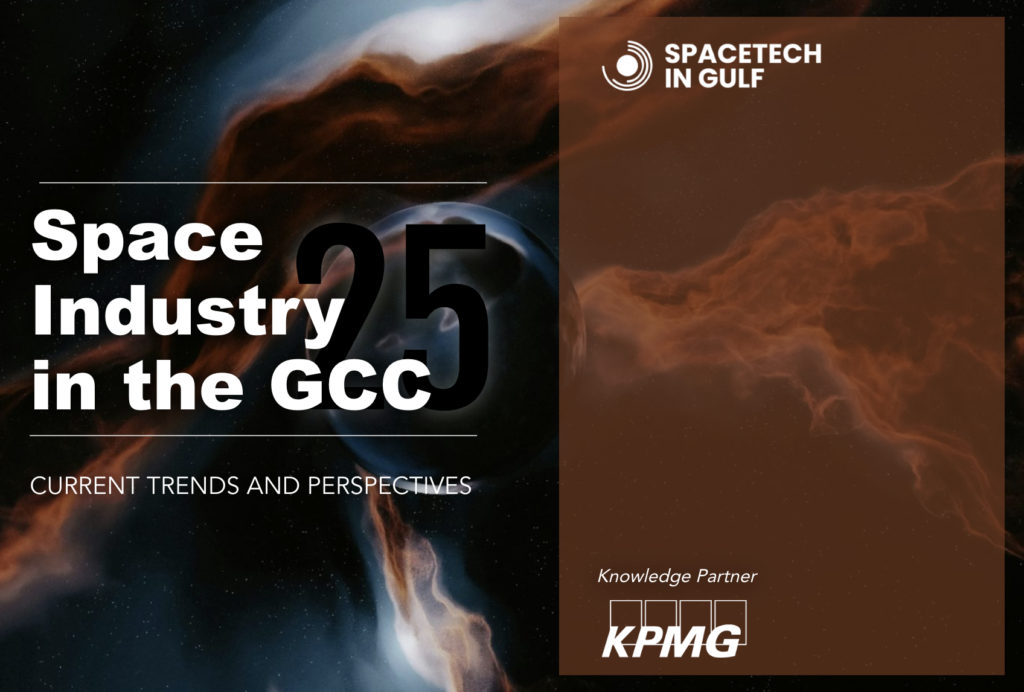
Click here to access the magazine
The study offers the most comprehensive assessment to date. SpaceTech in Gulf’s proprietary research has mapped over 930 active organizations that now form the backbone of the region’s space and defence ambitions. The analysis reveals a sector deeply integrating space infrastructure with national security, economic diversification, and AI-driven innovation.
“Our independent mapping and analysis capture the emergence of a fully-fledged industrial base that is starting to set its own strategic agenda. By tracking everything from core players to strategic partnerships, we see an ecosystem rapidly transitioning from demonstration to operational sustainability,” said Alex Cresniov, CEO and Founder of SpaceTech in Gulf.
Exclusive Regional Leadership Insights
The Magazine features authoritative contributions from across the GCC:
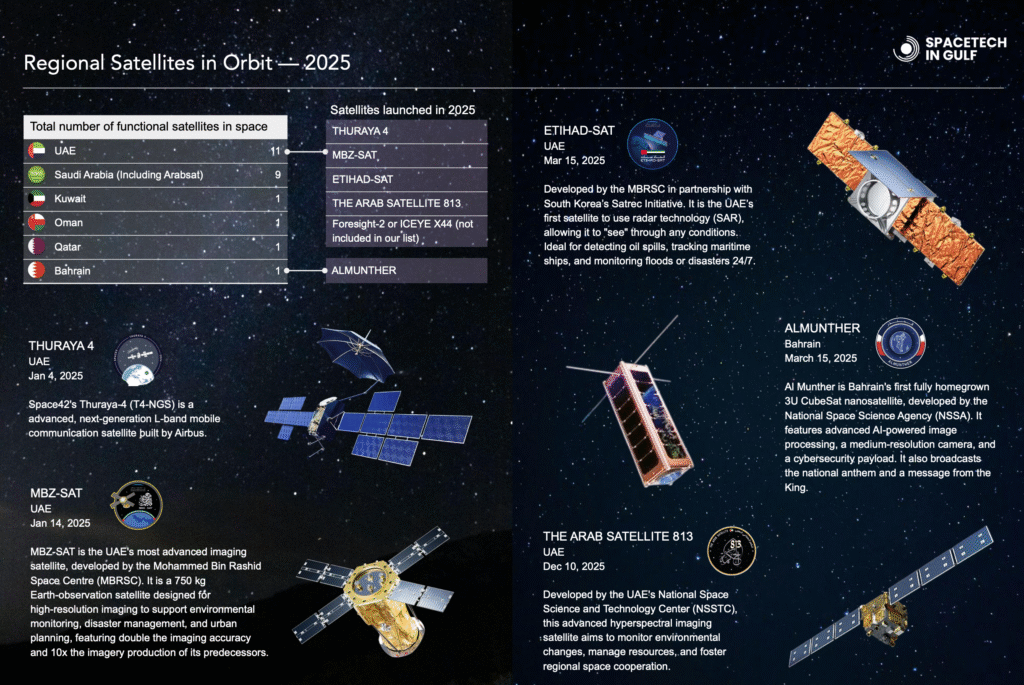
- Dr. Mohamed E. Al-Aseeri, CEO of the Bahrain Space Agency, detailed a year of sovereign capability-building. Highlights include the successful AlMunther satellite, inaugural hosted payloads, a new national ground station, and over 25 applied Earth Observation solutions driving sustainable development.
- Dr. Saoud Humaid Al Shoaili, Head of the National Space Program, MTCIT (Oman), outlined Oman’s strategic drive to become a regional downstream hub. Key 2025 milestones include the OmanSat-1 communications satellite contract, the Oman Space Accelerator Program, and development of the Duqm spaceport for launch services.
- The CST (Communications, Space and Technology Commission) highlighted Saudi Arabia’s record-breaking push in space entrepreneurship, catalyzed by initiatives like the SpaceUp competition with $28M in contract opportunities, a new Earth Observation platform, and progressive space sector regulations.
- The UAE Space Agency reinforced its exploration leadership and regional collaboration. Landmarks include activating data from the Arab Satellite 813 mission, advancing the Emirates Mission to the Asteroid Belt, and launching new satellites to bolster national communications and observation capabilities.
Key Trends 2025-2026: From Prestige to Strategic Sovereignty
“Space is no longer a standalone sector; it’s becoming the ultimate dual-use critical infrastructure, vital for both economic competitiveness and national security in the Gulf,” said Patrick Walthuis, Director of Defense and Security at KPMG Middle East, who contributed strategic analysis to the magazine.
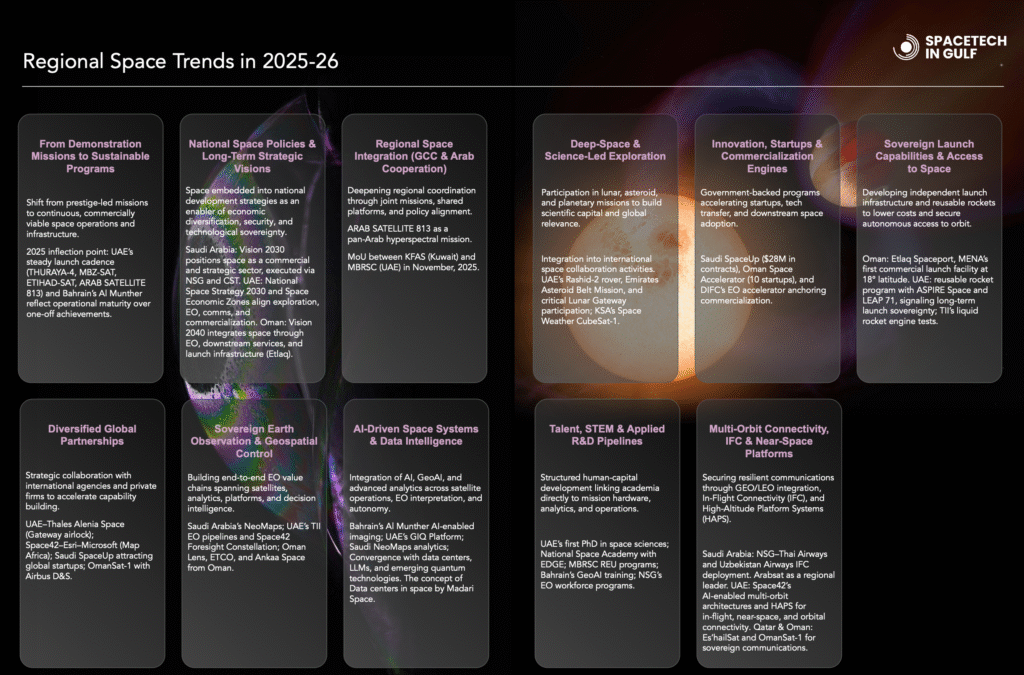
The report identifies a decisive shift from symbolic missions to a sustainable, sovereign space ecosystem. This transition is defined by three core pillars:
First, the GCC is establishing sovereign foundational infrastructure, moving from sporadic launches to operational continuity. This includes securing autonomous access to orbit via Oman’s Etlaq Spaceport and the UAE’s reusable rocket programs, and building complete Earth observation value chains.
Second, the sector is being transformed by advanced technology integration. Artificial Intelligence is now central to operations, from satellite imaging to data analytics, while new multi-orbit and high-altitude connectivity architectures are ensuring resilient communications.
Third, growth is fueled by activated commercial and human capital engines. Aggressive startup accelerators and funding programs are driving commercialization, while specialized academies and targeted R&D pipelines are directly building the expertise required for long-term leadership.
This strategic blueprint marks the GCC’s evolution into a unified, self-sustaining space power bloc.
“The commercial scaling of aerospace manufacturing and the diversification of supply chains are key economic engines,” added Arjun Sreekumar, Associate Director for Defense, Space and Aerospace at KPMG Middle East. “The strategic analysis we provided details how the region is building not just rockets, but a resilient, innovation-led industrial base.“
Definitive Database of the Space Industry
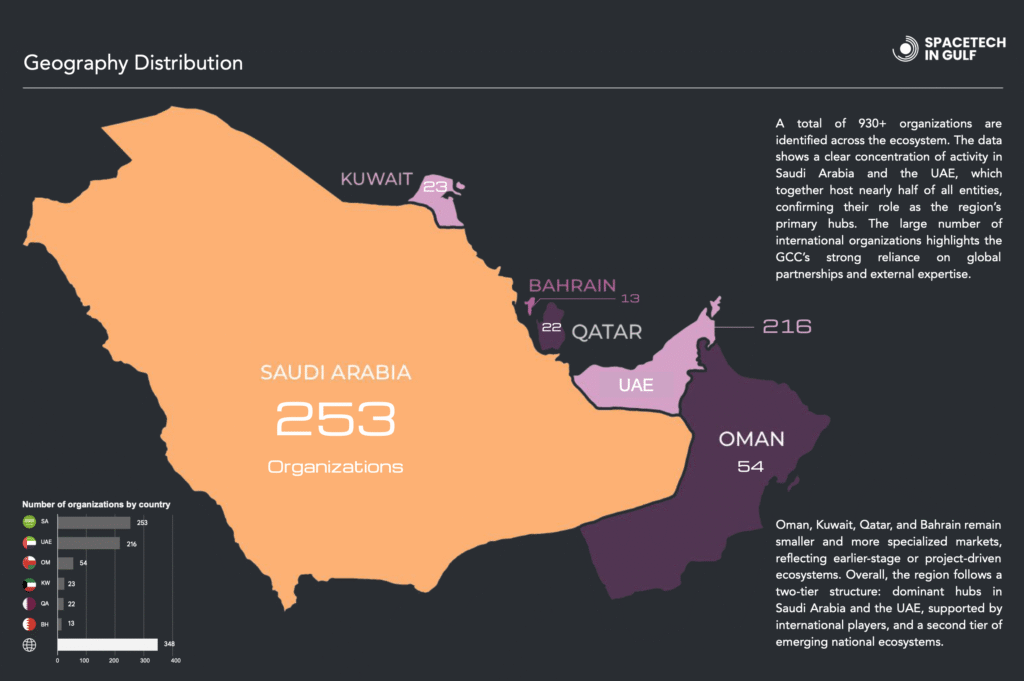
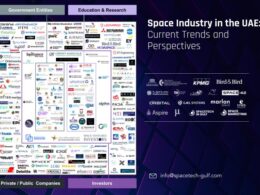
A core output of the research is a definitive, transparent database of the GCC space and defence landscape, compiled exclusively by SpaceTech in Gulf from open-source intelligence. It categorizes 728 companies, 94 government agencies, 64 academic institutions, and 42 investors. Sectors range from SATCOM and aerospace manufacturing to geospatial analytics and specialized software platforms. This granular view highlights how space investments are directly fueling broader national visions like Saudi Vision 2030 and Oman Vision 2040.
Why This Matters Globally
The GCC’s strategic pivot presents a new dynamic for the global space economy. The development of sovereign launch capabilities, a deeply integrated space-security nexus, and the prioritization of commercial sustainability signal the rise of a powerful, self-directed space bloc. This creates new partnerships, investment corridors, and competitive dynamics for incumbents worldwide.
About SpaceTech in Gulf
SpaceTech in Gulf is the premier analytics and market intelligence firm dedicated to the MENA space sector. Specializing in strategic communications and data-driven insights, the company empowers stakeholders to navigate the region’s unique challenges and opportunities, driving innovation and sustainable growth.
About KPMG Middle East
Part of the global KPMG network, KPMG Middle East provides audit, tax, and advisory services across the region. With a 50-year legacy, it combines deep local expertise with international reach, helping public and private sector clients solve complex challenges.
Media Contact:
Alex Cresniov
SpaceTech in Gulf
info@spacetech-gulf.com