

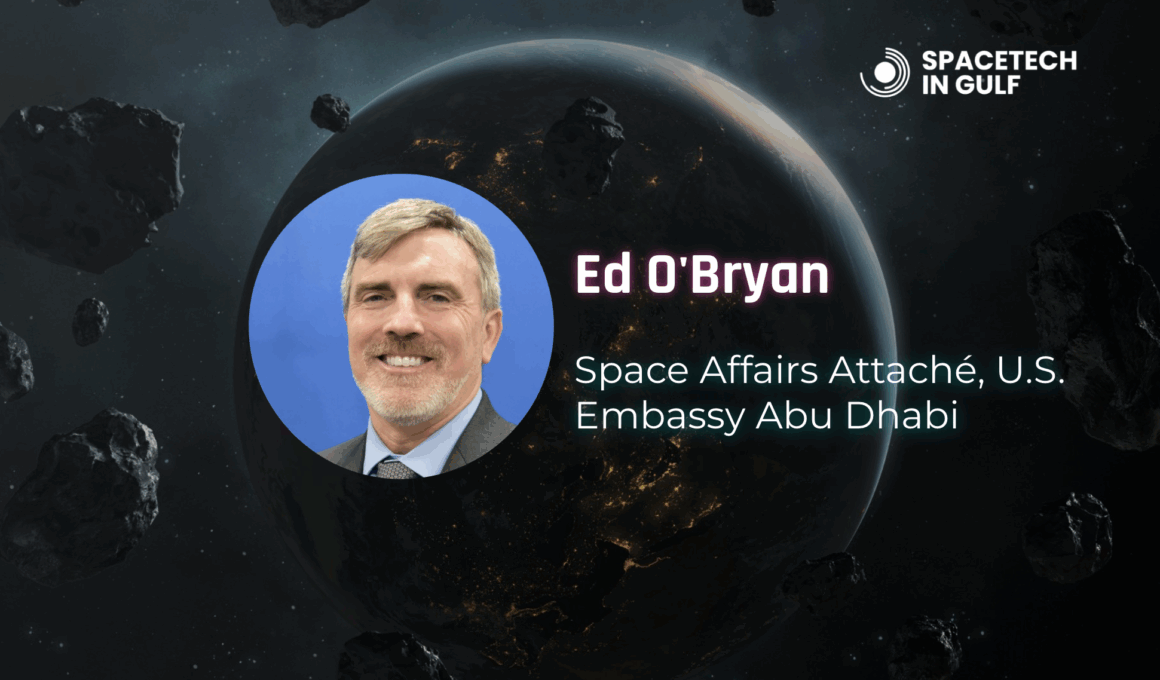
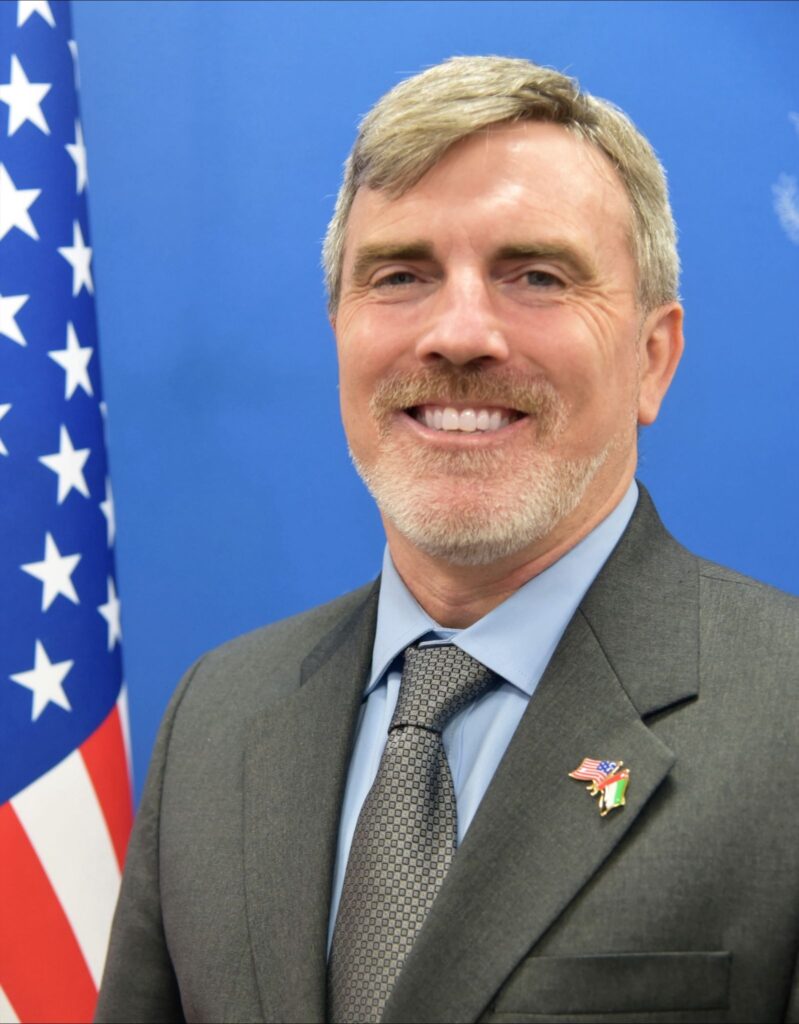
Space Affairs Attaché,
U.S. Embassy Abu Dhabi
Ed O’Bryan is a career Foreign Service Officer at the United States Department of State and is currently serving as the Space Affairs Attache at U.S. Embassy Abu Dhabi. Previous assignments include Saudi Arabia, Ukraine, Turkmenistan, and Washington DC. Ed holds bachelor and masters degrees from the University of Nebraska.
How would you describe the U.S.-UAE space relationship?
The U.S.-UAE space relationship is something we’re incredibly proud of, and it has deep roots that go back nearly half a century. In 1976, a team from NASA, including Apollo 17 astronauts, met with Sheikh Zayed to discuss the upcoming Space Shuttle program. That meeting planted the seeds for what has grown into one of our fastest-growing space partnerships today.
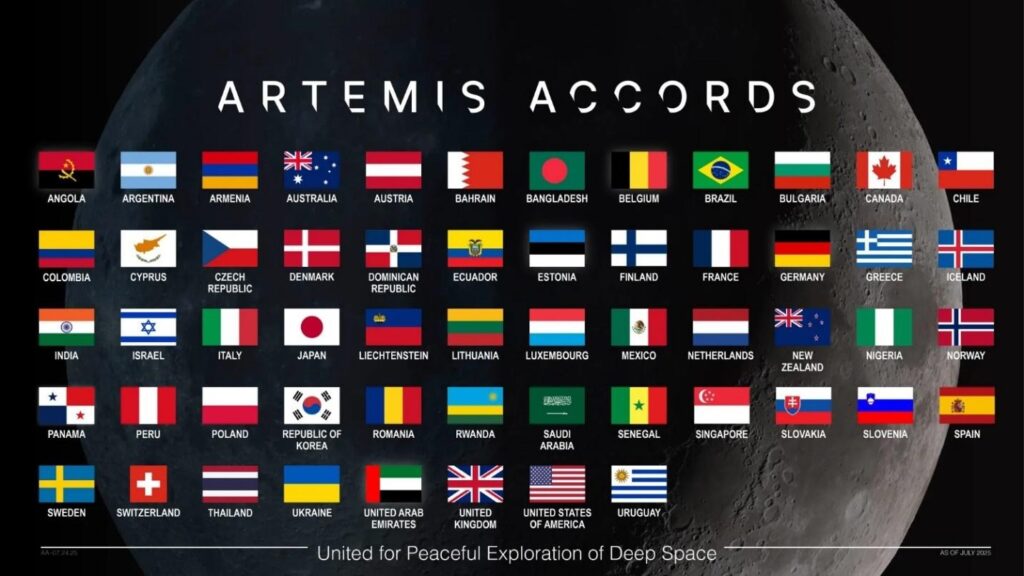
A major milestone in this relationship came in 2020, when the UAE became one of the eight founding signatories of the U.S.-led Artemis Accords. These Accords establish a framework for cooperation in the civil exploration and peaceful use of the Moon, Mars, and other celestial bodies. Since then, the Accords have expanded to include 56 members, and the UAE Space Agency (UAESA) has remained a vital and active participant. In fact, UAESA hosted an Artemis Accords Workshop this past May, further demonstrating its leadership in the global space community.
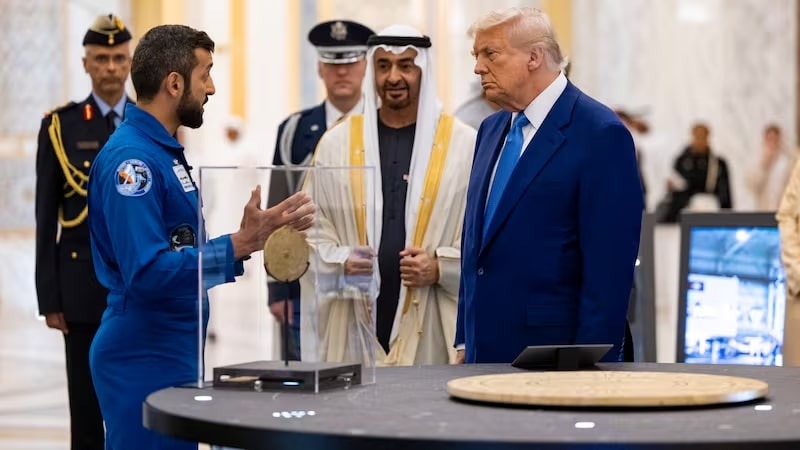
The collaboration extends to human spaceflight as well. Two Emirati astronauts have flown alongside U.S. astronauts on the International Space Station (ISS), including Sultan al Neyadi’s six-month mission in 2023. All four Emirati astronauts continue to train regularly at NASA facilities, preparing for future mission opportunities.
The partnership also includes significant contributions to lunar exploration. In 2024, the Mohammed Bin Rashid Space Centre (MBRSC) joined NASA’s Artemis Program and committed to providing the Crew and Science Airlock for the Gateway lunar space station. Gateway will orbit the Moon as part of NASA’s broader Moon-to-Mars architecture, and an Emirati astronaut is already planned to fly to Gateway once it becomes operational in the 2030s.
Beyond government collaboration, U.S. space companies are strong partners of the UAE as well. Earlier this year, SpaceX launched four UAE satellites on a single Falcon 9 rocket, including MBRSC’s MBZ-Sat, Space42’s Foresight, Al Ain Sat 1, and HCT Sat 1. MBRSC also partnered with Axiom Space to transport Sultan al Neyadi to the ISS in 2023 and recently announced a partnership with Firefly Aerospace to deliver its Rashid-2 rover to the Moon’s surface in 2026, aboard another SpaceX rocket.
This dynamic partnership reflects the shared vision and commitment of both nations to advancing space exploration and innovation, and we look forward to continuing to build on this strong foundation in the years ahead.
Are there joint research or academic programs between U.S. and UAE universities in space sciences or engineering?
The U.S. and UAE share a strong and growing network of academic and research partnerships in space sciences and engineering, with collaborations taking place across numerous institutions in both countries. One of the most prominent examples is the University of Colorado Boulder, which has been a long-time partner to the UAE through its Laboratory for Atmospheric and Space Physics (LASP). Over the years, more than a hundred Emirati scientists and students have worked alongside U.S. scientists at LASP to design missions and build spacecraft for groundbreaking projects like the Emirates Mission to Mars (EMM) and the Emirates Mission to the Asteroid Belt (EMA). The UAE’s Hope Probe, part of the Emirates Mission to Mars, is a testament to this collaboration. It is one of only six active spacecraft currently orbiting Mars. Since reaching the Red Planet in 2021, Hope has been sending back critical data on Martian weather, which will play a key role in supporting future missions to the planet’s surface.

Looking ahead, the UAE Space Agency’s Emirates Mission to the Asteroid Belt is another exciting project. Scheduled to launch the MBR Explorer spacecraft in 2028, this mission will visit seven asteroids on a historic deep-space journey. The UAE has also established itself as a regional hub for academic and research excellence in space. For instance, New York University’s Abu Dhabi campus has become a center for space studies, recently launching a PhD program in astrophysics and space systems. It’s remarkable that students interested in space are now coming to Abu Dhabi, rather than New York City, to pursue their studies.
Speaking of New York, the Rochester Institute of Technology (RIT) is another key player. Its U.S. campus is home to a world-leading imaging science center that develops satellite imaging technologies. Meanwhile, its Dubai campus is fostering growing opportunities for collaboration in Earth observation, providing students with access to cutting-edge research.
This spring, Khalifa University—whose space program is led by a former NASA scientist—along with UAE University and the University of Sharjah, hosted a senior NASA visitor to explore new cooperation opportunities. Beyond these institutions, many U.S. universities maintain strong research ties with the UAE. For example, the California Institute of Technology works closely with the Technology Innovation Institute in Abu Dhabi, while MIT and the University of Arizona also have active collaborations here.

These partnerships are just the beginning. There are many more connections between U.S. and UAE institutions, and we are always looking for new opportunities to expand this vital academic and research cooperation.
Are there any exchange programs focused on space or aerospace for UAE students? What other opportunities are available for UAE students?
Every year we have groups of high school students from the UAE attend space camps in the United States, including through the Endeavour Scholarship which is run by the Kallman Foundation. Another great program, initiated by SolarSpace, a U.S. company working in Dubai, took Emirati university students to a space camp in Arizona and plans to take another group this year.
The NASA Space Apps Challenge is the world’s largest hackathon and we are proud that MBRSC is one of NASA’s partners in this competition. Teams use NASA data to solve challenges created by actual NASA scientists. The event takes place every October and includes a series of trainings on how to access and use NASA data. We were thrilled to announce earlier this year that a team from UAE, four university students from Ras al Khaimah, won the 2024 competition, beating out 10,000 entrants with their project, and we hope to see another winner this year!
Which sectors do you see U.S. space companies being most active in.
UAE is fast becoming the satellite manufacturing hub for the region. By next year we will start seeing regular launches of commercial satellites that were built in the UAE. U.S. satellite manufacturer Loft Orbital has joined with UAE based Marlan space to create OrbitWorks and they are building an amazing facility outside Abu Dhabi. OrbitWorks will assemble, integrate, and test its first commercial satellites at that facility and then ship them to the United States for launch. Space42 and Fada are also planning to build satellites in the UAE as well. With so many satellites being built here, it also creates a great opportunity for U.S. companies to develop the local supply chain, as well as amazing new careers in the space sector.
Source: NASA
How does the Embassy facilitate partnerships between U.S. companies and UAE space entities, and what Embassy-supported services are available to help U.S. space companies enter the UAE market?
Supporting U.S. companies in the UAE is one of the most important things we do at the U.S. Embassy, and that starts with our U.S. Commercial Service which has a range of services available. U.S. companies can discuss export opportunities with the U.S. Commercial Service office closest to them, there are over 100 offices in the United States, or if already in the UAE, contact our offices in Abu Dhabi (Office.AbuDhabi@trade.gov) or Dubai (Office.Dubai@trade.gov). We regularly support trade missions and encourage U.S. companies to participate in conferences and expos in the UAE, particularly those with a space focus, such as the Abu Dhabi Space Debates and Dubai Air Show.
What kinds of new space technologies being developed in the United States do you think could be valuable in the UAE?
There are some incredible developments happening across the U.S. space sector. SpaceX continues to make the United States the best place in the world to launch spacecraft, and new rockets and launch companies are also coming online to ensure the United States provides the fastest and easiest access to space. Traditional sectors like communications, navigation, weather forecasting, and earth observation are all undergoing rapid technological developments, particularly due to AI, and are putting those U.S. companies far ahead in their markets. And even though it sounds like science fiction, I have seen amazing breakthroughs recently by U.S. companies that are doing things like mining on the moon and asteroids to bring back scarce resources, pharmaceutical companies developing better medicines in space, and companies moving data centers to space where solar power is plentiful. That is just the start, other technologies, like laser communications, in-space servicing of satellites, space-based solar power, and many more are all moving.
You can find more interviews and articles on the UAE space ecosystem in our latest magazine.