


Founder
of Aspire Space
Stan Rudenko is the founder of Aspire Space and a second-generation space enthusiast, growing up in Baikonur as the son of a rocket engineer. He witnessed his first rocket launch at age five, sparking a lifelong passion for space. A serial entrepreneur, Stan sold his previous high-tech company to dedicate himself fully to advancing space exploration.
Aspire Space has recently relocated its operations to the UAE. What drove this decision, and how does it align with your long-term vision?
First of all, the Emirati space programme is on the rise and the country is clearly going to make the next bold steps in the space journey.
Second, the UAE is probably the most open country in terms of attracting talent at the moment.
And a lot of space-related capabilities exist here already, we don’t have to start from a blank slate.
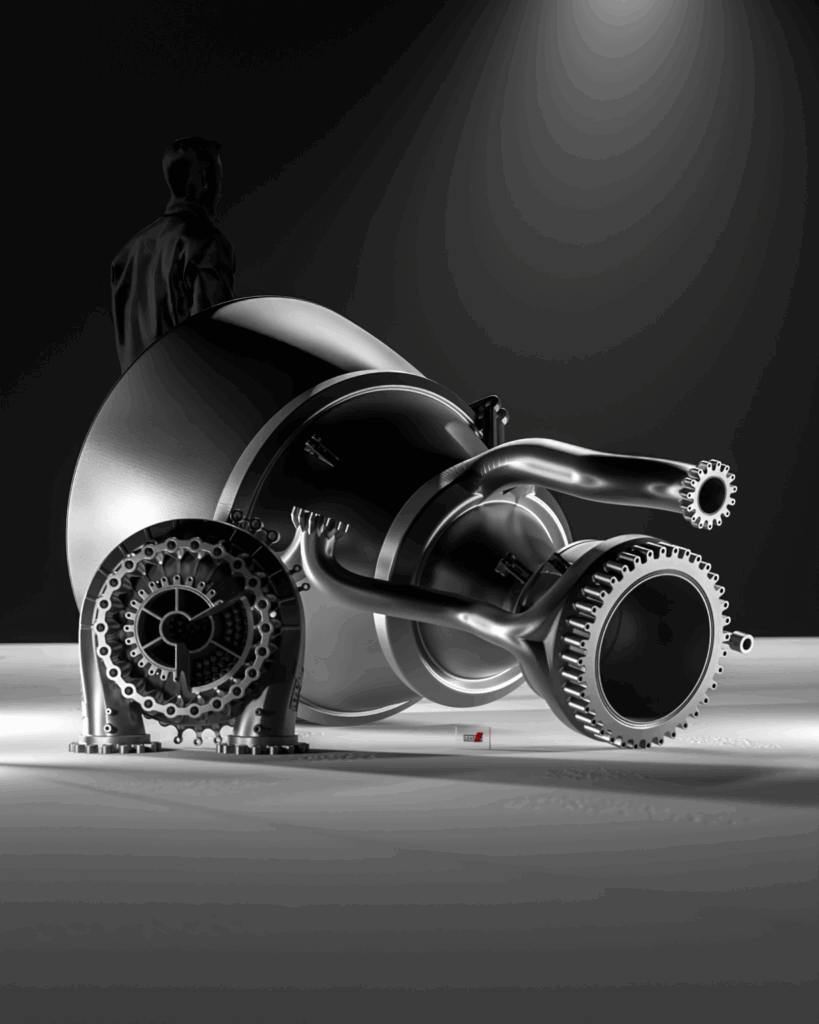
Could you walk us through the design philosophy of your R1 reusable launch vehicle and how it differentiates from other rockets on the market?
Rocket fundamentals have been the same since the 60-s and yet all the launchers are different. From the start we designed a space transportation system capable of delivering payloads to space stations and back, not just the isolated launcher. So our designs aim to execute those missions as efficiently as possible. For example we use a composite second stage to lower the full mass and fully automated launch operations, inherited from work on Zenit.
The partnership with LEAP 71 and their Noyron computational engineering model is unique. How exactly does this approach accelerate propulsion development compared to traditional methods?
Rocket engines design has been such an art all this time. Our colleagues from LEAP 71 make it way more predictable. The model knows physics and best practices, provides optimal designs and corrects them on the go, right after the tests. We believe it’s a cutting-edge approach to hardware engineering, pretty similar to software.
Your propulsion stack is based on MethaLOX. Why methane-oxygen instead of kerosene or hydrogen?

Methane is obviously better for reusability than kerosene, it burns clean. For the same reason it’s better for the environment. Hydrogen is great in terms of specific impulse, but very complicated to work with. Methane looks like a middle way. It’s not a coincidence that most of the new reusable launchers use it.
The S1 spacecraft concept is intriguing—a reusable orbital vehicle. What role do you see it playing in the emerging space economy?
We believe that the New Space Age will be no more about launch, it will be about space transportation. We will have many space stations and even more different orbital assets, so spaceships will be in high demand. Plus crew launches of course – by now there were less than 1000 humans in space, way more are going there very soon.
The global launch market is becoming crowded. Where do you see Aspire Space’s competitive edge, both technologically and commercially?
Let me express a contrarian opinion. Despite the common misconception, the launch market is not crowded. There are very few new launchers in operation. And a single one of them has over 90% market share. What we really see in the market is a substantial deficit of launch capacity. The demand for launches grows by the day.
Our advantage is the ability to provide a pretty diverse set of end-to-end space transportation services. We will be able to supply stations and return instruments back to Earth. We will offer exquisite missions for orbital research and in-space manufacturing: they will be launched on our rocker, performed on our spaceship and returned back to Earth by us.

How do you envision collaboration with the UAE government, space agencies, and local universities/industries in developing this ecosystem?
The UAE government invests substantial resources in the space industry and we all see very impressive results in new exciting missions and technologies. The national space ecosystem is getting mature. We have announced our partnership with LEAP 71 and we are working on collaboration with major local players. We plan certain steps to develop the ecosystem including building new infrastructure to be shared by different entities. Space is a joint effort of course. The same goes to the universities: we plan that our rocket scientists will be giving lectures and share their experiences; at the same time we hope to be able to tap into local talent graduating from those universities.
Are you planning to open your launch services to international commercial clients, or will early missions focus on UAE/governmental projects first?
From day one we plan our system as a global provider of space transportation services, giving access to space to the whole world. At the same time we will definitely prioritize Emirati missions and we hope to enable more of them.
Beyond rockets and spacecraft, what’s Aspire Space’s ultimate ambition? Do you see yourselves moving into lunar access, deep space, or building infrastructure in orbit?
Ten years from now the space economy will be very different. Multiple LEO space stations, orbital data centers, space-based solar power, in-space manufacturing and hopefully first Lunar bases. We are definitely willing to take part in some of those. Launchers and spaceships are not the endgame, they are means to create a space economy and explore the Universe. Humans are going to expand beyond Earth and we are willing to take part in this journey.
You can find more interviews and articles on the UAE space ecosystem in our latest magazine.