

The Middle East is experiencing a surge in research around Earth Observation (EO) and artificial intelligence (AI). This momentum is encouraging for the region, with Abu Dhabi in particular emerging as a hub of advanced EO and AI research.
Building on this strong foundation, the next step is to make sure innovation reaches the field, where it can deliver real impact.
With a focused push to commercialize EO systems, the region can turn advanced technology research from the region into practical solutions for food security, climate resilience, disaster response, and other pressing needs.
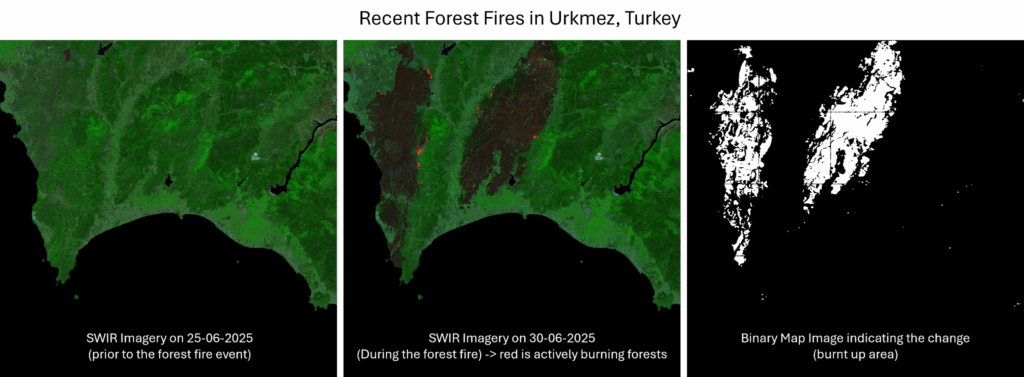
SWIR imagery highlights active fires (red) and a binary map quantifies the burnt area, demonstrating rapid satellite-based monitoring.
For example, agentic AI systems that fuse satellite imagery, rainfall data, and ground-based sensors are already capable of identifying flood risks in real time and guiding civil defense teams to respond.
Work on agentic AI at the Technology Innovation Institute (TII) in Abu Dhabi illustrates this potential. Decentralized digital agents can independently analyze satellite images and sensor data, launch tasks such as anomaly detection, and provide real-time support for use cases ranging from flood management to port logistics.
Unlike opaque black-box AI systems, these modular agents are adaptable and transparent, qualities that are essential for public-sector trust and adoption.
The opportunity now lies in accelerating the adoption of these systems and ensuring they reach those who need them most. To fully realize this promise, partnerships that align product development with operational requirements will be critical.
The challenge is what the technology community calls the “valley of death,” which is the difficult gap between lab-based innovation and real-world deployment. EO technologies are particularly exposed to this phase.
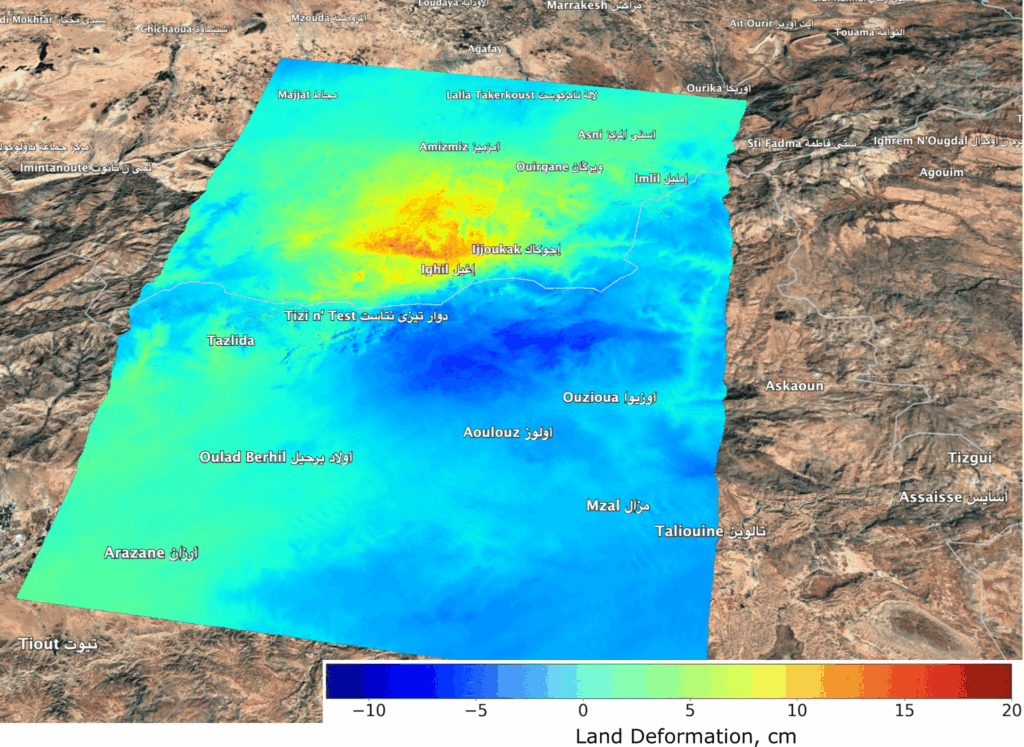
Deformation map reveals uplift (red–yellow) near Ighil and subsidence (blue) nearby, showing InSAR’s value for rapid post-quake assessment.
Many EO projects demonstrate technical feasibility but face hurdles when it comes to funding models, regulatory alignment, as well as integration into governments and industry workflows. These are common barriers in technology transfer worldwide, and overcoming them requires deliberates strategies.
Funding by itself won’t close this gap. What is needed is early-stage collaboration between researchers, policy makers, and end users. When these stakeholders engage from the outset, EO systems can be designed around practical needs and scaled with confidence. This type of collaboration transforms research from proof-of-concept exercises into operational tools.
Abu Dhabi has already defined six strategic sectors where EO and AI can deliver high-impact results: aerospace, agriculture, civil defense, healthcare, sustainability and energy, and logistics. These national priorities provide a clear roadmap for where EO innovation can make the greatest difference.
In agriculture, EO can track soil moisture and optimize irrigation for water-scarce farms. In healthcare, geospatial intelligence supports urban heat mapping and environmental health monitoring. For civil defense, EO agents can detect wildfires, while in logistics, satellite-linked agents can monitor shipping lanes in real time to support trade resilience.
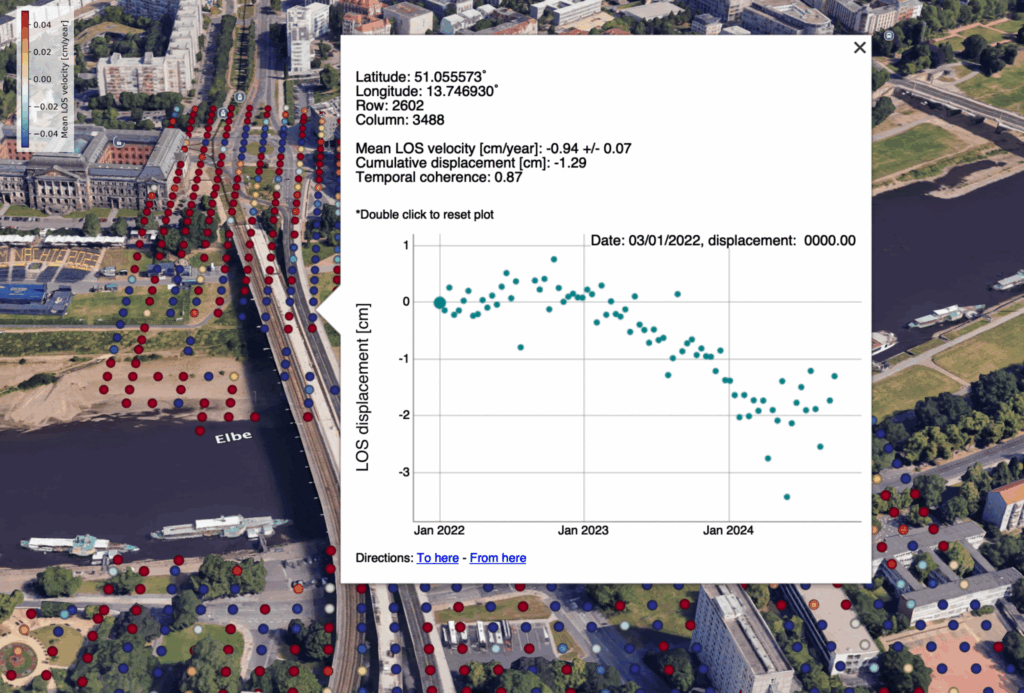
InSAR detected progressive ground subsidence from 2022–2024, signaling deformation.
These are immediate applications ready to deliver tangible impact as commercialization gathers steam.
EO research that aligns with these priorities and develops systems and partnerships that directly address them will be best positioned for commercialization. Equally important, regulators and end-users can already engage in the process, ensuring solutions are trusted, relevant, and designed for adoption. This dual alignment creates the conditions for successful deployment at scale.
The Middle East has an opportunity to set a global standard for how EO research transitions from theory into practice. Seizing this opportunity will have impact far beyond the region itself.
Ultimately, EO systems will make a difference where it counts, which is in the decisions of city planners, emergency responders, farmers, and infrastructure operators.
The data is already available. The technology is ready. What is needed now is the will to implement, the partnerships to scale, and the systems to sustain.
With these steps, the Middle East is well positioned to lead in this domain, setting global benchmarks in how EO is applied to climate resilience, food security, disaster response, and sustainable urban development.

Abdelkarim Watmani is Acting Director and Senior Project Manager at TII in Abu Dhabi, where he leads the Photonics Department and the Earth Observation & Situation Awareness Program. He is also a Doctorate candidate at École des Ponts Business School, specializing in Innovation Management and Technology Transfer & Commercialization.
You can find more interviews and articles on the UAE space ecosystem in our latest magazine.