




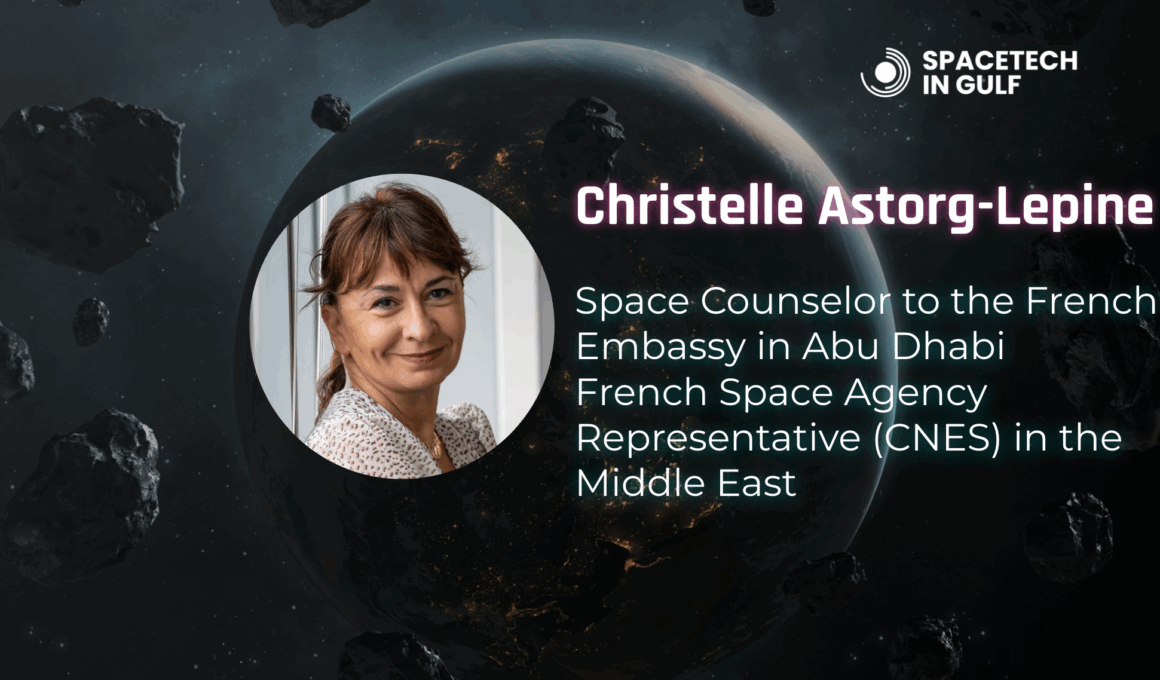

Space Counselor to the French Embassy in Abu Dhabi
French Space Agency Representative (CNES) in the Middle East
Christelle Astorg-Lepine graduated from an Aerospace Engineering High School and held a Master’s degree in Energy Conversion from the University of Paris VI. She joined CNES (French Space Agency) in 1995 and began her career in the Propulsion Department of the Launchers Directorate. Between 1997 and 2005, she managed large projects such as the Ariane 5 Cryogenic Main Stage and the Vinci engine. She then led the Future Launcher Projects Department, initiating innovative projects including Student and mini-launchers projects.
In 2008, she became part of the French delegation to the European Space Agency as a Future Launchers and Orbital Infrastructures Specialist. From 2010 onwards, she shifted towards digital transformation and internal communications at CNES, leading major projects including the redesign of the CNES intranet and managing internal communications across the agency’s centers.
In 2019, Christelle took charge of the Connect by CNES program to foster innovation by linking CNES expertise with startups and industrial groups in France and abroad.
Between 2021 and 2024, she joined a new company, Starburst Accelerator, directing the BLAST program and later becoming General Manager of Starburst France.
Since 2024, she has been back at CNES founding the Space Foundation to encourage public engagement and youth interest in space through educational programs and initiatives. Since January 2025, Christelle holds the strategic role of Space Advisor at the French Embassy in the UAE, representing CNES also in Saudi Arabia, Oman, Qatar, Jordan, and Egypt. Her mission is to promote civil, commercial space cooperation between France and these countries.
How would you describe the current state of space cooperation between France and the UAE?
The space cooperation between France and the United Arab Emirates can be described as long-standing, built on trust, and directed toward strengthening a strategic partnership.
This collaboration began in 2007 in the industrial field with a contract awarded by the Emirati company Yahsat to a consortium composed of Thales Alenia Space and Astrium for the development of a dual-use satellite communications system.
In 2013, the UAE launched the Falcon Eye project, aimed at developing advanced Earth observation satellites with both civilian and military applications. The program was carried out by Airbus D&S and Thales Alenia Space. Although the first satellite, Falcon Eye 1, was lost during its 2019 Vega launch, the second mission, Falcon Eye 2, was successfully completed in December 2020. More recently, Thales Alenia Space signed a contract with the Mohammed Bin Rashid Space Centre (MBRSC) for the development of the Emirati Airlock module within the Lunar Gateway program.
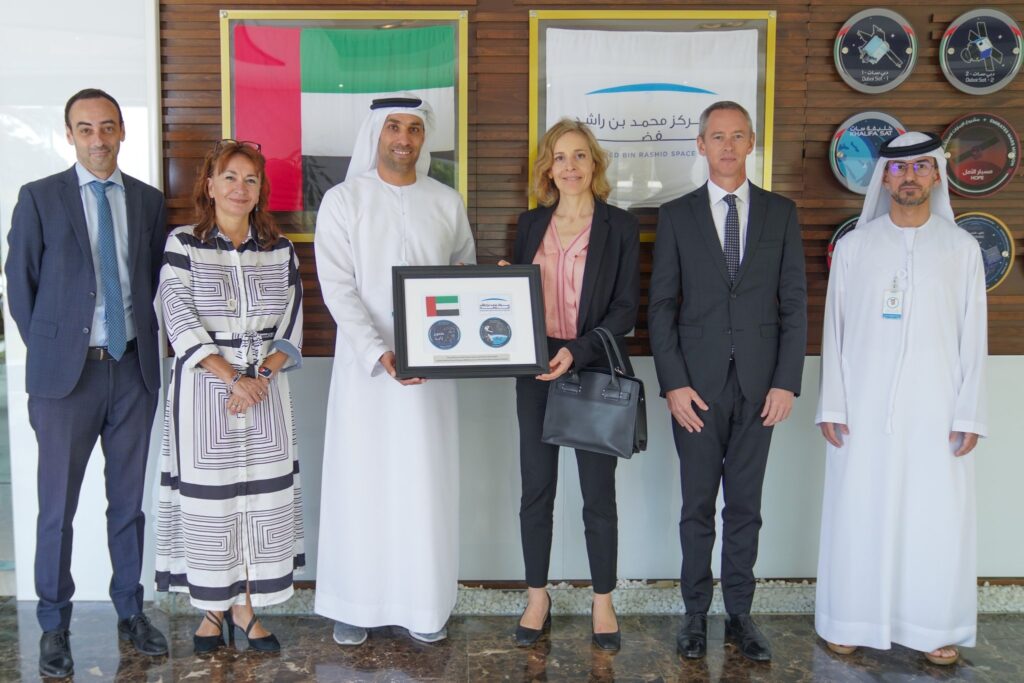
Since 2020, CNES and MBRSC have been cooperating on the Emirati lunar rover Rashid, with CNES providing the cameras. French experiments were also included in the mission of astronaut Sultan Al Neyadi. In parallel, CNES has maintained close ties with the UAE Space Agency (UAESA) since 2015 through a dedicated sub-group under the France–UAE strategic dialogue and through its permanent office in Abu Dhabi, opened in 2018.
Cooperation has also extended to the GNSS project launched in 2021, with exchanges between CNES and the National Space Science and Technology Center (NSSTC). This initiative supported innovative solutions from French industry, notably the start-up U-Space and major groups such as Thales and SAFRAN.
United by a shared vision of sovereignty and technological progress, the UAE and France are committed to further strengthening their strategic partnership, with space increasingly becoming a central pillar of their cooperation. At the most recent strategic dialogue in May 2025, both countries decided to elevate cooperation to a new strategic level by considering new ideas like consolidating joint infrastructure, establishing a common investment fund, and thinking about a Franco-Emirati Space Hub dedicated to fostering start-ups, research, and cultural exchange.
What are France’s strategic interests in the UAE’s growing space sector?
Space is an issue of shared strategic interests, forging trusted partnerships is more essential than ever. The United Arab Emirates, close allies of France, are a key player. Their pursuit of critical space capabilities resonates with French know-how, especially within a new generation of promising start-ups. Drawing on its broad expertise, France can naturally support this momentum, reinforcing the spirit of partnership and shared ambition.
How does the French Embassy support bilateral space collaboration – scientifically, commercially, and institutionally?
The role of the French Embassy is particularly important during the annual France–UAE Strategic Dialogue, held between the two governments. Within this framework, the space component of the dialogue is co-chaired by CNES and the UAE Space Agency (UAESA), underlining the importance both countries attach to this domain.
Thanks to this partnership, the UAE and France have expanded their collaboration in lunar exploration, most notably through the Rashid Rover 2 and Rashid Rover 3 missions. These projects exemplify the deepening ties between the two nations in advancing space science and exploration. At the most recent Strategic Dialogue, both parties reaffirmed their shared ambition to strengthen cooperation in space exploration and human spaceflight. More broadly, they underscored their commitment to elevating their cooperation toward a true strategic partnership — uniting established space industry leaders with New Space actors. This includes reinforcing a joint ecosystem between French and Emirati stakeholders while exploring future-oriented initiatives such as shared infrastructure, collaborative projects, and the creation of a Franco-Emirati Space Hub dedicated to innovation and cultural exchange.
What role do space counselors like yourself play in fostering cross-border partnerships between agencies and companies?
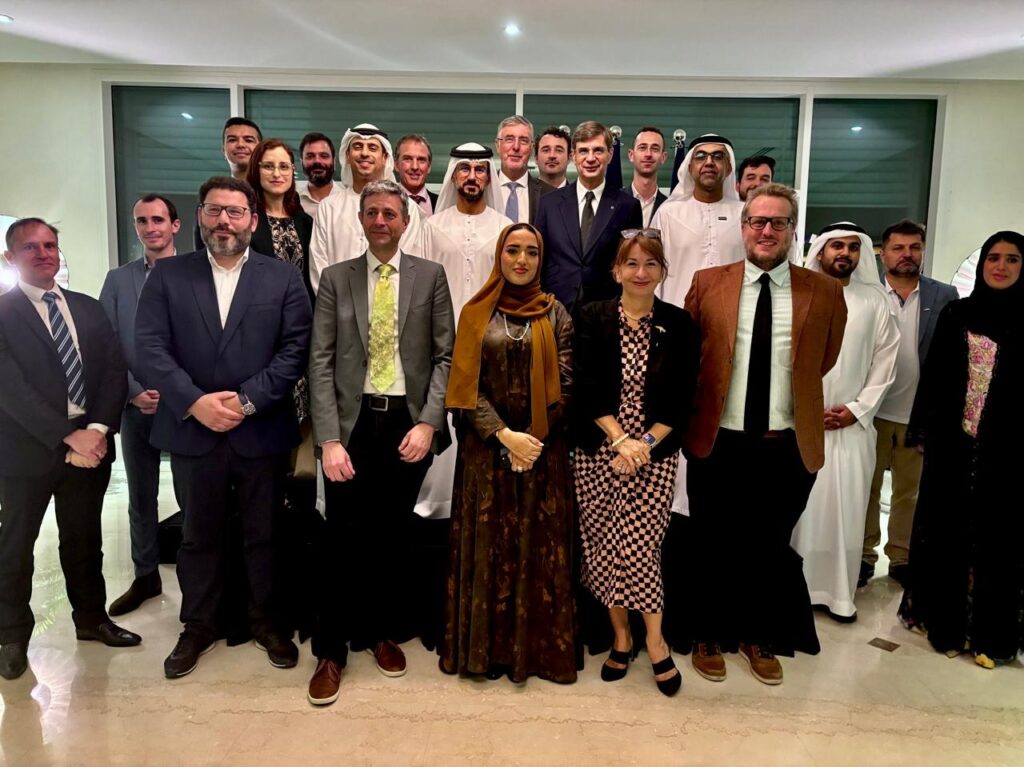
France is one of the very few countries to benefit from dedicated space counselor within its embassies. Today, only seven countries host such advisers, making this presence a real asset for French companies seeking to expand internationally. With a local presence since 2018, bilateral relations are strengthened, and opportunities for cooperation become far more substantial. In addition to more traditional collaborations with our historical space companies, France offers a unique ecosystem of space start-ups. This landscape has already led to concrete initiatives. Last May, for example, Abu Dhabi hosted the first-ever Franco–Emirati New Space Week, which brought together more than 50 representatives from both nations’ space sectors. This event helped to spark fresh collaborations and launch tangible projects between French start-ups and Emirati institutions.
Similarly, during the Dubai Air Show, a French New Space pavilion will be organized for the first time within the Space Pavillion, gathering over ten new French companies — including CAILABS, CYSEC, SKYNOPY, UNSEENLAB, EXOTRAIL, U-SPACE, GROUNDSPACE, OLED Communication, The Exploration Company, and ALATYR. These showcases highlighted the talent, technologies, and unique expertise of French space actors eager to establish a foothold in the Emirates and further develop capabilities locally.
How do CNES and the UAE Space Agency or MBRSC collaborate on missions or R&D?
As highlighted in the France–UAE Strategic Dialogue, CNES and the UAE Space Agency (UAESA) are working closely to advance forward-looking initiatives, including shared infrastructure, joint projects, and the establishment of a Franco–Emirati Space Hub dedicated to innovation and cultural exchange. An historic part of this collaboration lies in lunar exploration, through joint efforts between MBRSC and CNES on the Rashid Rover missions. These projects stand as strong symbols of the deepening ties between the two nations in advancing space science and exploration. A concrete example of this partnership was the comprehensive environmental test campaign successfully carried out by the Mohammed Bin Rashid Space Centre (MBRSC) at CNES facilities in Toulouse. Building on this momentum, a new agreement was also signed with Novespace, a CNES subsidiary, to enable an Emirati experiment during the 2025 zero-gravity scientific flight campaigns.
Parallel to these efforts, since 2021, CNES has been working with the National Space Science and Technology Center (NSSTC) on a project formerly known as GNSSaS and now renamed LEONAV, a nanosatellite demonstrator for geolocation in low Earth orbit (LEO PNT). CNES deployed one of its experts to support the project in 2021 and continues to provide technical assistance, leading up to its planned launch in 2026. More recently, CNES has also begun discussions with the Technology Innovation Institute (TII) on a potential agreement in the field of optical communications, which includes the use of an advanced optical and quantum observatory based in Abu Dhabi.
Are there ongoing or planned joint Earth Observation, climate monitoring, or deep space missions involving French and Emirati institutions?
Yes, there are ongoing collaborations in these areas. The UAE Space Agency (UAESA) joined the Space Climate Observatory at its creation by CNES in 2019 and officially signed the Charter in December 2023, followed by the Mohammed Bin Rashid Space Centre (MBRSC) in June 2023. These commitments highlight the growing Franco–Emirati cooperation on Earth observation and climate monitoring. In parallel, we also support UAESA’s initiative to establish an expert group on Space Situational Awareness (SSA) — a priority shared by France within COPUOS which further strengthens joint efforts to address global space challenges.
Are there any notable success stories or flagship projects between French and Emirati companies?
Beyond the long-standing industrial cooperation between France and the UAE through Yahsat and the Falcon Eye satellite developed by Thales and Airbus, many other projects are currently underway. We can mention the recent contract for the design and manufacture of a turnkey 12U satellite between the Emirati National Space Science and Technology Center (NSSTC) and U-Space, a French smallsat constellation manufacturer. It will be the precursor of a future constellation dedicated to the Emirati LEONAV programme, which aims at deploying a Low Earth Orbit, Positioning, Navigation and Timing (LEO PNT) service.This project embodies the long-term cooperation between France and the United Arab Emirates in Aerospace and Defense, with a sustained collaboration between the UAE Space Agency and the CNES (Centre National d’Études Spatiales), illustrating a shared desire to share skills and technologies, and to support innovative companies within the two countries capable of meeting the technological and industrial challenges of the future.
In addition, we can also mention that Loft Orbital, a fast-growing French space infrastructure company founded in 2017 with headquarters in Toulouse and San Francisco, has partnered with Abu Dhabi’s Marlan Space to launch Orbitworks — the Middle East’s first commercial satellite manufacturing company. With an initial investment exceeding $100 million, Orbitworks will produce up to 50 satellites per year from a cutting-edge facility in Abu Dhabi. This joint venture leverages Loft Orbital’s innovative satellite platform technology, which supports diverse missions such as Earth observation, telecommunications, and scientific research. The partnership illustrates a flagship success story between French and Emirati space industries, helping position the UAE as a regional leader in satellite manufacturing and space innovation. In conclusion, this partnership stands on a solid and confident foundation for the future.
How can French SMEs and startups participate in the UAE’s space programs and infrastructure development?
The United Arab Emirates has clearly identified the key technologies needed to develop innovative space solutions for both military and civilian sectors. These include global satellite constellations to ensure worldwide coverage and resilient connectivity for Earth observation, navigation or positioning. France has a particularly vibrant and creative New Space start-up ecosystem, strongly oriented toward the future. Many show strong interest in the UAE market and they can offer significant added value in terms of quality and innovation, especially in leveraging space data applications across sectors like insurance, finance, agriculture, maritime, health, mobility, and security.
Programs such as the Orbitworks joint venture between French-founded Loft Orbital and Abu Dhabi’s Marlan Space exemplify how international collaboration is shaping the region’s space ambitions and opening doors for innovative players.
Do you see opportunities for UAE-based space companies to expand into the French or broader European markets?
Yes, there are significant opportunities for UAE-based space companies to expand into the French and broader European markets, as illustrated by the example of Madari. Founded in Abu Dhabi, Madari Space has established a base in Toulouse, France — the leading European space hub. Madari is preparing to launch the world’s first orbital data center in low Earth orbit by late 2026, aiming to revolutionize data storage and processing by moving it off the planet to reduce environmental impact and enhance real-time analytics.
This presence in Toulouse allows Madari to tap into France’s rich aerospace ecosystem, benefiting from local expertise, technology partnerships, and access to European markets. The collaboration between Emirati innovative companies like Madari and the French space sector exemplifies how UAE firms can integrate into Europe’s advanced space infrastructure network, accelerating their technological development and commercial reach.
What programs exist to promote academic and student exchange between France and the UAE in the field of space sciences?
Both countries are actively considering establishing cooperation through ongoing discussions between CNES and UAESA. The concept under reflection involves creating a Franco-Emirati Space Hub designed to rapidly develop emerging players from both countries along the entire space value chain. This Space Hub aims at promoting the Franco-Emirati ecosystem, linked to a joint research program. This hub would be designed to support the rapid development of new entrants in the Emirates to accelerate their growth and potentially facilitate their future establishment in France.
How does France view the UAE’s long-term space vision, such as the Mars 2117 program or lunar exploration goals?
France views the UAE’s long-term space vision as both impressive and inspiring. France would be delighted to collaborate closely with the UAE on these exciting endeavors, combining the strengths and expertise of both nations to contribute meaningfully to humanity’s next great frontier in space.
You can find more interviews and articles on the UAE space ecosystem in our latest magazine.