



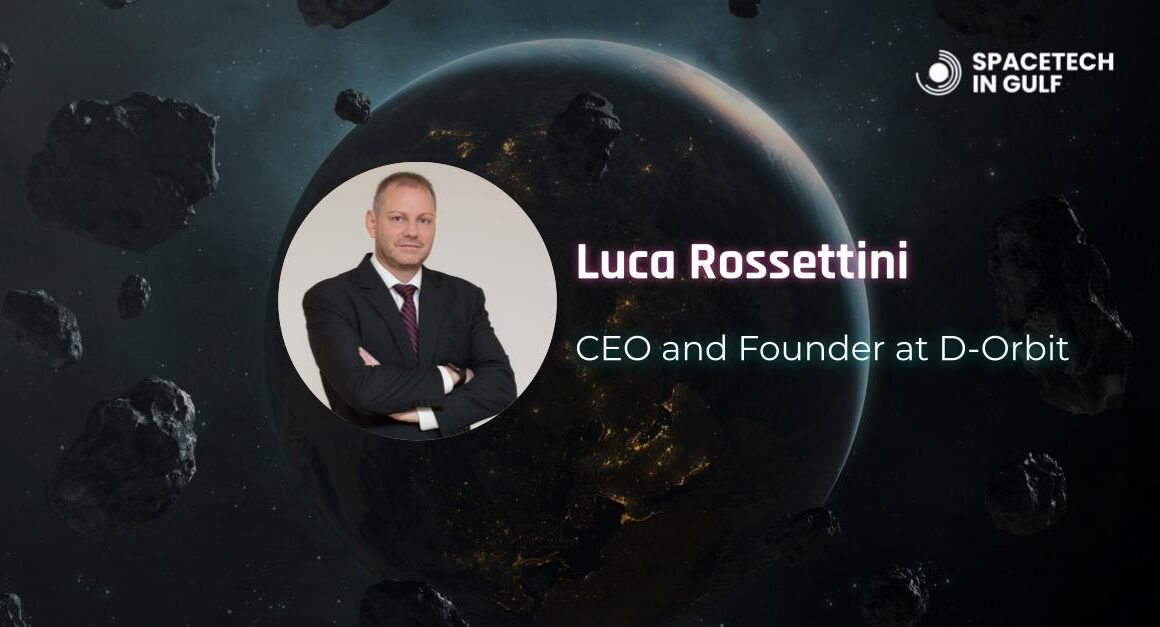

CEO and Founder at D-Orbit
Luca is a visionary entrepreneur, seeking a profitable and sustainable expansion of humankind in space. In 2009 Luca won a Fulbright scholarship and in 2010 obtained a Certificate in Technology Entrepreneurship in Silicon Valley, California. After an internship position at NASA Ames Research Center, Luca Rossettini went back to Italy and founded D-Orbit, developing a solution for Space Logistics & Transportation.
Luca is an entrepreneur, seeking a profitable and sustainable expansion of the humankind in space. In 1998 Luca quit his Airborne Officer career and got a Master’s in Aerospace Engineering in Italy (2003). After a year working in a US research lab on nanotechnologies applied to space propellant, he came back to Europe, where, in 2005, he successfully concluded a Master’s in Strategic Leadership Towards Sustainability.
During his Ph.D. studies in Advanced Space Propulsion Luca founded IRTA (startup providing advanced vision and slow-motion tracking techniques) and co-founded The Natural Step Italia (The Natural Step is an international NGO that helps corporations and communities to pursue their objectives within a strategic sustainability framework), where the idea of applying strategic sustainability concepts to the space sector originated. In 2008 he applied for the European Astronauts Corp among 10,000 candidates. He went through the whole selection and positioned among the first two hundred.
In 2009 Luca won a Fulbright scholarship and in 2010 obtained a Certificate in Technology Entrepreneurship in Silicon Valley, California. After an internship position at NASA Ames Research Center, Luca went back to Italy and founded D-Orbit, developing a solution for Space Logistics & Transportation.
D-Orbit started with a focus on debris mitigation, how has the company’s vision evolved toward in-orbit logistics and transportation?
When we founded D-Orbit in 2011, orbital debris was already seen as a threat to sustainable space operations. From the start, our roadmap envisioned an interplanetary logistics infrastructure connecting Mars, the Asteroid Belt, the Moon, and Earth, capable of transporting goods, people, information, and energy.
Our initial focus was debris mitigation, since without a safer orbit no progress would be possible. But as we engaged with customers, it became clear that space needed far more: infrastructure, and urgently. Just as roads and ports enable trade on Earth, space requires its own logistics backbone.
This drove us to expand beyond mitigation and in 2020 we launched our first ION Satellite Carrier, a pivotal step in building the in-orbit economy. Since then, with 19 missions and 200+ payloads delivered, we’ve proven how in-orbit logistics reduce mission complexity and accelerate deployment. Today, our work spans transportation, in-orbit servicing, and space cloud services, capabilities designed to make access to space faster, more sustainable, and scalable.

The ION Satellite Carrier has already flown multiple missions; what are the most important lessons learned from these deployments?
Operating the ION family has given us invaluable insights. The first lesson is flexibility: missions are complex, and unexpected challenges, whether changes in customer needs or orbital conditions, demand the ability to adapt in orbit, reprogram missions, and use payloads in new ways.
The second is that operational excellence matters as much as technical innovation. Building spacecraft is only half the challenge; operating them reliably across missions builds lasting trust. Through our heritage, we have refined our processes for consistency and performance.
Finally, each flight acts as a laboratory, with lessons feeding directly into the next generation of ION vehicles and services. This iterative approach ensures our customers benefit not only from proven technology, but from the cumulative knowledge gained mission after mission.
Beyond rideshare deployments, how is D-Orbit expanding the capabilities of ION (e.g., hosted payloads, space cloud services, satellite as a service)?
Beyond rideshare, ION has become a versatile modular platform enabling advanced services. Customers now “rent” shared ION vehicles or ask us to operate dedicated ones, transforming the traditional CAPEX of missions into OPEX with predictable costs. Many use ION as an orbital lab to test technologies, validate concepts, or deliver services without building their own satellites, lowering barriers to entry and accelerating time-to-market.
We are also pioneering space cloud services by embedding computing infrastructure directly onboard. Data can be processed in orbit rather than sent back to Earth, enabling real-time insights. A key example is the Worldfloods experiment with Trillium Technologies and the University of Oxford, where AI running on ION generated actionable flood maps for responders within seconds.
Finally, with our satellite-as-a-service model, companies can focus on their applications while we handle all spacecraft operations. Together, these capabilities position ION as both an innovation hub and a building block of future distributed space infrastructures.
What are D-Orbit’s next steps in in-orbit servicing, and could you share more about the RISE mission and its significance for the space industry?
In-orbit servicing is the next step toward a sustainable space economy. Extending satellite life through repair, repositioning, refueling, or responsible deorbiting reduces debris and enables new business models.
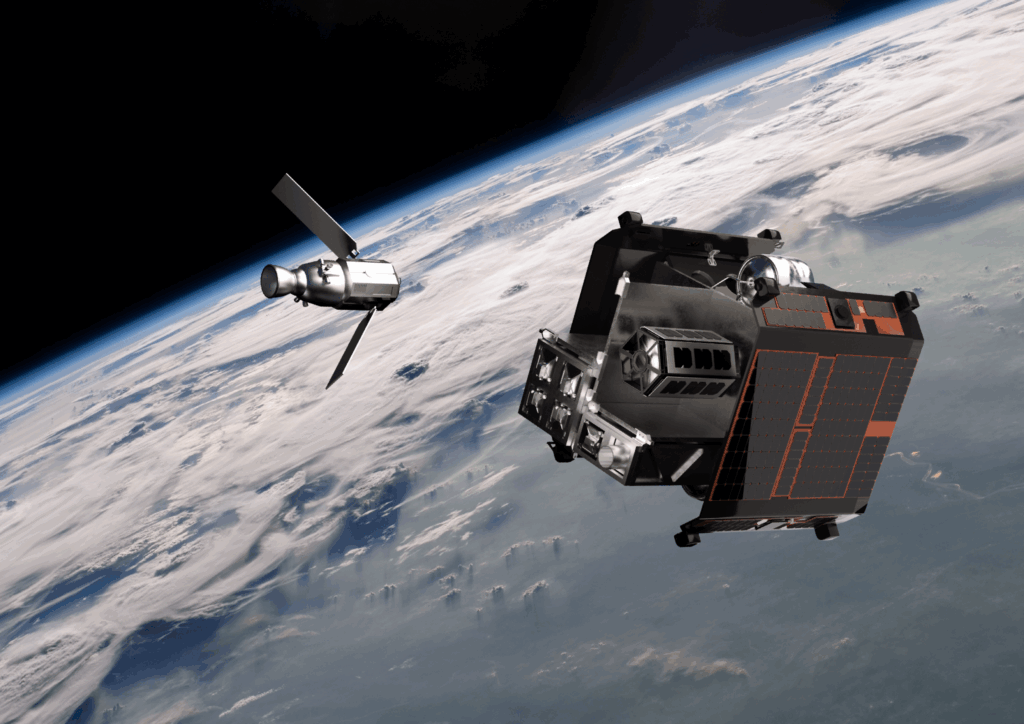
Our upcoming RISE mission, using the new GEA servicing spacecraft, will mark Europe’s first demonstration of comprehensive servicing in geostationary orbit, including autonomous docking, maintenance, and end-of-life disposal. GEO is where many of the world’s most valuable satellites operate, making this a milestone not only for D-Orbit but for Europe as a whole. It ensures independent access to capabilities previously dominated by the US, strengthening both governments and commercial operators.
RISE also showcases the power of public–private collaboration, uniting ESA, national agencies, and industry. For us, it is more than a technical achievement, it is proof that in-orbit servicing is ready to move from concept to commercial reality, laying the groundwork for a truly regenerative space economy.
What potential do you see in space cloud services, and can you share some relevant examples of AI/ML tests in orbit?
Space cloud services can transform the industry by solving one of its main bottlenecks: data transfer. Instead of downlinking vast amounts of raw data, satellites can process it in orbit and send only actionable insights. This reduces latency, lowers costs, and enables near real-time decision-making, including autonomous machine-to-machine communication between satellites and ground systems.
A strong example is the Worldfloods experiment on ION with Trillium Technologies and the University of Oxford. AI algorithms onboard detected floods in imagery and delivered ready-to-use maps to responders within seconds, a breakthrough for disaster management where time is critical. The potential extends from agriculture and environmental monitoring to defense and autonomous servicing. Looking ahead, we envision a distributed network of cloud-enabled satellites, with ION at its core, much like AWS or Azure revolutionized IT, making space operations faster, smarter, and more sustainable.
D-Orbit has been expanding its global footprint with new offices and operations in key markets. How does this international growth support your long-term strategy?
Space is a global business, and proximity to customers is vital for speed, agility, and collaboration. Expanding our footprint positions us closer to key markets, helping us understand local needs, deliver faster support, and integrate into regional ecosystems. Our presence across Europe, North America, and Asia provides access to talent, supply chains, and partnerships with commercial players, governments, and agencies. It also enables us to co-develop technologies and align with regional regulations.
The Middle East, especially the UAE and Saudi Arabia, is a particularly dynamic hub, with ambitious investments and progressive policies. By establishing a presence there, we can support local initiatives while connecting them to the broader global space network.
How important are collaborations with institutional players such as ESA, the European Commission, or national space agencies to your growth strategy?
Institutional partnerships are vital because they align long-term policy goals with commercial innovation. Agencies like ESA, the European Commission, and national space agencies provide vision, stability, and regulatory frameworks in an industry defined by high risk and rapid change. They also enable projects no single company could achieve alone. A prime example is the RISE mission, Europe’s flagship in-orbit servicing initiative, while programs like IRIDE and PNRR strengthen Europe’s technological base and expand access to space services.
For us, these partnerships go beyond funding, they accelerate innovation, lower barriers for new players, and safeguard Europe’s strategic autonomy. By combining institutional reach with private agility, we can scale faster and build a resilient ecosystem that benefits both Europe and the global space economy.
Which industries beyond traditional satellite operators (e.g., telecom, Earth observation, defense) are you seeing the most demand from for in-orbit logistics?
The space sector is expanding beyond its traditional players as non-space industries recognize the value of in-orbit services. We see growing demand from insurance, energy, environmental monitoring, finance, and smart cities. Insurers use real-time data for risk assessment, while energy companies monitor assets and resources. Tech firms are also extending cloud and AI into orbit, creating new service categories that merge terrestrial and space networks. This trend is especially strong in the Middle East, where the UAE and Saudi Arabia are investing heavily to diversify their economies and integrate sectors like energy, finance, and environmental management with space-based solutions. D-Orbit’s infrastructure enables these organizations to reduce complexity, cut costs, and scale faster, turning ambitious visions into operational services.
Ultimately, this convergence shows space is becoming an integral part of the global economy, much like aviation or the internet, with the Middle East emerging as one of its most dynamic hubs.
The GCC, and the UAE in particular, are investing heavily in space. How does D-Orbit view the Gulf region as a potential market for space logistics?
We see the Gulf, especially the UAE and Saudi Arabia, as one of the most dynamic and strategic markets in today’s space economy. Both are investing boldly through their national agencies, positioning themselves as regional leaders driving innovation and diversification across industries. For D-Orbit, this is more than a market opportunity, it’s a chance to co-create a new ecosystem. Our flexible satellite platforms and evolving logistics, servicing, and space cloud capabilities directly support their goals, from Earth observation and connectivity to sovereign space assets. Through our Distributed Space Program, we also share heritage and designs to help the region achieve independent access to space quickly, accelerating local industries while connecting them to the global network.
The scale and vision of these investments create ideal conditions for collaboration, with the Gulf poised to become a key node of the in-orbit economy and a driver of sustainable growth for decades to come.
What opportunities do you see for collaboration with UAE entities like the Mohammed Bin Rashid Space Centre (MBRSC) or the UAE Space Agency?
Entities such as MBRSC, the UAE Space Agency, the Saudi Space Agency, and CST are driving the Gulf’s ambitious space strategy. We see opportunities to collaborate across satellite deployment, constellation management, in-orbit servicing, logistics, and space cloud services. Our modular satellite platforms reduce timelines and costs while enabling advanced experiments in orbit. Through our Distributed Space Program, we share designs, production capabilities, and operational expertise to help these organizations rapidly develop independent access to space, shortening cycles from years to months and fostering local talent and industry. The visionary leadership and appetite for innovation in the UAE and KSA make them natural partners. Together, we can create joint programs and breakthrough technologies that advance national goals and position the Gulf as a global hub for space logistics and next-generation services.
Could D-Orbit’s flexible and modular satellite platforms help accelerate the GCC’s ambitions to rapidly develop sovereign capabilities in areas such as Earth observation and connectivity?
Absolutely. Our flexible, modular platforms are built to accelerate sovereign capabilities, making them well suited for the GCC’s ambitious programs, especially in the UAE and Saudi Arabia. For Earth observation, they enable rapid constellation deployment and hosted payload missions, reducing time-to-market and program risk. In connectivity, the same architecture can support telecom payloads and experimental technologies, providing a fast, cost-effective path to next-gen broadband and IoT constellations.
Through our Distributed Space Program, we share designs, production, and operational know-how with regional agencies, cutting development timelines from years to months while building local talent and industry. By integrating these platforms into national strategies, the GCC can move from users of space services to global leaders, positioning the region as a key hub for the in-orbit economy.
You can find more interviews and articles on the UAE space ecosystem in our latest magazine.