




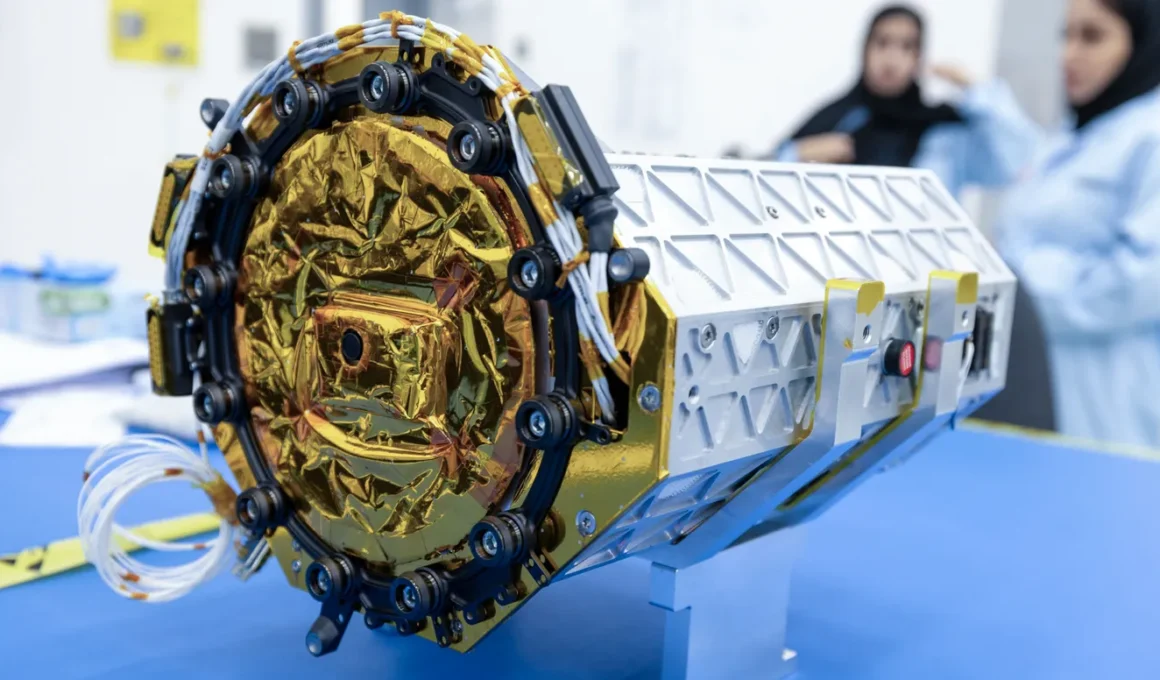
The Technology Innovation Institute (TII) has finished building and testing a landmark asteroid-landing probe in Abu Dhabi. Developed for the Emirates Mission to the Asteroid Belt (EMA), the probe is set for transport to Colorado for final integration aboard the MBR Explorer spacecraft ahead of its planned March 2028 launch.
The mission represents the UAE’s second interplanetary project and marks the first time the primary spacecraft components have been designed, engineered, assembled, and tested within the country.
Key Mission Highlights
- Historic Trajectory: Over an eight-year journey spanning roughly 5 billion kilometers, the MBR Explorer will execute gravity-assist maneuvers around Venus, Earth, and Mars. It will fly past two planets and six main-belt asteroids before reaching its final target, the asteroid 269 Justiti
- Surface Landing Target: The TII probe is the mission’s sole deployable payload. Upon arrival at 269 Justitia in early 2036, it will separate from the main spacecraft to descend and land on the surface. If successful, Justitia will become only the seventh asteroid in history visited on its surface by a space probe.
- Autonomous Operations: Because of the vast distances involved, the probe is engineered to operate with total autonomy. Managed by a custom digital processing unit developed by TII, onboard software handles power management, navigation, image selection, and data processing without receiving real-time commands from Earth or the main spacecraft.
- Multi-Camera Payload: Equipped with wide-field and narrow-field cameras, the probe will take images throughout its cruise phase—transmitting data back at roughly six-month intervals—before conducting high-resolution context and surface imaging during its descent and landing.
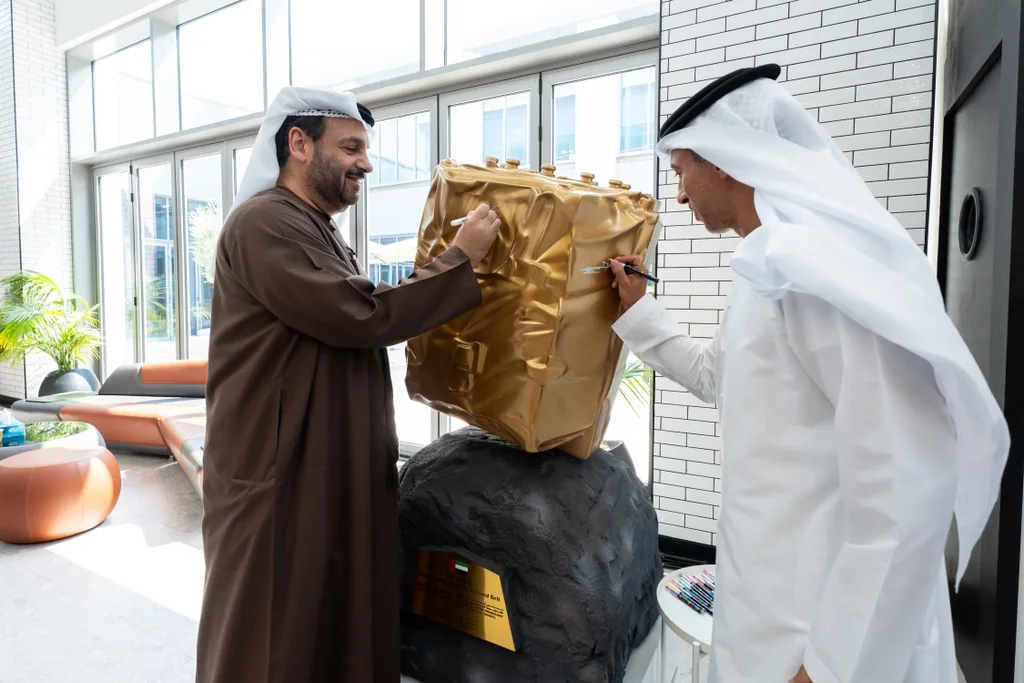
Designed, built and tested in Abu Dhabi, TII’s probe is the mission’s only deployable payload, operating fully autonomously around and on Justitia.
Thought to have formed in the distant Kuiper Belt in the outer Solar System, 269 Justitia may preserve clues to how water and organic material were distributed during the formation of the planets.
Scientific Importance of 269 Justitia
The target asteroid, 269 Justitia, is notable for being among the reddest bodies observed in the main asteroid belt. Its spectral signature resembles objects found in the distant Kuiper Belt beyond Neptune, leading scientists to hypothesize that it originally formed in the extreme cold of the outer Solar System before migrating inward.
By sending a surface probe to Justitia, researchers can examine preserved organic material and volatile compounds from the early Solar System without requiring a multi-decade journey to the Kuiper Belt. Upon landing, the probe will capture close-range imagery and excavate the asteroid’s surface to reveal sub-surface characteristics that cannot be analyzed from orbit.
Collaborative Development & Sovereign Space Goals
The probe was developed by TII’s Propulsion and Space Research Center in partnership with the UAE Space Agency, HEX20, Khalifa University, and UAE University’s National Space Science and Technology Center.
In addition to expanding technical capabilities in deep-space hardware, autonomous software, and thermal engineering, the program has focused on training local engineers. The project aligns with the UAE’s National Space Strategy 2031 and follows the approval of a 1 billion AED International Space Cooperation Program aimed at accelerating domestic technology development and international research partnerships.