


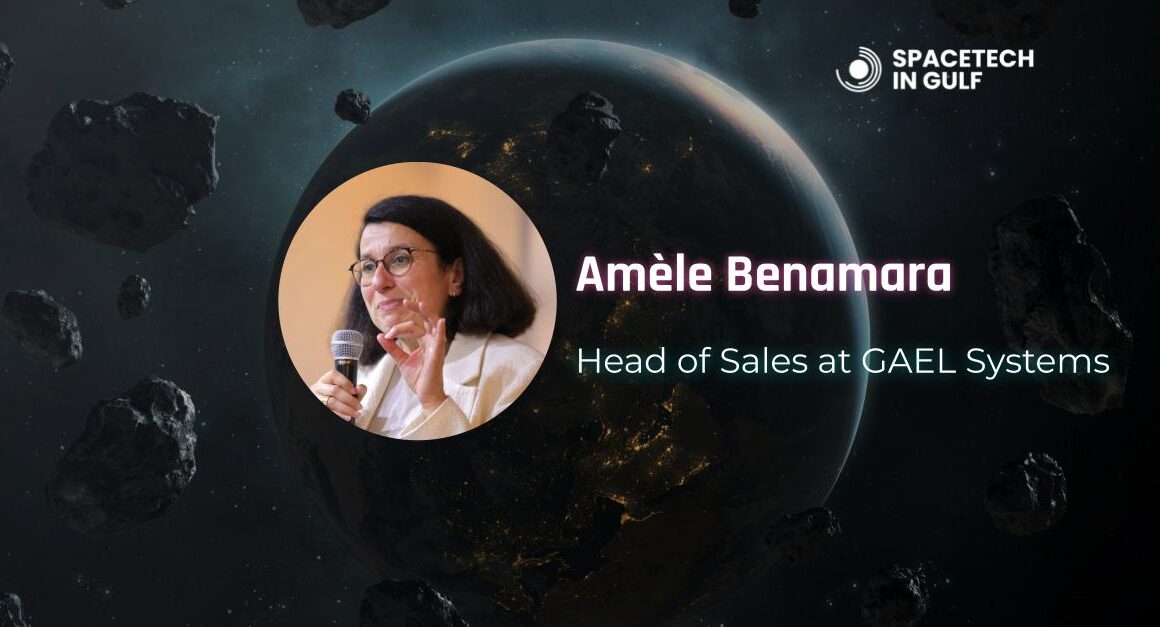

Head of Sales at GAEL Systems
Amèle Benamara has an engineering background and began her career in the automotive industry. Over the years, she held several positions as Project Manager, Cost planner, Bid Manager and Key Account Manager, gaining valuable experience in managing complex projects and fostering long-term client relationships.
Building on this expertise, she joined GAEL Systems as Head of Sales, where she is now focusing on cloud computing and Earth Observation data. In this role, she combines her technical background with her business acumen to support innovation, strengthen partnerships, and contribute to the development of data-driven solutions for the space industry.
Can you tell us how GAEL Systems has evolved since its founding in 1990, and what inspired your mission to specialize in Earth observation data management?
We initially developed a software suite called Telimago for processing optical imagery. Building on this, we created Amalfi, an automated quality control tool designed to execute inspection plans—first applied to Envisat data and later extended to Sentinel-1 and Sentinel-2 datasets.
As the European Space Agency’s Sentinel ground segment evolved—particularly with the rise of cloud computing—we adapted accordingly. We developed key software solutions, DHuS and ENS, which enable ESA to archive and distribute Sentinel data through the Copernicus Access Hub and ONDA-DIAS.
We also implemented a traceability service to monitor and expose the full lifecycle of data products. In parallel, we introduced a new software platform, GSS, designed to ingest, store, and disseminate data efficiently.
Today, we are actively contributing to the Destination Earth (DestinE) programme, a flagship Earth Digital Twin initiative led by the European Commission.

How do you balance the development of open-source solutions like DHuS with commercial services — and why is openness important for the EO community?
The Earth Observation (EO) sector is undergoing a significant paradigm shift. In the past, we focused on developing tailored solutions for specific use cases—DHuS being a prime example. Today, our work increasingly centers around creating space data-driven services that cater not only to space industry stakeholders but also to non-space end users.
This transformation began with the emergence of DIAS cloud-based platforms, which marked a turning point by shifting the model from “bringing data to the user” to “bringing the user to the data.”
In this new landscape, software is no longer a standalone product—it has become a core component of integrated systems. The true value now lies in software architecture design and infrastructure orchestration, where expertise in system integration and scalability is key.
As part of this approach, GAEL Systems also integrates a wide range of open-source software solutions, leveraging community-driven innovation to build robust and flexible services.
You recently migrated 5.7 PB of Sentinel-2 data to the cloud at 20 Gbps. What best practices or innovations helped you achieve this scale and speed?
This is a good example of using open-source software in our solution.
In collaboration with our client, we conducted a benchmark of various solutions, which led to the following architecture: a pool of transfer machines positioned neither at the source nor the destination. Each machine runs a multi-threaded agent (worker), while a central orchestrator manages the list of products to be transferred.
The agents process these jobs in parallel, allowing us to maximize bandwidth by executing independent transfer tasks concurrently. In some cases, products are split into smaller fragments (chunks) to further optimize performance.
This approach takes advantage of the load balancing capabilities of certain storage platforms (e.g. S3) and improves overall I/O throughput.
We also implement transfer monitoring to track daily performance and ensure data completeness, avoiding any gaps in the transferred content.
Traceability is a big focus. How does your system ensure data integrity, and why is that critical for users like climate scientists or government agencies?
Our traceability service enhances data integrity on two key levels:
- Only certified data providers are authorized to sign trace records, ensuring the authenticity of the source.
- The data content is verified using a hash algorithm, embedded within the trace record alongside other relevant metadata.
When combined with our quality control tool, this system provides full assurance of a product’s origin, detects any corruption or tampering, and confirms whether it meets the required specifications.

How are you integrating new AI and machine learning techniques into your platforms for faster or more insightful Earth observation analysis?
We host AI-based models within our collaborative framework DeltaTwin, designed to enable users to build and execute custom workflows that combine Earth Observation (EO) and non-EO data, while also offering integrated storage of results.
For example, we offer an AI model developed by Colab+Atlantic that performs downscaling of hourly air temperature forecasts over the Lisbon Metropolitan Area (AML), improving spatial resolution for urban-scale applications.
Looking ahead, we are also exploring the integration of AI into our quality control tool. One key use case is the ability to dynamically trigger specific checks when anomalies are detected during operations. Furthermore, our image analysis-based inspections could benefit significantly from AI acceleration, enabling faster and more scalable quality assessments.
With the rise of Digital Twins, how do DeltaTwin and SesamEO help organizations move from raw EO data to real-time simulations and insights?
With these services running on the DestinE Core Platform, our goal is to empower end users to select models, processing chains, or tools, and to build tailored workflows within their specific domain of interest.
Users can store their results and share them within their communities, fostering collaboration and knowledge exchange.
Our composable architecture allows for the reuse of simple workflows to construct more complex, scalable systems, supporting innovation through modular design.
We recognize that end users have the deepest understanding of the insights they seek from EO and non-EO data. Our role is to provide a robust, flexible framework that enables them to turn that understanding into actionable services.
You play a big role in the ESA Copernicus Open Access Hub. What lessons have you learned from serving over 700,000 users worldwide?
Serving a user base of over 700,000 is a significant challenge. To meet this demand, we developed the software solution DHuS, which has been deployed across multiple cloud providers. We also operated one of the distribution nodes, directly supporting a portion of the user community.
This large-scale operation provided valuable insights: the underlying infrastructure must be highly scalable—across storage, compute, and network layers—to ensure consistent performance. In parallel, we learned the importance of simplifying the software lifecycle by adopting a microservices architecture, replacing traditional monolithic designs. And naturally, comprehensive monitoring remains a critical component for maintaining reliability, detecting issues early, and optimizing system performance.
Can you share a case study where your solutions made a real impact — for example, enabling rapid disaster response, urban planning, or climate monitoring?
Among the solutions in our portfolio, the GAEL Store Service (GSS) stands out as a cloud-based platform designed to ingest, store, and disseminate Earth Observation (EO) data. It is highly scalable, easily extensible, and agnostic to both cloud environments and data formats, making it adaptable to a wide range of use cases.
We were approached by Geoscience Australia, who had developed a bespoke in-house software solution that had become increasingly difficult to maintain. In less than six months, we successfully customized GSS to align with their existing infrastructure and specific requirements.
Their platform, the Copernicus Australasia Regional Data Hub, is now fully operational, efficiently synchronizing data from Europe to Australia and supporting EO data distribution across the Australasian region.
What unique opportunities do you see for countries like the UAE, which are investing in EO satellites, data centers, and digital twin initiatives?
The UAE could benefit from existing customizable solutions that are already fully operational in Europe. As many of these are open-source, implementation costs would be significantly reduced and time to market accelerated.
How can your mission-agnostic approach and cloud-native tools support the UAE’s goal to become a regional hub for space data and sustainability innovation?
There are several cloud providers available, but regional constraints—particularly those related to data sovereignty—can limit deployment options.
GAEL Systems’ solutions are infrastructure-agnostic and can be deployed on any platform, including on-premises environments. Furthermore, due to the growing number of satellites, it is not feasible to redevelop software for each one individually. To address this, GAEL Systems has developed add-ons to its core solutions that allow for rapid and seamless adaptation to any satellite.
Are there any Gulf-focused partnerships or collaborations you are exploring or would like to see in the near future?
In the near future, we aim to collaborate with local companies that are part of the space ecosystem in the UAE. While we can provide the technological solutions, commercial engagement and project support cannot be managed directly from France. Our goal is to contribute our expertise in Earth Observation (EO) data access and integrity to the UAE. The approaches and tools we have developed—proven effective with Sentinel, Landsat, and ALOS satellites—are adaptable to any satellite platform.
What emerging trends in EO data management or infrastructure excite you the most — and how should smaller or new space nations prepare for them?
We are actively involved in the European Commission’s Destination Earth (DestinE) programme and currently offer two services on ESA’s DestinE Core Platform: DeltaTwin and SesamEO. DeltaTwin provides a scalable processing environment that we are progressively enhancing with AI models. SesamEO serves as a proxy to multiple data sources, offering access to a wide range of data collections. These two services are designed to work in tandem, enabling seamless integration of data access and processing. We are also developing new services that will interoperate with other components of the Core Platform. In the context of urban digital twins, we are focusing on ensuring interoperability through the implementation of Minimal Interoperability Mechanisms (MIMs).
What advice would you give to local EO startups or research teams trying to scale their data workflows and tap into global EO networks?
A wide range of open-source solutions are available and can serve as valuable starting points. Conducting a comprehensive benchmark study is an essential first step in this journey. Equally important is identifying the end-users of the solution, as their needs and expectations will significantly influence its design and implementation.
What’s next for GAEL Systems in 2025 and beyond? Any new projects, features, or milestones our readers should watch for?
The years 2025 and 2026 will be pivotal for our continued participation in the DestinE programme. During this period, our services—DeltaTwin and SesamEO—will be expanded with additional features.